Send
Close Add comments:
(status displays here)
Got it! This site "creationpie.org" uses cookies. You consent to this by clicking on "Got it!" or by continuing to use this website. Note: This appears on each machine/browser from which this site is accessed.
Common translation error witness encounter
1. Common translation error witness encounter
This content is being developed.
2. Dunning-Kruger effect
In general, the
Dunning-Kruger effect is that there a systematic trend where people with lower ability in a specific area tend to overestimate their actual ability. Likewise, someone with a higher ability often tends to underestimate their actual ability. This specific idea is from 1999 by David Dunning and Justin Kruger.
The original study was based on logical reasoning and grammar (and social skills).
One might say that
they do not know what they do not know. [Dilbert cartoon] [Microsoft expert question]
3. Common translation error witness encounter

Here is a very common pattern that A might encounter when witnessing about the Bible "
truth" to B who considers them-self a faithful believer of the Bible.
A to B: There are many translation errors in the Bible.
B: (emphatically with righteous indignation and possibly some anger): Are you saying the Bible is not true? Another reaction is: If I can't trust the Bible, what can I trust?
From this interaction, one can conclude the following about B (who is usually well-meaning).
B does not understand the meaning of "truth" (both secular "truth" and Bible "truth").
B does not have a good understanding of "logic".
B thinks that he/she understands both "truth" and "logic".
One conclusion: B is using their own opinion, in the guise of logical reasoning, to promote their belief to others.
One goal of this content is to go through the logic and reasoning needed to put faithful belief in the Bible on a logical and rational foundation - rather than on an opinion foundation posing as logic and reason.
4. Aristotle: Opinion and knowledge
English: These considerations make it clear that it is impossible to have opinion and knowledge at the same time about the same object; otherwise one would apprehend that the same thing both could and could not be otherwise. (Loeb#391, p. 171)
Greek: Φανερὸν δ' ἐκ τούτων ὅτι οὐδὲ δοξάζειν ἅμα τὸ αὐτὸ καὶ ἐπίστασθαι ἐνδέχεται.ἅμα γὰρ ἂν ἔχοι ὑπόληψιν τοῦ ἄλλως ἔχειν καὶ μὴ ἄλλως τὸ αὐτό· Aristotle: Posterior Analytics [89a]
One destroys an opinion posing as knowledge by pointing out reality, invalid logic, assumptions, etc. If a model explains some, but not all, phenomena, one cannot discredit the model by pointing out what it does not explain. One really needs to come up with a better model. Example:
Older model: Newtonian physics (still valid in many respects)
Newer model: quantum and/or relativistic physics
Is a model an opinion? Is quantum mechanics an opinion?
5. Truth and logic and reason
Over the years, I have heard many supposed logical reasons why the Bible is true. They all fail except for one, one that is rarely used. These logical reasons originate with some author, commentator, etc., and are then repeated as valid until many believe in the truth of the reasoning.
These invalid arguments invariable have the following form, called begging the question or assuming the conclusion.
I assume that the Bible is true.
I can then prove that the Bible is true.
Why do you not believe the proof?
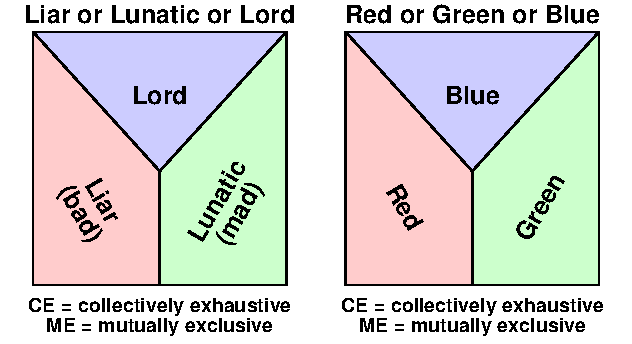
One example of this reasoning is the liar, lunatic or Lord reasoning.
6. Trilemma: Step 4
Trilemma:
Jesus is Liar or Lunatic or Lord.
Jesus is red or green or blue.
The colors
red,
green and
blue are
mutually exclusive and
collectively exhaustive.
You can now prove to yourself that Jesus is
blue.
You can believe me that Jesus is not red.
You can believe me that Jesus is not green.
The only choice left is blue.
You have now proved to yourself that Jesus is blue.
Can you see anything in this logical argument that may cause you to question the logic?
7. Truth
Almost all authors, even popular Christian authors and apologists (meaning I could find no exceptions) do not define truth but talk around it without any formal definitions.
The best I could find so far is the exhaustive book of Josh McDowell which provides a few sentences here and there, without precise definitions, of truth.
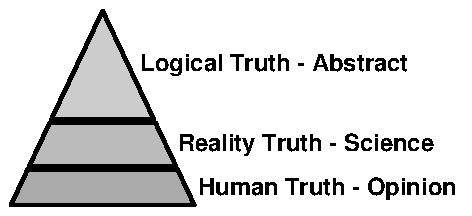
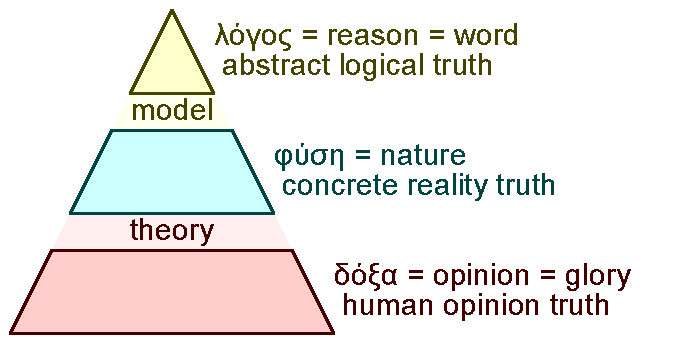
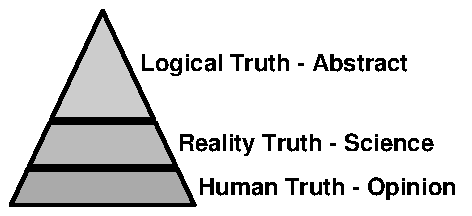
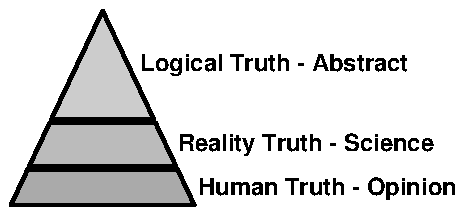
There are three levels of truth.
Aristotle covers these level in great detail in various ways.
Logic
Reality
Opinion
8. John 14:6 Way truth and life
John 14:6 Jesus saith unto him, I am the way, the truth, and the life: no man cometh unto the Father, but by me. [kjv]
λεγει αυτω ο ιησους εγω ειμι η οδος και η αληθεια και η ζωη ουδεις ερχεται προς τον πατερα ει μη δι εμου [gnt]
… via … veritas … vita … [v]
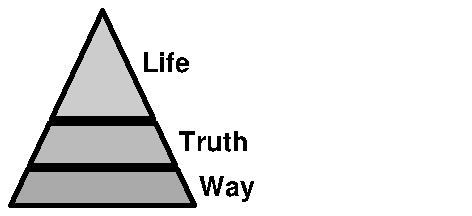
Jesus is the
"way",
"truth" and
"life".
In Latin, these three words start with "
v":
"via",
"veritas" and
"vita". The Greek and Hebrew words for
"truth" have to do with "
reality" and
not "
logic" or "
opinion". Thus, Jesus is the
"way" (opinion as in glory), the
"truth" (reality as in science) and the
"life" (logic as in information).
9. John 14:6
KJV: Jesus saith unto him, I am the way, the truth, and the life: no man cometh unto the Father, but by me.
Greek: λεγει αυτω ο ιησους εγω ειμι η οδος και η αληθεια και η ζωη ουδεις ερχεται προς τον πατερα ει μη δι εμου
Latin: dicit ei Iesus ego sum via et veritas et vita nemo venit ad Patrem nisi per me
10. Reasoning methods
Three reasoning methods the following.
deduction: top-down using logic
induction: bottom-up using reality
abduction: inside-out using opinion
The reasoning of abduction appears to be, as a "
bait" and "
switch", a way to slide in another reasoning method. It is justified using methods already present in sophisticated deduction and induction. That is, probability and statistical methods to make the best inference/deduction (e.g., Bayesian analysis, Min-Max in game theory, etc.). As a result of adding abduction as a reasoning method, opinions can be constructed, even when those opinions do not fit logic nor reality well, and the resulting reasoning process called abduction.
11. Facts and truth
Note that when a group deception is based on
empty opinion and/or
invalid logic, and
not logic nor
reality, using
logic or
reality (e.g.,
facts) will tend to result in
no change to the
opinion of the group.
1. There is one concrete reality truth. There are many perceptions of reality using logic and/or opinion.
2. One can deceive with invalid logic.
3. One can deceive with empty opinion.
When Paul, as he often does, points this out, questionable translations carefully obscure what he is saying.
[Bible is not a logic system]
12. Truth
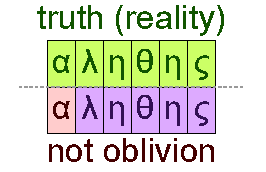
Both the Greek word for "truth", used by Jesus, and the Hebrew word for "truth", are based in the idea of reality (truth).
Logical truth is symbol manipulation to arrive at a conclusion based on premises. Logical truth has no (direct) connection with reality. To provide a connection, one must provide a model of reality and an interpretation between the logic and reality.
13. Greek truth as reality
14. Hebrew truth as reality
Genesis 2:3 And God blessed the seventh day, and sanctified it: because that in it he had rested from all his work which God created and made. [kjv]
… אלהים … בראאלהיםלעשות [he]
In Genesis 2:3, the end of the verse says that God rested from his work which "
God created and made". This is the basis for the Hebrew word for truth which, like the Greek word for truth, «
αλήθεια», has to do with the reality of our world.
The Hebrew word for truth, "
אמת" has the first letter of the Hebrew alphabet at the beginning, the middle letter near the middle, and the last letter at the end.
15. Acrostic
Taking the last letter of the three words as an acrostic, and making a new Hebrew word, one gets the Hebrew word "
אמת" which means "
truth".
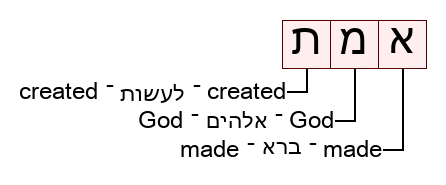
If the first letter of the Hebrew word for truth is removed, the resulting word is "
dead" (noun) or "
dying" or "
diseased" (adjective).
16. Logic
Logical truth has no (direct) connection with reality.
David Hilbert
pure mathematics
An extreme form of logic is that of the design and implementation of computer programs.
To make a connection of logic to reality a model and interpretation is needed.
17. David Hilbert
David Hilbert (German mathematician) was an influential German mathematician. In 1928, he proposed finding a consistent mathematical system that will allow all possible truths to be decided. This would allow the automatic, or mechanical, proving of all possible mathematical truths. In 1931, Gödel proved that this could not be done.
Hilbert started the separation of mathematics from philosophers (opinion truth) and reality truth. Today, (pure) mathematics is a logical truth consisting of symbol manipulation with no direct connection with reality truth or opinion truth.
18. A digital world
We live in a digital world of
0 and
1,
no and
yes,
off and
on, quantum mechanics, etc.: ways of representing "
information" (and "
randomness").
0111011011001100101000000010011001010101001101000111101001000011
0010110101101010000011100100110100101111100000100001100010011110
0010001011110001001010110110010101101000010110111101001100000010
0100111000110111000011010100011111111010101111000010001100111010
1111000010010010101100101011110101101011001010001110110111000110
0000010101101010101010011010010111000111110110110100010001100110
1001100101100000101011100110000010101111010101000000011101000010
0100000111111010001011111001000100110110110110001011010010111001
19. Values
How many values, or results, are there of a logical truth expressed as a logical expression?
Most people would say there are two. Those are true and false.
For simple logic (e.g., propositional logic) this is sufficient and correct.
Note that the two values or symbols can be any two symbols as long as they are identifiable and not the same.
20. Implication
Assume, logically, that A implies B.
The following are true:
A implies B. Called modus ponens.
not B implies not A. Called modus tolens.
The following are then not true (except for a very small number of cases that happen to be true):
not A implies not B. This is the fact check fallacy.
B implies A. This is the converse fallacy.
Someone who has been taught that if there are errors in the Bible then the Bible is not true has fallen victim to the fact check fallacy. That is, the conclusion can still be true in the presence of invalid logic.
21. Logical inference groups
| The following are all equivalent. |
| A implies B |
modens ponens |
| B if A |
(top down) |
| (not B) or A |
|
| (not B) implies (not A) |
modens tollens |
| A or (not B) |
|
|
 |
The two tables are
symmetric. If the top table is
true, then the bottom table is
not true, that is,
false, and vice-versa.
| The following are all equivalent. |
| B implies A |
converse error |
| A if B |
(top down) |
| (not A) or B |
|
| (not A) implies (not B) |
fact check fallacy |
| B or (not A) |
|
|
 |
There are a terrible lot of lies going about the world, and the worst of it is that half of them are true. Winston Churchill.
Note that if the bottom table is
true, then the top table is
not true or
false. To see this requires algebraic substitution of names for other names (as in a code). This is part of the programming process in computer science, software engineering, etc.
22. Matthew 24:22 Variable operands and operators
Matthew 24:22 And except those days should be shortened, there should no flesh be saved: but for the elect's sake those days shall be shortened. [kjv]
και ει μη εκολοβωθησαν αι ημεραι εκειναι ουκ αν εσωθη πασα σαρξ δια δε τους εκλεκτους κολοβωθησονται αι ημεραι εκειναι [gnt]
| Variable operands for the verse |
| X |
εκολοβωθησαν αι ημεραι εκειναι |
those days be shortened |
no "nt" |
| X |
κολοβωθησονται αι ημεραι εκειναι |
those days be shortened |
"nt" |
| Y |
εσωθη πασα σαρξ |
saved all flesh |
|
| E |
δια (τους) εκλεκτους |
by the elect |
|
| Connective operators for the verse |
| if not |
ει μη |
if not |
"I am" |
| if not |
ουκ αν |
if not |
|
| but by |
δια δε |
through but |
|
To support the idea of a
good "elect". the Greek for
"by" or
"through" was changed (reversed) to
"for".
23. Matthew 24:22 Abstracted logic
Matthew 24:22 And except those days should be shortened, there should no flesh be saved: but for the elect's sake those days shall be shortened. [kjv]
Let
X be "
those days/parts be shortened or cut off",
Y be "
flesh saved",
E be
"elect".
1. if not X then not Y but by E is X. (as stated, modus tollens)
2. if Y then X but by E is X. (modus ponens)
E is self-deceived (surrounding verses) and decides that Y needs to be achieved (equivocation on "flesh" and "saved") by doing X (converse fallacy).
3. if X then Y but (since) by E is X. (converse fallacy by E)
E (deceived) decides that X needs to be done to get Y and convinces others "in this way/manner" (surrounding verses).
4. if not Y then not X but (since) by E is X. (restated as fact check fallacy)
In three verses, Jesus will remind us that he had told us this before.
24. Matthew 24:22 Paraphrase
Matthew 24:22 And except those days should be shortened, there should no flesh be saved: but for the elect's sake those days shall be shortened. [kjv]
και ει μη εκολοβωθησαν αι ημεραι εκειναι ουκ αν εσωθη πασα σαρξ δια δε τους εκλεκτους κολοβωθησονται αι ημεραι εκειναι [gnt]
Paraphrase using the above logic:
And if those days [parts there yes] were not cut off (horns/rules removed) no flesh would be saved, but though the (deceived) elect's (false) ideas, those days [parts there yes] will be cut off (horns/rules removed) in order to (invalid logic) save all flesh.
Jesus wants to "cut off" certain unnecessary horns/rules/parts (yoke of compulsion) in order to "save" "all" "flesh" in a "heavenly" manner.
The (deceived) "elect" want to "cut off" all horns/rules/parts in the (false) idea that this will "save" "all" "flesh" in a "worldly" manner.
Discuss: Has it ever happened that
false teachers want to "
cut off"
all horns/rules/parts in order that
all "
flesh" might be "
saved"? Does it help fill the pews (or their own salary)?
25. Models and reality
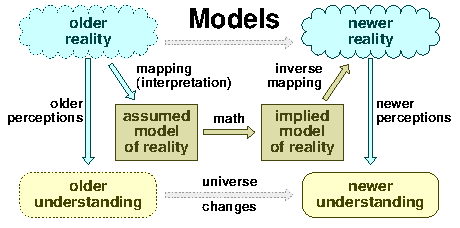
A
model is an
abstraction (
interpretation) of
reality that can be used for prediction and/or understanding.
Given new information or insight, a
model can be enhanced and/or refined over time.
Multiple models: Duality.
Essentially, all models are wrong, but some are useful. George Box, Statistician.
The best material model of a cat is another, or preferably the same, cat. Norbert Wiener (and A. Rosenblueth).
A model is a
useful fiction. Some would try to declare a model
guilty by pointing out places where the model does not fit (fact check fallacy).
If the model fits, you must acquit! (paraphrase from a famous legal case).
26. Model build
To discredit an opinion, one can find errors in the opinion. The same does not work well with a model. If a model does explain
all phenomena sufficiently well, one needs to find a better model that handles those phenomena.
In desperation, those tied to
opinion may question whether a model
exists to explain the phenomena (even when presented with a model).
Note that some, such as
flat earthers, may not accept any model but rely primarily on their
opinion.
Those who believes in a flat earth have nothing to fear but sphere itself!
27. Inerrancy progression
Two people can see the same thing in different ways. Sometimes both are true in some sense.
Jesus say he is the
way,
truth (reality) and the
life.
28. Comparison
For the sake of argument, assume that there is a Creator God.
DNA, complex digital code, is designed by God with fault tolerant properties so that, in the presence of (limited) errors, life can continue.
Human communication (e.g., playing a DVD, TV broadcast, etc.) has many errors but techniques to minimize those errors. Once can still see and understand what is being conveyed.
Why then does the Bible, as a digital message, need to have no errors?
29. Analogy
Someone might say: I would not use a Bible that has errors in it. I might as well throw it out.
Your body, that God made, is filled with DNA and other digital errors. Why do you continue to live in it?
30. Values
For non-simple logic (e.g., predicate logic) there are three values that can result.
true (or yes, or 1, etc.)
false (or no, or 0, etc.)
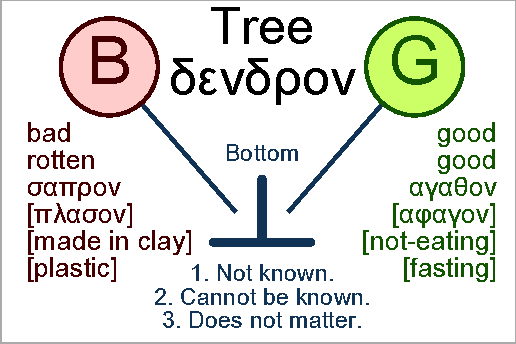
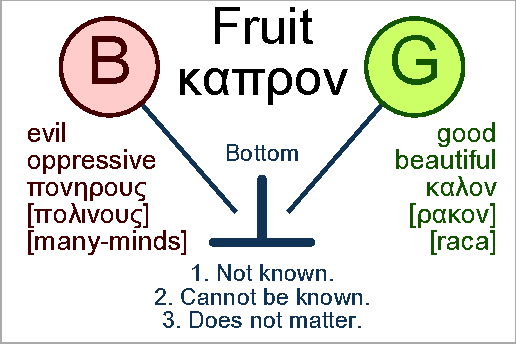
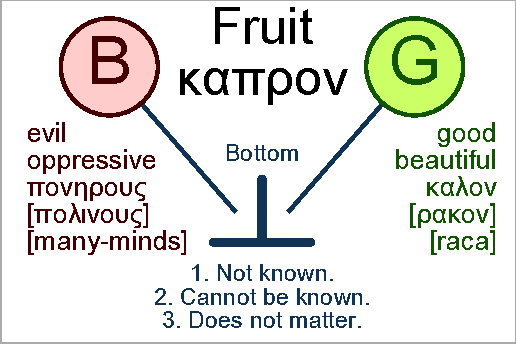
bottom (with at least three interpretations, all effectively the same logically)
we do not know
we cannot know
it does not matter
When one requires a yes-no or true-false answer from a question and does not allow a bottom value, strange logical reasoning results. Aristotle called this Sophistic (clever, cunning) reasoning.
Note: Programming languages and database systems use a value called null to represent the bottom value.
31. Email analogy
Suppose an email message (Bible) arrives that claims to be from your boss (God).
You find some spelling and grammer errers, but can still understand the message. Due to inerrancy considerations, you might reason as follows.
The boss made a mistake. I can ignore the message.
Someone must have changed the message but the original was inerrant.
Does it matter?
The message tells me about things that only the boss (God) knows. (authentication code)
Is the authentication more important than any spelling or grammar mistakes in the message?
Discuss: Why do some people spend more time arguing about spelling and grammer errers and fixing them than in actually doing what the message says to do?
[spoofing, man in the middle attack, Shannon, Hamming]
32. Three errors puzzle

What is not there may be important?
Consider this self-referential sentence that has real issues. First, find them. Then ask yourself the following question. How easy is it to fix them?
[basketball story]
33. Option buttons and check boxes
In user interface design,
option or
radio buttons allow one choice from a set of selections whereas
check boxes allow each selection to be either checked or not checked.
| Logical situations |
False dilemma
(pick only one) |
Not false dilemma
(pick all that apply) |
| • this |
☐ this |
| • that |
☐ that |
|
☐ something else |
| Summary |
| • option button |
☐ check box |
| select only one |
select or not select |
|
The legal process often forces false dilemma situations, sometimes to create perjury traps.

Is it white or black? Pick one.
White - you are lying.
Black - you are lying.
See how this works. Aristotle called this reasoning (and many other types of reasoning) Sophistic reasoning.
|
34. Brainwashing
One way to look at brainwashing (and related ideas) is that it is a
false dilemma where only one option is provided.
Discuss: Suppose a Biblical passage (verse or verses) has more than one possible meaning but only one meaning is provided in a translation. How does this compare with brainwashing?
How does the translator know they are correct?
Security issue (often called Schneier's Law): Thinking that because you cannot break a code you created, no one else can. Schneier quote:
Anyone, from the most clueless amateur to the best cryptographer, can create an algorithm that he himself can't break. Charles Babbage, designer of the first programmable computer in, wrote in 1864 about the "
strong conviction" people have that they can create an unbreakable cipher.
[Enigma]
35. Programming language domain theory
Consider the Russell Paradox. Are each of the following contradiction in terms? Can they actually exist?
Can a "rotten" "tree" ever have "beautiful" or "raca" "fruit"?
Can a "good" or "not eating" "tree" ever have "oppressive" "fruit"?
36. Good and raca
37. End of page