Send
Close Add comments:
(status displays here)
Got it! This site "creationpie.org" uses cookies. You consent to this by clicking on "Got it!" or by continuing to use this website. Note: This appears on each machine/browser from which this site is accessed.
Punishment by Spoonerisms: switched consonants
1. Punishment by punny puns
Luke 6:21 Blessed are ye that hunger now: for ye shall be filled. Blessed are ye that weep now: for ye shall laugh. [kjv]
μακαριοι οι πεινωντες νυν οτι χορτασθησεσθε μακαριοι οι κλαιοντες νυν οτι γελασετε [gnt]
A
pun is a play on words or double meaning for a word or phrase. Some people love puns. Some people hate puns. There are many puns, or play on words, used in Hebrew (and Greek) in the Bible. Most puns are by sound, some by meaning, etc.
2. Pig Latin
Pig Latin is a switching of consonants and syllables in a certain way. English examples go back into the 1800's. Pig Latin is different than Dog Latin (future topic).
A Pig Latin recording, sung by Arthur Fields in 1919, is the song "I-Yay Ove-Lay oo-yay earie-day".
A Three Stooges episode (1938) has Moe attempt to teach Curly Pig Latin. This episode taught anyone watching the rules for Pig Latin.
In Monsters.Inc, Sully tells Mike to "ook-lay in the ag-bay".
In Lion King, Simba calls the hyenas stupid, to which Zazu says "Ix-nay on the oopid-stay.".
The German word
"Night" ≈ "not", sometimes pronounced in English as "
nix", has come into limited use in the Pig Latin form of "
ixnay" or "
icksnay".
3. Punishment by Spoonerisms: switched consonants
A
Spoonerism, named for William
Spooner (1844-1930), switches consonants of words. Vowels can often be pronounced such as to sound similar.
It is kisstomary to cuss the bride.
The Lord is a shoving leopard.
Mardon me padam, This pie is occupewed. Please sew me to another sheet.
| shake a tower |
take a shower |
| runny babbit |
bunny rabbit |
| fight a liar |
light a fire |
From the comedy group
Capitol Steps (1980's):
Resident Pagan (President Reagan).
The same effect can be achieved in many languages, including Greek. [Caesar using Greek to encrypt Latin]
4. Similar sound search
The following Greek letters (and combinations) are the same today or were similar enough then to be recognized as play on words.
| ο, ω |
same sound today |
| υ, ι, οι, η |
some sound today |
| χ, κ, γ |
similar sound then |
| τ, σ, ζ |
similar sound then |
| δ, τ |
similar sound then |
| β, π |
similar sound then |
One way to search for similar-sounding words is to map related characters to the same character and then search using that mapping.
 |
Details are left as a future topic.
|
5. General Spoonerism pattern
A general pattern of a Greek Spoonerism, as found, say, in the
GNT (Greek New Testament) is the following.
Let C be a sequence of (pronounceable) consonants. Some will sound similar to other consonants so constructed.
Let V be a sequence of (pronounceable) vowels. Some will sound similar to other vowels so constructed.
Let PREFIX C1 V1 C2 V2 SUFFIX be a word. For many Spoonerisms there may be no PREFIX nor SUFFIX.
Then the following are possible Spoonerism words.
PREFIX C2 V2 C1 V1 SUFFIX
PREFIX C2 V1 C1 V2 SUFFIX
6. Error correcting codes
Fault tolerance is important in distributed systems and in organizations.
Redundancy can be used to
detect and
correct errors (discrepancies).
Bar codes, ISBN, Credit card numbers, UPC, CRC checks, parity checks, etc.
Space shuttle: Four redundant computers with one backup (cross-checking 500 times a second).
Accounting (manual) method of casting out nines.
Masoretic Hebrew text copying rules.
Rhyme and meter in poetry. [Chinese language sounds]
Two (reliable) witnesses (at least) needed.
An understanding of
FTC (Fault Tolerant Computing) techniques and that of an
ECC (Error Correcting Code) are important in understanding the differences in various Bible texts.
The key to fault tolerance is
redundancy. The simplest model is to use redundancy and take a majority vote of the various ways. There are many more advanced methods not discussed here.
[Godfather movie and language codes]
7. Good bad and ugly
The Good, the Bad and the Ugly is a 1966 Italian epic spaghetti Western film directed by Sergio Leone and starring Clint Eastwood as "the Good", Lee Van Cleef as "the Bad", and Eli Wallach as "the Ugly". Wikipedia (as of 2022-08-30)
This movie was filmed in parts of Spain and Italy.
8. Rudolph
Inspired by the story of the
Ugly Duckling, Robert May, in 1939, created the story of
Rudolph the Red-Nosed Reindeer.
In 1949 the song and melody by
Johnny Marks made Rudolph more popular. The TV special in the 1960's added to the legend of Rudolph, reindeer, the North Pole, and Santa - with elves, etc.
Rudolph has a red nose but the English word
"Rudolph" is from the German word
"Rudolf" ≈ "Rudolph" is from the old German words for "
fame" and "
wolf".
9. Spoonerisms: good, bad, ugly
Jesus appears to use play on words, at several levels, to provide authentication codes, meaning verification codes, continuity codes, etc. An overview is the following, characterized as
good,
bad or
ugly.
☐
Good: Literal meaning(s).
☐
Good: Non-literal meaning(s).
☐
Bad: Direct play on words.
☐
Ugly: Spoonerism play on words.
A fault-tolerant communication method, such as spread-spectrum communication, uses redundancy at multiple levels as part of an error correcting code to detect and, within limits, correct codes not faithfully transmitted.
10. Matthew 23:34 Jest for fun punishment
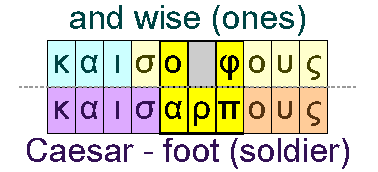
Matthew 23:34 Wherefore, behold, I send unto you prophets, and wise men, and scribes: and some of them ye shall kill and crucify; and some of them shall ye scourge in your synagogues, and persecute them from city to city: [kjv]
| words |
play on words |
complexity |
type |
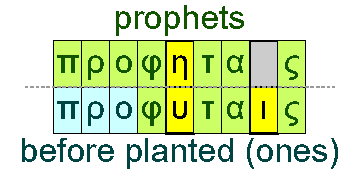
| prophets |
newly planted ones (sent) before |
simple |
good |
| and clever/cunning (ones) |
Caesar foot (soldiers) |
extended |
bad |
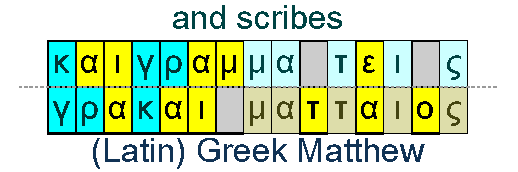
| and scribes |
Latin/Greek/Jew Matthew |
contorted |
ugly |
Punny paraphrase:
... I send you simple puns, extended puns, contorted puns. Out of them, the simple ones will kill you, the extended ones will crucify you, and the contorted ones will scourge (sting) you in your pews, and will pursue you from city (many) to city (many) (you will not be able to un-hear them.)
There are, then,
three play on words in sequence (as a third level meaning).
[tongue in cheek vs. tongue in check]
11. Matthew 12:40 Days and nights
Matthew 12:40 For as Jonas was three days and three nights in the whale's belly; so shall the Son of man be three days and three nights in the heart of the earth. [kjv]
ωσπερ γαρ ην ιωνας εν τη κοιλια του κητους τρεις ημερας και τρεις νυκτας ουτως εσται ο υιος του ανθρωπου εν τη καρδια της γης τρεις ημερας και τρεις νυκτας [gnt]
Greek:
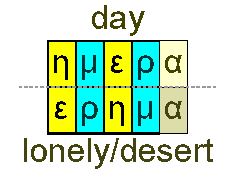
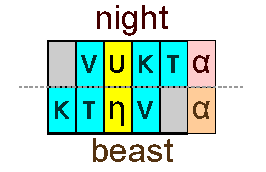
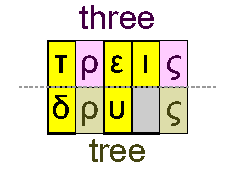
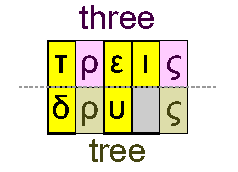
three days and three nights.
Play:
tree wilderness and tree beast .
Gathering of believers of Jesus: ... freely you have received, freely give ...
Church as master organization: ... treely you have received, treely give ...
[Three Dog Night]
12. Day and night
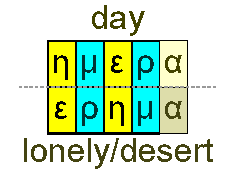
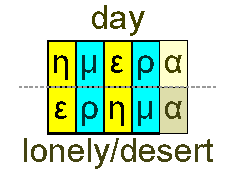
The ancient Greek word
"μέρος" ≈ "part, portion, share". The ancient Greek word
"ἡμέρᾱ" ≈ "day, time" can be a play on words with
"the parts" as
"οι μέρη" ≈ "the parts".
By contrast,
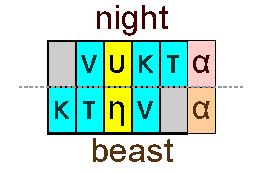
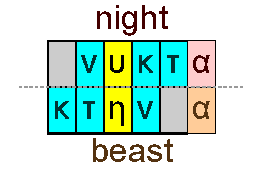
"νύξ" ≈ "night" and
"νύκτός" ≈ "(of the) night". A play on words, as a
Spoonerism, could be the following.
"κτηνα" ≈ "beast".
"κῆτος" ≈ "whale, sea monster",
"κτῆσις" ≈ "act of acquiring, ownership, taking"
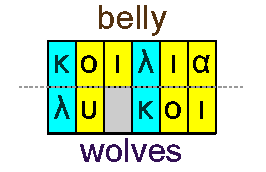
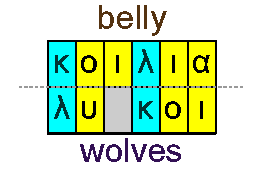
13. Belly of the wolves Spoonerism
Matthew 12:40 For as Jonas was three days and three nights in the whale's belly; so shall the Son of man be three days and three nights in the heart of the earth. [kjv]
ωσπερ γαρ ην ιωνας εν τη κοιλια του κητους τρεις ημερας και τρεις νυκτας ουτως εσται ο υιος του ανθρωπου εν τη καρδια της γης τρεις ημερας και τρεις νυκτας [gnt]
7:15 Beware of false prophets, which come to you in sheep's clothing, but inwardly they are ravening wolves. [kjv]
προσεχετε δε απο των ψευδοπροφητων οιτινες ερχονται προς υμας εν ενδυμασιν προβατων εσωθεν δε εισιν λυκοι αρπαγες [gnt]
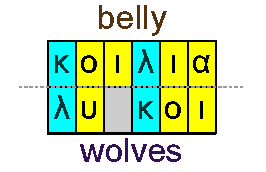
"κοιλία" ≈ "belly, stomach, hollow" and is from the ancient Greek word "κοῖλος" ≈ "hollow".
"λυκοί" ≈ "wolves".
The ancient Greek word
"λύκος" ≈ "wolf" but could be a
"jackdaw",
"starling",
"thrush", or similar
bird.
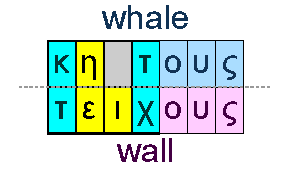
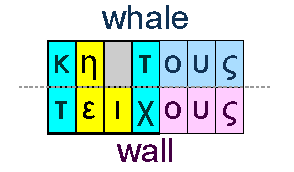
14. Whaling wall Spoonerism
Matthew 12:40 For as Jonas was three days and three nights in the whale's belly; so shall the Son of man be three days and three nights in the heart of the earth. [kjv]
ωσπερ γαρ ην ιωνας εν τη κοιλια του κητους τρεις ημερας και τρεις νυκτας ουτως εσται ο υιος του ανθρωπου εν τη καρδια της γης τρεις ημερας και τρεις νυκτας [gnt]
2 Corinthians 11:33 And through a window in a basket was I let down by the wall, and escaped his hands. [kjv]
και δια θυριδος εν σαργανη εχαλασθην δια του τειχους και εξεφυγον τας χειρας αυτου [gnt]
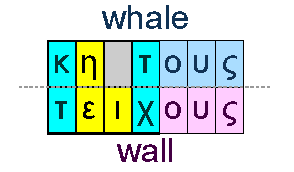
"κῆτους" ≈ "of the whale, sea monster" (genitive).
"τεῖχους" ≈ "of the mound, earth works, wall" (genitive).
15. Matthew 12:40 Whale belly Spoonerism
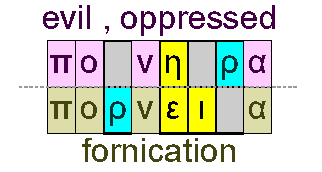
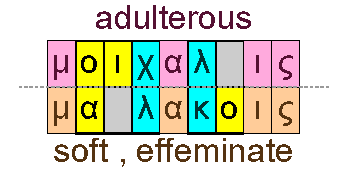
16. Matthew 12:39 Evil and adulterous
17. Matthew 12:40 Jonah in the belly of the whale
Matthew 12:40 For as Jonas was … in the whale's belly; … [kjv]
ωσπερ γαρ ην ιωνας εν τη κοιλια του κητους … [gnt]
The
KJV (King James Version) moves the "
three" "
days" and "
three" "
nights" from
after the
"whale" to
before the
"belly". [temple woken up]
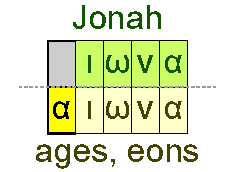
Greek: ... for as Jonah was in the belly of the whale ...
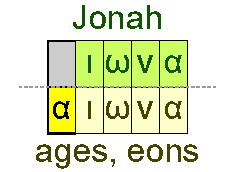
Play on words: ... for as the ages was (are) in the wolves of the wall ...
Might the
"wolves" and the
"wall" be related to the "
wide" "
area" connected by the "
narrow" "
gates"?
[Spoonerisms, Anabaptist book]
18. Matthew 12:39 Sign of the Messiah
Matthew 12:39 But he answered and said unto them, An evil and adulterous generation seeketh after a sign; and there shall no sign be given to it, but the sign of the prophet Jonas: [kjv]
ο δε αποκριθεις ειπεν αυτοις γενεα πονηρα και μοιχαλις σημειον επιζητει και σημειον ου δοθησεται αυτη ει μη το σημειον ιωνα του προφητου [gnt]
Was Jesus the
"Messiah" or just a
"sign" of the
"Messiah"? Does Jesus ever claim to be the
"Messiah"?
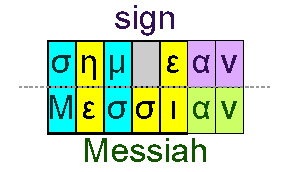
"σημέαν" ≈ "mark, sign, omen, flag" (accusative)
"Μεσσίαν" ≈ "Messiah, anointed one" (accusative)
The Greek words for
"sign" and
"Messiah" are
Spoonerisms. The word
"Jonah" is used by Jesus in only two places in Matthew. How well does this play on words fit what Jesus says?
19. Matthew 24:3 Sign of the Messiah
Matthew 24:3 And as he sat upon the mount of Olives, the disciples came unto him privately, saying, Tell us, when shall these things be? and what shall be the sign of thy coming, and of the end of the world? [kjv]
καθημενου δε αυτου επι του ορους των ελαιων προσηλθον αυτω οι μαθηται κατ ιδιαν λεγοντες ειπε ειπον ημιν ποτε ταυτα εσται και τι το σημειον της σης παρουσιας και της συντελειας του αιωνος [gnt]
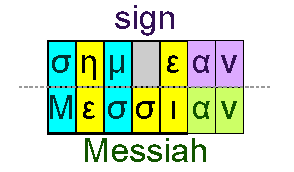
"σημέαν" ≈ "mark, sign, omen, flag" (accusative)
"Μεσσίαν" ≈ "Messiah, anointed one" (accusative)
Jesus uses the Greek word for
"sign" as a play on words, using a Spoonerism, with
"Messiah". The disciples appear to not be aware of this correspondence.
20. Lowly birds
Matthew 13:4 And when he sowed, some seeds fell by the way side, and the fowls came and devoured them up: [kjv]
και εν τω σπειρειν αυτον α μεν επεσεν παρα την οδον και ηλθεν ελθοντα τα πετεινα και κατεφαγεν αυτα [gnt]
11:29 Take my yoke upon you, and learn of me; for I am meek and lowly in heart: and ye shall find rest unto your souls. [kjv]
αρατε τον ζυγον μου εφ υμας και μαθετε απ εμου οτι πραος πραυς ειμι και ταπεινος τη καρδια και ευρησετε αναπαυσιν ταις ψυχαις υμων [gnt]
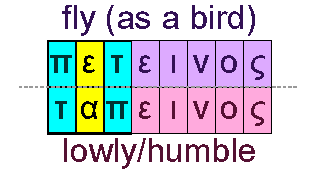
The etymology of the Greek word for
"lowly" or
"humble" is not known. As a
Spoonerism (exchanged consonants), the word for
"lowly" or
"humble" is a play on words with
"birds"
"πετεινός" ≈ "fully fledged, able to fly" as in a "bird".
"ταπεινός" ≈ "low-lying, humbled, downcast" (etymology unknown)
21. Matthew 5:22 Angry paraphrase
Matthew 5:22 But I say unto you, That whosoever is angry with his brother without a cause shall be in danger of the judgment: and whosoever shall say to his brother, Raca, shall be in danger of the council: but whosoever shall say, Thou fool, shall be in danger of hell fire. [kjv]
5:22:
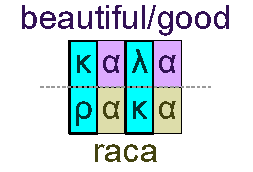
But I say to you. Whoever is [and remains] angry with the brother (Jesus) is liable for the judgment. Whoever says to the brother Raca (Aramaic word for fool) [rag, band aid], is liable with respect to the council (religious institution that uses that language). But whoever calls the brother (Jesus) fool (Greek word) is liable for hell fire. Additional (double) meanings:
If Jesus (one of the many) is angry with the brother, that brother is liable for the judgment (as is Jesus who must then do that judgment) .... but whoever Jesus calls a fool (Greek word, in parables, sayings, etc.) is liable for hell fire (as is Jesus who must then do that hell fire).
Can Jesus implicitly and indirectly call the religious establishment
"fools" by teaching the "
truth"? Once the people know the "
truth", it becomes obvious to them that the religious establishment is not teaching the entire "
truth" and they thus appear as
"fools".
[computer science teaching examples, Green Acres syndrome]
22. Matthew 5:22 Foolish raca
Matthew 5:22 But I say unto you, That whosoever is angry with his brother without a cause shall be in danger of the judgment: and whosoever shall say to his brother, Raca, shall be in danger of the council: but whosoever shall say, Thou fool, shall be in danger of hell fire. [kjv]
εγω δε λεγω υμιν οτι πας ο οργιζομενος τω αδελφω αυτου εικη ενοχος εσται τη κρισει ος δ αν ειπη τω αδελφω αυτου ρακα ενοχος εσται τω συνεδριω ος δ αν ειπη μωρε ενοχος εσται εις την γεενναν του πυρος [gnt]
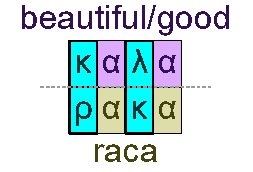
The English word
"raca" comes from the ancient Greek word
"ῥακά" ≈ "idiot, fool, good-for-nothing" which comes from Aramaic (similar to Hebrew) word
"ריקא" ≈ "worthless person".
The ancient Greek word
"μωρε" ≈ "foolish, stupid" (as used) from
"μωρός" ≈ "foolish, stupid" as in the English word
"moron".
23. Strongs - raka - fool
*G4469 *1 ῥακά (rhak-ah') : of Chaldee origin (compare H7386); O empty one, i.e. thou worthless (as a term of utter vilification):--Raca.
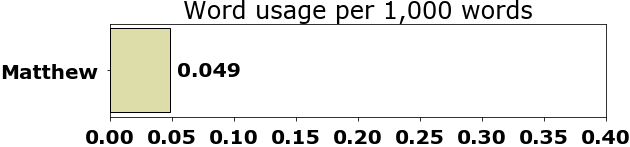 |
Words: ρακα=1
|
*G3474 *12 μωρός (mo-ros') : probably from the base of G3466; dull or stupid (as if shut up), i.e. heedless, (morally) blockhead, (apparently) absurd:--fool(-ish, X -ishness).
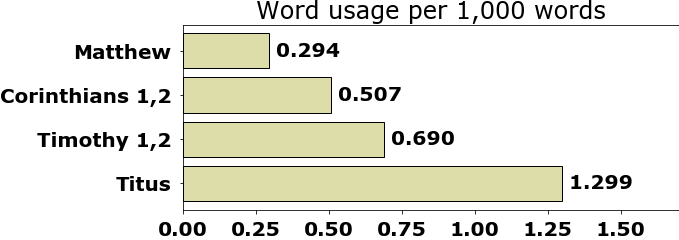 |
Words: μωρα μωραι=3 μωρας=2 μωρε=1 μωροι=2 μωρον μωρος μωρω
|
The Greek words used by Jesus for
"Raca" and
"fool" appear only
once in this exact form in the
GNT (both in this verse) and
not in the
LXX (Septuagint).
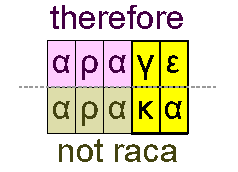
Perhaps Jesus is using a play on words. Perhaps a
Spoonerism. Perhaps even
Latin. Such a usage should fit into the context which is that of top-down or, for non-computer scientists, backwards order.
24. Gift at the alter
There are two main events or competitions.
Great Commission (what Jesus wants you to do).
Gifts on the altar (what birds want you to do)
Which is the most important event or competition?
Which is just a shadow of an event or competition?
25. Matthew 5:22 Foolish Rome connection
Matthew 5:22 But I say unto you, That whosoever is angry with his brother without a cause shall be in danger of the judgment: and whosoever shall say to his brother, Raca, shall be in danger of the council: but whosoever shall say, Thou fool, shall be in danger of hell fire. [kjv]
εγω δε λεγω υμιν οτι πας ο οργιζομενος τω αδελφω αυτου εικη ενοχος εσται τη κρισει ος δ αν ειπη τω αδελφω αυτου ρακα ενοχος εσται τω συνεδριω ος δ αν ειπη μωρε ενοχος εσται εις την γεενναν του πυρος [gnt]
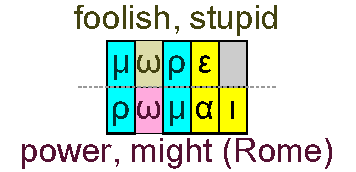
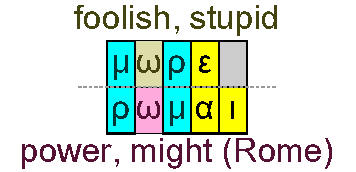
Greek "μωρε" ≈ "foolish, stupid".
Latin "Rome" ≈ "Rome" (vocative) and Greek "Ῥώμη" ≈ "Rome".
Greek "ῥώμη" ≈ "might, power, force, strength".
Greek: "ῥακά" ≈ "idiot, fool, good-for-nothing"
Greek "χαρά" ≈ "favor, grace" and, in context, "joy".
Latin "hara" ≈ "animal pen, chicken coop, pigsty".
26. Matthew 5:22 Foolish Rome connection
Matthew 5:22 But I say unto you, That whosoever is angry with his brother without a cause shall be in danger of the judgment: and whosoever shall say to his brother, Raca, shall be in danger of the council: but whosoever shall say, Thou fool, shall be in danger of hell fire. [kjv]
εγω δε λεγω υμιν οτι πας ο οργιζομενος τω αδελφω αυτου εικη ενοχος εσται τη κρισει ος δ αν ειπη τω αδελφω αυτου ρακα ενοχος εσται τω συνεδριω ος δ αν ειπη μωρε ενοχος εσται εις την γεενναν του πυρος [gnt]
27. Matthew 5:22 Joyous fool connection
Matthew 5:22 But I say unto you, That whosoever is angry with his brother without a cause shall be in danger of the judgment: and whosoever shall say to his brother, Raca, shall be in danger of the council: but whosoever shall say, Thou fool, shall be in danger of hell fire. [kjv]
Does it make any sense to make comparisons of the following, using
Spoonerisms of the Greek with Latin (transliteration)?
By embracing the brother Jesus, one effectively calls the council "raka" or (Latin Spoonerism) an "animal pen" or "chicken coop" or "pigsty" or (Greek Spoonerism) "grace" or "favor".
By embracing the "council", one effectively call the brother Jesus a "fool" or (Latin Spoonerism) "Rome" or (Greek Spoonerism) "Rome" or "might" or "power" or "strength".
[chicken coop]
28. Matthew 10:3 Matthew the tax collector
Matthew 10:3 Philip, and Bartholomew; Thomas, and Matthew the publican; James the son of Alphaeus, and Lebbaeus, whose surname was Thaddaeus; [kjv]
φιλιππος και βαρθολομαιος θωμας και ματθαιος μαθθαιος ο τελωνης ιακωβος ο του αλφαιου και λεββαιος ο επικληθεις θαδδαιος [gnt]
Matthew was one of the twelve disciples of Jesus. The book of
Matthew is assumed to have been written by him.
"Ματταῖος" ≈ "Matthew" or "Ματθαῖος" ≈ "Matthew".
The Greek word comes from the Hebrew/Aramaic word
"מתי" (mattay) ≈ "Matthew" which means, literally, "
gift of the Lord" . Is the book of "
Matthew" a "
gift of the Lord"?
Matthew worked for the
Romans. The Latin word
"Matthaeus" ≈ "Matthew". A good tax collector would have had multiple language skills, reading and writing skills, shorthand skills, a good memory, attention to detail, etc.
29. Matthew 23:34 Scribes
Matthew 23:34 Wherefore, behold, I send unto you prophets, and wise men, and scribes: and some of them ye shall kill and crucify; and some of them shall ye scourge in your synagogues, and persecute them from city to city: [kjv]
δια τουτο ιδου εγω αποστελλω προς υμας προφητας και σοφους και γραμματεις και εξ αυτων αποκτενειτε και σταυρωσετε και εξ αυτων μαστιγωσετε εν ταις συναγωγαις υμων και διωξετε απο πολεως εις πολιν [gnt]
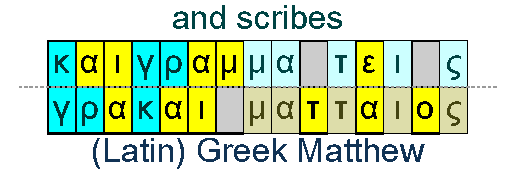
The Greek for
"and" "scribes" does not fit will with the rest of the verse. A play on words, with Spoonerism, is that of (transliterated) Latin "
Greek" and "
Matthew".
The Latin word
"Graecus" ≈ "Greek" and of uncertain origin. At that time, the Latin "
c" was a hard "
c" as in a "
k" sound. A Latin to Greek transliteration would be something like
"γραικους" ≈ "Greek" .
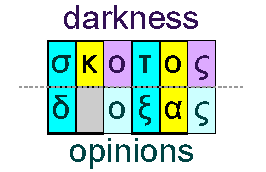
30. Matthew 6:23 Dark opinions
Matthew 6:23 But if thine eye be evil, thy whole body shall be full of darkness. If therefore the light that is in thee be darkness, how great is that darkness ! [kjv]
εαν δε ο οφθαλμος σου πονηρος η ολον το σωμα σου σκοτεινον εσται ει ουν το φως το εν σοι σκοτος εστιν το σκοτος ποσον [gnt]
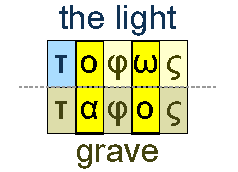
"το" ≈ "the" and "φως" ≈ "light" (photon)
"τάφος" ≈ "burial, funeral, tomb, grave".
"σκότος" ≈ "darkness, gloom".
"δόξης" ≈ "opinion, expectation"
Paraphrase:
If then the light[tomb/grave] that (is) in you is darkness, [opinions] how much [feet/fish] opinionated (is/are that/those) darkness [opinions].
Words
opinion and
opine, Greek sounds: "
sk" and "
ks", "
t" and "
d".
The
ancient Greek word
"δόξα" ≈ "opinion, expectation" as in
"doxology". This word, after the Latin, is often translated as "
glory" as a narrowing of a
good opinion. [
doxx from
docs from Latin
teach related to Greek
opinion]
31. Matthew 5:13 Salt code word
Matthew 5:13 Ye are the salt of the earth: but if the salt have lost his savour, wherewith shall it be salted? it is thenceforth good for nothing, but to be cast out, and to be trodden under foot of men. [kjv]
υμεις εστε το αλας της γης εαν δε το αλας μωρανθη εν τινι αλισθησεται εις ουδεν ισχυει ετι ει μη βληθηναι βληθεν εξω και καταπατεισθαι υπο των ανθρωπων [gnt]
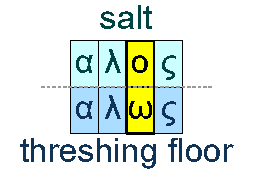 |
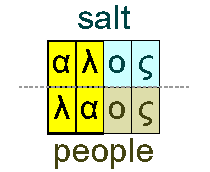 |
play on words
(bad)
|
Spoonerism
(ugly)
|
You are the salt of the earth. (good)
You are the threshing floor or halo of the earth. (bad)
You are the people of the earth. (ugly)
32. Matthew 18:4 Humbled at the same level
Matthew 18:4 Whosoever therefore shall humble himself as this little child, the same is greatest in the kingdom of heaven. [kjv]
οστις ουν ταπεινωση ταπεινωσει εαυτον ως το παιδιον τουτο ουτος εστιν ο μειζων εν τη βασιλεια των ουρανων [gnt]
The
ancient Greek word
"ταπεινός" ≈ "low-lying, humbled, downcast". The
KJV often translates the Greek word for
"humbled" as
"abased".
How might this
child have been
"humbled"? Does one need to eat
"umble", later
"humble", pie?
Humility is not thinking less of yourself, but thinking of yourself less. C.S. Lewis.
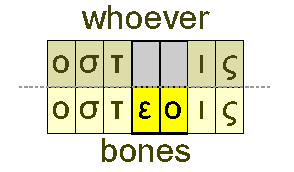
The
"whoever" indicates that one might want to look for another related meaning in play on words. [Paul and Philippians]
33. End of page