Got it! This site "creationpie.org" uses cookies. You consent to this by clicking on "Got it!" or by continuing to use this website. Note: This appears on each machine/browser from which this site is accessed.
This content has been augmented from scattered and related content. This has been added with links. This page needs reorganized as to order and repetition. (as of 2025-11-07)
2. Romans 1:20 Invisible things
Romans 1:20For the invisible things of him from the creation of the world are clearly seen, being understood by the things that are made, even his eternal power and Godhead; so that they are without excuse: [kjv]
τα γαραορατααυτου απο κτισεωςκοσμουτοις ποιημασιν νοουμενα καθοραται η τε αιδιος αυτου δυναμις και θειοτης εις το ειναι αυτουςαναπολογητους [gnt]
What are the "invisible things"? For this verse, one often hears a discussion of "atoms" as not being "visible". Is God made up of "atoms"? Is the creator God within space and time? The verse says the "invisible things of him".
One can divide "things" into concrete or physical "things" and abstract "things" as in ideas or thoughts. There may be evidences of one's thoughts or ideas. There may be evidence of God's thoughts or ideas. That is the visible world we see. If one takes "science" as the search for the "truth" of "reality" then the following appear to hold.
One cannot prove God exists using science.
One cannot prove that God does not exist using science.
Our reality is within time and space and matter. Is there anything we know that can transcend time and space and matter?
Romans 1:20For the invisible things of him from the creation of the world are clearly seen, being understood by the things that are made, even his eternal power and Godhead; so that they are without excuse: [kjv]
τα γαραορατααυτου απο κτισεωςκοσμουτοις ποιημασιν νοουμενα καθοραται η τε αιδιος αυτου δυναμις και θειοτης εις το ειναι αυτουςαναπολογητους [gnt]
The idea of "information" can transcend time and space and matter. Quantum information theory will confuse this idea by defining information as time and space and matter as we know it.
To avoid this confusion, one can use the term "coded information" is in the coded information in DNA (Deoxyribonucleic Acid), a book, a computer program, etc.
DNA is a 3x4x4 code with 64 "instructions" that act as (redundant) codes for the amino acids plus start and stop codes.
The amount of information that can be represented with bits can be eye-opening. Here are some graphical examples.
8 rows x 10 cols = 80 bits
It would take about 40,000,000,000 years (i.e., 40 billion years, or 40,000 million years) at 1,000,000 variations a second, never trying the same one more than once, to try every possible bit combination of 80 bits.
To do 1,000,000,000 (1 billion) variations a second, add 10 more bits for a total of 90 bits.
To require 40,000,000,000,000 (i.e., 40 trillion) years, add 10 more bits for a total of 100 bits.
About 60 bits are needed to identify any second in 40 billion years.
7. Backtrack to the beginning
The coded information argument (proof) requires a creator God.
1. Coded information exists in large quantities such as DNA (billions of bits of coded information).
2. Coded information cannot arise by change (with probability quickly approaching zero).
The coded information argument (outside of time and space) is not an argument of science (inside time and space).
If you do not believe in a creator God, you believe that everything happens by chance.
Movie quote from the Matrix: Choice is an illusion, created between those with power, and those without. (reminds one of the "birds").
It is well known that, in general, one cannot test computer programs to insure that they are correct.
It is impossible to test be enumeration (i.e., checking all possibilities) whether a 64 bit processor can multiply two 64 bit integers. Testing would require 128 bits of test cases, or more than 1,000,000,000,000,000,000,000,000,000,000,000,000 possibilities.
How are programs proven correct?
Programs such as the multiplication problem are proven correct by using mathematics and a divide-and-conquer technique (specifically structural induction). That requires intelligence!
10. Intelligent source assumption
Any model that attempts to explain how information can arise by chance cannot assume intelligence as that is what is to be explained.
This is called "begging the question" (a mistranslation of "assuming the initial point").
Note that any model that attributes the origin of information and/or intelligence to "space aliens" cannot be true unless the "space aliens" are outside of space and time. The other explanation is that the Creator must be outside of space and time.
This conclusion follows from the same structural induction arguments related to Godel's incompleteness theorem.
About 270 bits provide a unique identification code for each small particle in the known universe, estimated to have about 1080 particles.
Thus, 300 bits can identify each particle in 1,000,000,000 (1 billion) universes.
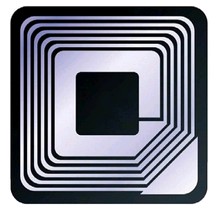
RFID (Radio Frequency Identification) tags, with 512 bits, can identify each particle in the known universe.
12. 400 bits
15 rows x 27 cols = 405 bits
So, to enumerate every bit combination for 400 bits would require that each small particle in 1,000,000,000 (1 billion) universes represent a computer that goes through 1,000,000,000 (1 billion) bit combinations a second for 40,000,000,000,000 (40 trillion years) without ever trying the same bit combination more than once.
13. Probability
Note: If you turned every one of 1080 small particles in the known universe into super-computers, and ran them each trying 1,000,000,000 (1 billion) combinations of zeros and ones for 15,000,000,000 years (15 billion years), and never tried the same bit combination twice, the probability that you could match the above bit pattern is one in the following.
1,000,000,000,000,000,000,000,000,000,000,000
This is 1033. Obviously, obtaining even a small pattern requiring exact matching by random chance is not possible.
Note: The above bit pattern would represent about 85 characters (6 bits per character) or about one line of text.
14. Boltzmann brains
A Boltzmann brain is named after Ludwig Boltzmann, whose ideas were being ridiculed. The counter-argument to Boltzmann's claims were as a thought experiment of statistical physics whereby, by random chance, a complete human brain with memories, etc., would arise from random statistical fluctuations with a higher probability than other events (e.g., the universe as we know it from the "big bang").
Let us return to "yes" and "no" answers.
15. Entropy of yes no answers
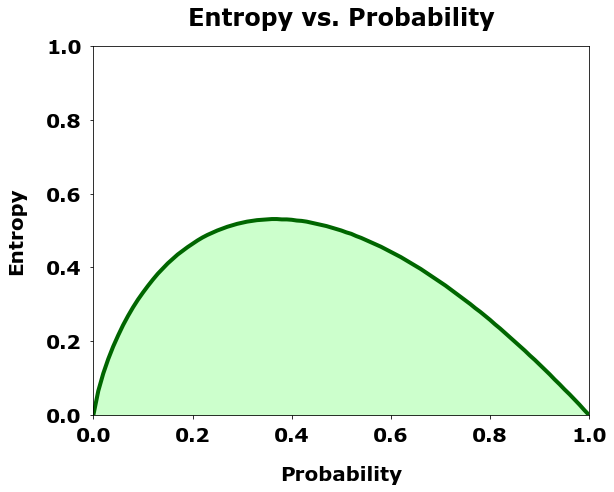
The entropy of giving a definitive "yes" or "no" answer to a given question can be plotted for the probability of the result of a choice.
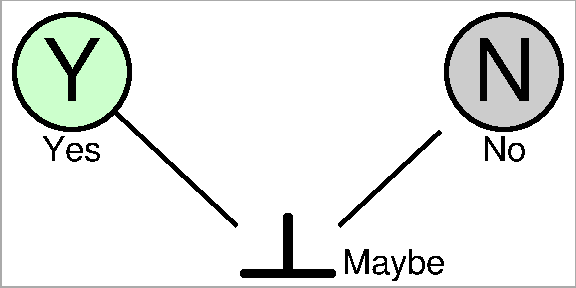
"yes" is a definitive answer.
"no" is a definitive answer.
"maybe" is the "bottom" or "⊥" or "?" (missing) value that may have a probability associated with it.
Note that when the probability is 0.5, as in a flip of a fair coin, the entropy is 0.5.
The relevant questions to ask any supporter of evolution are the following.
Does information exist?
Where did information originate?
Note that information here means "coded information" as in a formal computer or natural written language. The field of quantum information sidesteps the issue by claiming that everything is information. For such claims, one must specify "coded information".
17. Flip of a fair coin
Related fields:
Statistics Informatics ComputerScience
What is the (approximate) probability that the flip of a fair coin results in heads?
If you say it is one half, then that is the probability to you. I can see the coin and to me it is either zero or one - I know the result.
The field of statistics has a deep connection to computer/information science though it may not be immediately obvious.
Saying: "statistics means nothing to a rock". Unlike data (every particle in the universe), codedinformation requires an intelligent "point of view".
The entire field of statistics is the concept of known and unknown information by an observer and determining a "best guess" at what the state of the actual information of interest.
The term "data" is used to refer to "everything" and "information" to refer to "data" that has "meaning" or "value" to an "intelligent" entity.
19. Arguments
Note that arguments involving science, physics, chemistry, geology, etc., can be very difficult to precisely quantify such that an average person can understand the issues.
However, arguments involving high school mathematics involving powers of two make it possible for the average person to understand the essential arguments about creation and evolution.
Numbers can be represented and processed using base 2 - powers of two.
Since 1000 = 103, every power of 3 in base 10 is "about" a power of 10 in base 2. Thus, 1,000,000 = 106 is "about" a power of 6/3*10 = 20 in base 2. That is, 103 is about 220.
21. Bit comparisons
Bits
needed to represent this value.
1
2 (one coin flip)
2
4 (two coin flips)
3
8 (three coin flips)
4
16 (four coin flips)
10
1,024 (ten coin flips, KB)
20
≈1,000,000 (MB, 20 questions)
30
≈1,000,000,000 (GB, billion)
40
≈1,000,000,000,000 (TB, trillion)
Game of 20 questions.
220 = 1,000,000
Not possible:
brute force enumeration
guessing long passwords
testing programs for correctness
information arising by chance
One goal of computer science: Convert 1,000,000 to 20.
Goal: Given random amino acids everywhere, pick out all right-handed or left-handed at random to build a protein. This can be analyzed as a classical statistics coin flipping model.
22. Bit progression
Bits
needed to represent this value.
12,000,000
Information in simplest self-replicating cell self-organizing (nucleotide level)
6,000,000,000
Information in human DNA (nucleotide level)
58
Microseconds in 8,000 years
270
Every small particle in the known universe
328
For each do million times a second for 8,000 years
348
Do for every particle for 8 billion years
358
Do for every particle for 8 trillion years
628
Make every particle a universe for 8 trillion years
In the beginning, God created the heavens and the earth. (336 bits)
IN THE BEGINNING, GOD CREATED THE HEAVENS AND THE EARTH. (280 bits)
(56 letters/spaces, 5 or 6 bits per letter/space)
How can one get from 628 bits to 12,000,000 bits (nucleotide level) or 100,000,000,000,000 bits (atomic level)?
23. Self-organizing self-replicating cell
The 100,000,000,000,000 bits for a self-replicating cell self-organizing assumes that all of the needed "molecules" (e.g., amino acids) exist and have no trouble combining and that only the information needs to be organized.
Software complexity: 12,000,000 bits of DNA information.
Hardware complexity: 12,000,000 bits minimum in the molecular machines that must "match" the software DNA information.
Since the two are independent, the bit probabilities are multiplied together to get 12,000,000*12,000,000 = 144,000,000,000,000.
For simplicity in the above table, the nucleotide bit level and the atom bit level probability of 100,000,000,000,000 is used.
24. Exponential arithmetic
If the reasoning seems strange, you need to get used to exponential arithmetic.
Of course, if you want to argue that there is always a chance, no matter how small, then the following assumptions need to be quantified.
The atoms and atomic laws formed out of nothing.
The amino acids to make the information self-organized (they don't).
Every site in the universe is suitable for formation of life (not true).
The amino acids can be easily combined together (they can't).
Only information needs to be matched, not molecular machines representing the information.
The entire cell infrastructure (other than information) is ignored (it can't be ignored).
The cell will continue to live and replicate (it won't everywhere in the universe, as assumed above).
All other living organisms will develop from this one self-replicating cell (that adds trillions of more bits of required probability).
The universe is suitable for habitation in a large number of places.
26. Long passwords
Long passwords, as "coded information", cannot be broken by brute force (random or systematic guessing) with probability approaching 1.0 (certainty).
This problem is isomorphic to proofs that information cannot arise by chance since there is not enough time or space in the known universe for this to happen.
Details are left as a future topic.
27. Science and mathematics
As Stephen Hawking has stated in justifying the acceptance of some of his own work, moving a problem from the science domain to the mathematics domain (in his case, work involving black holes), makes the work and conclusions hard to refute. In the same manner, a creation debate moved to the realm of classical statistics (e.g., coin flipping) makes the work and conclusions hard to refute. This talk/session will review some secular and non-secular work in information theory and then provide some simple rules of thumb for making and explaining the case that, for coded information, there is not enough time nor space for any plausible evolution argument.
28. Some creative bits about coded information
Here is a summary of the two-step (coded) information argument.
1. Coded information exists (DNA, book, etc.).
2. Coded information cannot arise by chance. (with probability quickly approaching 1.0)
Any theory of evolution must account for coded information arising by chance.
The only alternative appears to be that of a creator God outside of time and space. Ways have been proposed to get the needed infinity.
Monkeys typing (begs the question in that it assumes the result).
Oscillating universe.
Many worlds.
Note that the only alternative for those not wanting a creator is to assume coded information can arise by chance. This contradicts both logic and observed reality and requires a lot of "faith". To read about that "faith", check out the Wikipedia page on "Junkyard tornado".
Genesis 1:1In the beginningGodcreated the heaven and the earth. [kjv]
בראשיתבראאלהים … השמים … הארץ [he]
εν αρχηεποιησεν ο θεος τον ουρανον και την γην [lxx]
Both the Bible and current scientific thought (since the end of the 19th century) agree that there is a beginning to time and an end to time as we know it. The two viewpoints disagree on the time scale.
Modern secular view: Due to the 2nd law of thermodynamics, about 1900, it was recognized that there must be a beginning of time and an end of time.
There are (at least) two parts to a more complete identification of truth.
1. There is a creator God (outside of time and space as we know it). This book attempts to address this in a hand-waving and imprecise manner. The information argument is much more brief and precise and simple. The ID (Intelligent Design) movement is limited to this part of the problem.
2. The creator God could send us a message. How do we recognize this message and know that this message is the true message from the creator God? The Bible is the leading candidate for this message, but there are others.
32. A more complete problem of truth
Part 1 requires coded information theory and a simple reality binding to DNA, amino acids, or something similar.
Part 2 requires linguistic study, valid logical analysis, etc., and is much more involved and difficult.
Through chapter 3 (as of 2025-03-24), part 2 has not been mentioned nor addressed.
A "revelation", such is the Book of Revelation, is a "revealing" of something, usually some form of "truth". The Bible is known as a "special revelation".
The idea of "general revelation" is that truths can be revealed by God's creation. This idea sounds interesting and innocent. However, the same ideas can be twisted and used by false teachers to allow ideas in science, psychology, etc., to supersede or take precedence over what the Bible says. Here is one deception process.
Define and justify "special revelation".
Define and justify "general revelation". This then supports the idea of the "creator".
Do an equivocation (semantic slide) and bring what is called "general revelation" and have it supersede "special revelation".
34. Progressive revelation: revealing progress over time
The idea of "progressive revelation", in Biblical terms, is that as time progresses (goes forward) , God has revealed his plan and goal. Some type of value has been added.
A fundamental question in any revealing is whether that revealing of information is completely new or just new to the person obtaining that information.
Another question is how a false teacher could use the ideas of "progressive revelation" to deceive others.

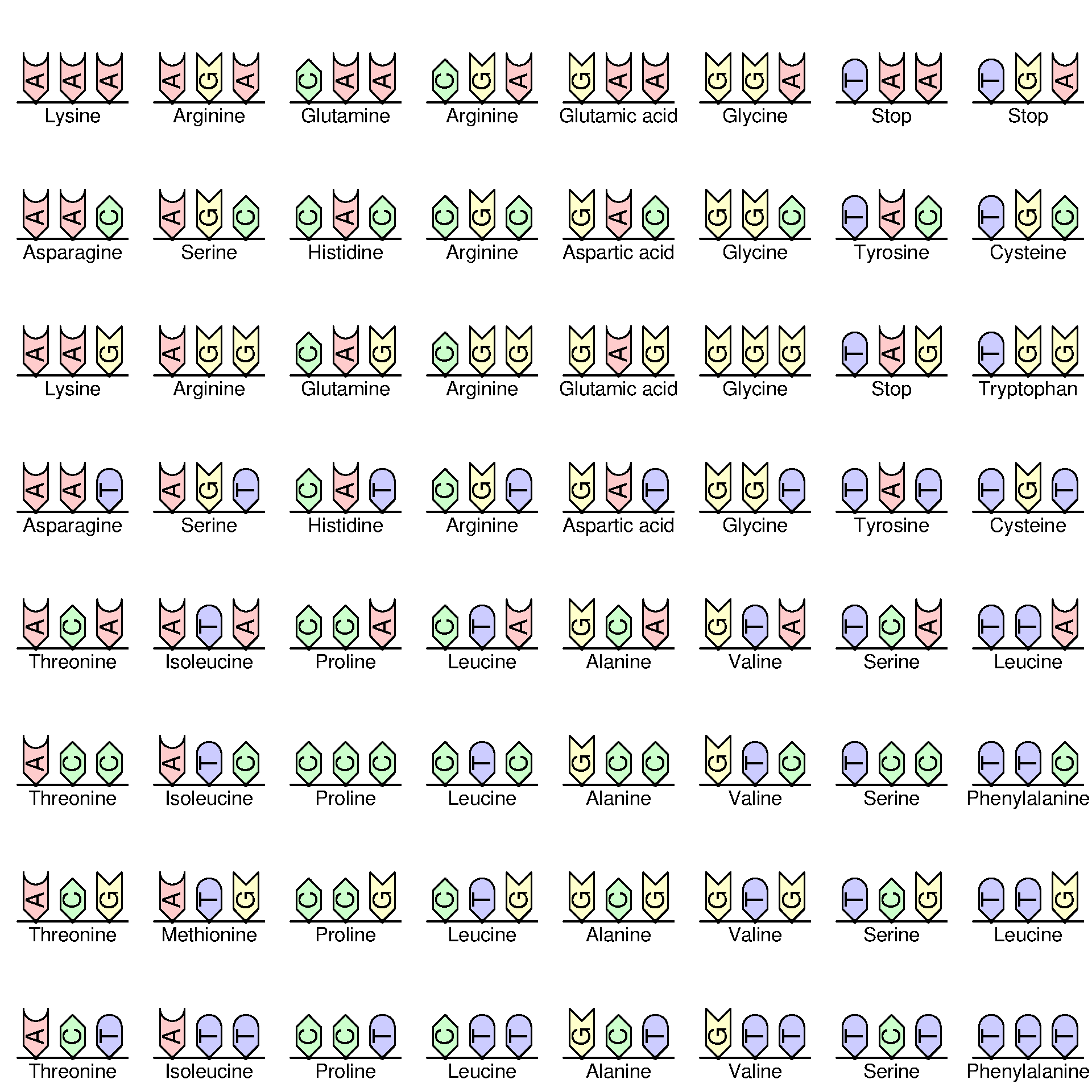 The idea of "information" can transcend time and space and matter. Quantum information theory will confuse this idea by defining information as time and space and matter as we know it.

 If you do not believe in a creator God, you believe that everything happens by chance.












 The only alternative appears to be that of a creator God outside of time and space. Ways have been proposed to get the needed infinity.
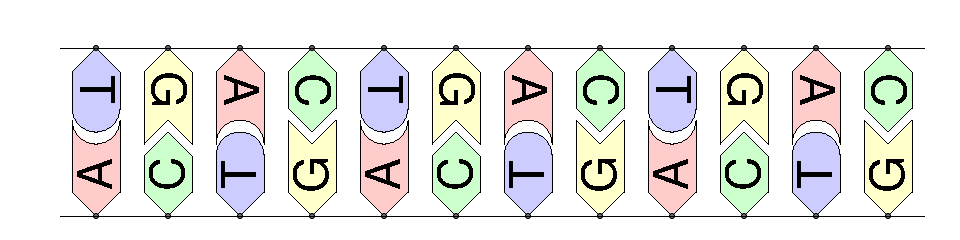 DNA as coded information is created in days 3, 5 and 6.


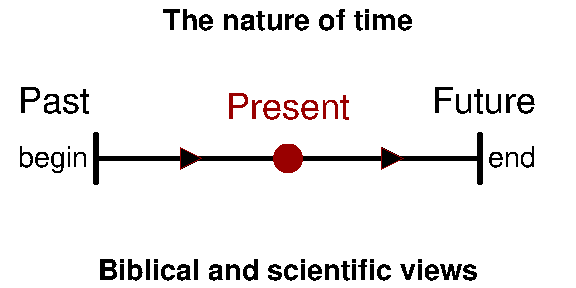 Both the Bible and current scientific thought (since the end of the 19th century) agree that there is a beginning to time and an end to time as we know it. The two viewpoints disagree on the time scale.





 The idea of "progressive revelation", in Biblical terms, is that as time progresses (goes forward) , God has revealed his plan and goal. Some type of value has been added.