Send
Close Add comments:
(status displays here)
Got it! This site "creationpie.org" uses cookies. You consent to this by clicking on "Got it!" or by continuing to use this website. Note: This appears on each machine/browser from which this site is accessed.
Aristotle
1. Aristotle
Aristotle (Greek scientist and philosopher) was the personal tutor of Alexander the Great and wrote many important works in science and philosophy.
Physics
Metaphysics (the book "after" physics)
Sophistic Refutations (identifying and refuting bad logic)
... and many others ...
2. Half done
Well begun is half done. Aristotle (Greek scientist and philosopher)
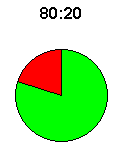
A software engineering principle, based on the 80-20 rule, is that 80% of the functionality (of a software program) can be achieved with 20% of the (overall) effort. The remaining 20% of the functionality takes 80% of the (overall) effort.
3. Dimensions
Aristotle (Greek scientist and philosopher) in his works called Metaphysics dealt with the ideas of abstract dimensions of mathematics and the apparent dimensions of reality.
4. Tutor of Alexander the Great
Aristotle (Greek scientist and philosopher) was the personal tutor of Alexander the Great who command an army of over 10,000 soldiers traveling over 10,000 miles in 15 years (mostly on foot), never losing a battle, and conquering the known world at the time.
5. Aristotle
In the 4th Century BC, Aristotle, personal tutor of Alexander the Great, wrote many important books, including a book on physics or "
nature" (i.e., reality).
The modern Greek word
"φύση" (FEE-see) ≈ "nature". The modern Greek word
"φυσική" (fee-see-KEE) ≈ "physics" which is the study of the reality of time and space as we know it.
6. Metaphysics
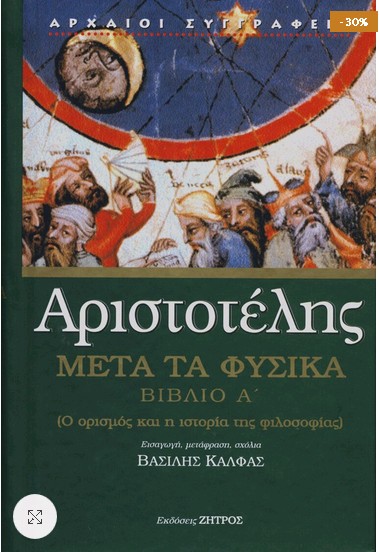
Many years later, in cataloging his works, a collection of works that were hard to categorize were bound together and put after the Aristotle's book on "
physics".
This collection of works become known as «
τα μετά τα φυσικά», or, literally, "
the (book) after the physics" where "
physics" had to do, in part, with observed reality, mathematical abstraction, and the correspondence between them.
7. Book
In the "
after the physics" book, Aristotle addressed causation, mathematics, a divine creator(s), etc. The word "
metaphysics" became known as heavenly or out-of-world ideas (religious, etc.).
A recurring theme in Aristotle's work on "
metaphysics" was that of separating logical reality from physical reality.
8. Book
A useful $13 book (Spring 2021), no commentary, just the text, is
Aristotle's Metaphysics in English Latin and Ancient Greek from Hermes Language Reference. ISBN-13 : 978-1973405368.
9. Teaching method
The Apostle Paul, and many others, have often used a teaching method demonstrated and used by
Aristotle (Greek scientist and philosopher) , personal tutor of Alexander the Great, some 400 years earlier and still used today.
Tell them what you are going to say.
Say it.
Tell you what you told them.
Aristotle does not appear to have defined this method. He just used it a lot and others copied him.
10. Eristic reasoning
The word "eristic", as in a reasoning process, goes back to Aristotle and is discussed in his works Prior analytics and Sophistical refutations (and referenced from his other works).
Aristotle did not like the idea of "sophists" using bad logic to make money from people by convincing them of things that were not true. These things were often the things that these people wanted to hear. This is similar to a false prophet in the Bible, a false teacher throughout history. etc.
11. Logic: syllogisms
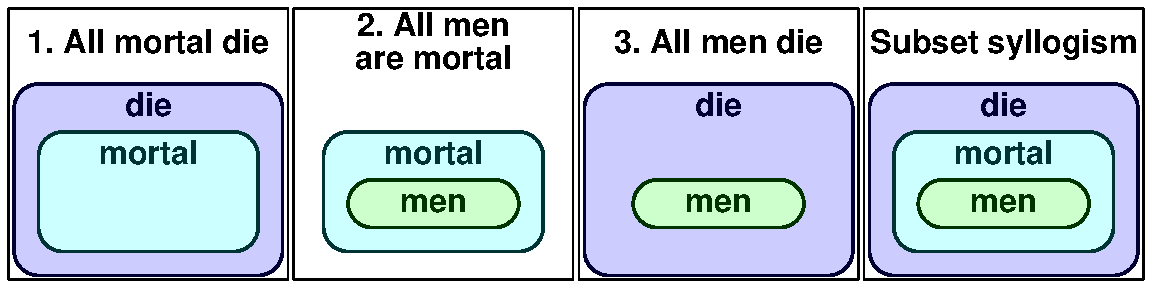
Logical reasoning in Greek
philosophy often took the form of a
syllogism that uses deductive reasoning to arrive at a conclusion.
Some people think syllogisms are "
silly" and will use the pun "
sillygism" to refer to a "
syllogism".
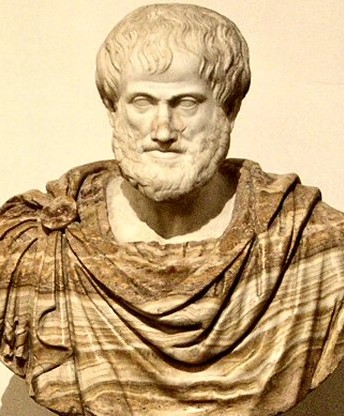
12. Aristotle: wisdom
Knowing yourself is the beginning of all wisdom. Aristotle (Greek scientist and philosopher)
This is a
self-referential or
reflexive statement.
13. Mental tolerance
It is the mark of an educated mind to be able to entertain a thought without accepting it. Aristotle (Greek scientist and philosopher)
14. Education
Educating the mind without educating the heart is no education at all. Aristotle (Greek scientist and philosopher)
15. Patience
Patience is bitter, but its fruit is sweet. Aristotle (Greek scientist and philosopher)
16. Educated
The educated differ from the uneducated as much as the living differ from the dead. Aristotle (Greek scientist and philosopher)
17. War and peace
It is not enough to win a war; it is more important to organize the peace. Aristotle (Greek scientist and philosopher)
18. Truth
The high-minded man must care more for the truth than for what people think. Aristotle (Greek scientist and philosopher)
19. Friends
A friend to all is a friend to none. Aristotle (Greek scientist and philosopher)
20. Poverty
Poverty is the parent of revolution and crime. Aristotle (Greek scientist and philosopher)
21. Equality
The worst form of inequality is to try to make unequal things equal. Aristotle (Greek scientist and philosopher)
22. Teaching
Those that know, do. Those that understand, teach. Aristotle (Greek scientist and philosopher)
A typical modern progression in teaching is the following, partly tongue-in-cheek but with some basis in reality.
Those that cannot do, teach.
Those that cannot teach, administrate.
23. Humor
The secret to humor is surprise. Aristotle (Greek scientist and philosopher)
24. Art
The aim of art is to represent not the outward appearance of things, but their inward significance. Aristotle (Greek scientist and philosopher)
25. Meaning and interpretation
26. Sophistic refutations
Aristotle wrote a book called
On Sophistic Refutations in which he detailed the "
false reasoning" used by Sophists (from the Greek word for "
wisdom") who would use invalid logic to convince others of ideas to make money for themselves. In English, "
sophistic" logic or "
false reasoning" is "
sophistry".
One of the many types of invalid logic detailed by Aristotle was "
eristic" reasoning. Paul uses that word often but it is often translated, without the "
bad logic" connection, as "
strife"
27. Colossians 2: False reasoning
The ancient Greek word
"παραλογίζομαι" ≈ "reason falsely" is used often by Aristotle in his work
On sophistic refutations. Paul uses this word in Colossians - a book that uses many Aristotelian words. Apparently "
false reasoning" in "
teaching" was a problem at the church at Colossae.
Colossians 2:4 And this I say, lest any man should beguile you with enticing words. [kjv]
τουτο δε λεγω ινα μη τις μηδεις υμας παραλογιζηται εν πιθανολογια [gnt]
The Latin for "
enticing words" is "
subtle sermons".
One meaning:
Beware lest anyone use false reasoning on you with subtle sermons.
28. The actual potency and inner workings of energy
Galatians 3:5 He therefore that ministereth to you the Spirit, and worketh miracles among you, doeth he it by the works of the law, or by the hearing of faith? [kjv]
ο ουν επιχορηγων υμιν το πνευμα και ενεργων δυναμεις εν υμιν εξ εργων νομου η εξ ακοης πιστεως [gnt]
Energy is a word and concept that has ancient roots but had a
different meaning in ancient times. Aristotle first used the ancient Greek word
"ενέργεια" ≈ "actuality" for
"actuality", literally,
"in working".
The ancient Greek word
"δύναμις" ≈ "power, might, strength, potentiality" and is used by Aristotle for something that has
"potential".
KJV (King James Version) : ... worketh miracles among you ...
Paraphrase: ... actualizes the potential in you ...
The root word is
"work" and is used many times in the
LXX (Septuagint) and
GNT (Greek New Testament).
29. Energy of the mind
The energy of the mind is the essence of life. Aristotle (Greek scientist and philosopher)
The quote means "
The actuality/thinking of the mind is the essence/potentiality of life".
Aristotle first coined the ancient Greek word
"ενεργεί" ≈ "actuality" (in his usage) and that means, literally,
"inner work" or
"in working". That is, "
thinking" in contrast to a "
potential".
This might be compared and/or contrasted with "
I think, therefore I am" from Descartes.
30. Error of the converse
In his
Sophistic Refutations, Aristotle presents, at length, the fallacy of the
affirming of the consequent. This fallacy is often used in marketing. Here is an example.
"champions eat Wheaties" does not mean that
"eating Wheaties makes one a champ".
Other names:
converse error (logic, not the shoe company),
confusion of necessity and sufficiency. Proper reversal of the conditional probability requires
Bayes Rule.
31. Show why deceptions was deceptive
Aristotle says that in addition to showing why apparent but false reasoning is false, one should, in addition, show why it appeared to be true.
Recognizing bad reasoning based on what one thinks is true is harder than just turning down the actual "
temptation".
32. Aristotle and coming to be
Aristotle uses the Greek word for "
coming to be" or "
birth" many times in his works. One of Aristotle's works is the ancient Greek word
"Περὶ γενέσεως καὶ φθορᾶς" ≈ "On the coming to be and passing away" (of the universe).
English: ... for coming-to-be and passing-away occur when things come together and are dissolved. Loeb #400, p. 166.
Greek: συνιόντων γὰρ καὶ διαλυομένων ἡ γένεσις συμβαίνει καὶ ἡ φθορά. [314b]
Aristotle uses a Greek word for "
dissolving" that is
not the Greek word translated as "
dissolve" in the
GNT.
Jesus says that he did not come to "dissolve the law" (incorrect translation).
Jesus says that he did not come to "reside in the law" (correct translation). He came to "reside" with sinners such as Zacchaeus (same Greek word).
33. Defining a definition
The ancient Greek word (
rough breathing)
"ὅρος" ≈ "boundary, definition" and is the source of the English word
"horizon".
Aristotle often emphasizes the importance of
"definitions" in identifying bad logic. Of course, Aristotle then defines what he means by a
"definition".
English: A definition is a phrase indicating the essence of something. (Loeb#391, p. 281)
Greek: Ἔστι δ´ ὅρος μὲν λόγος ὁ τὸ τί ἦν εἶναι σημαίνων, [Topica, 101b-102a]
"λόγος" ≈ "rational explanation, word".
"σημαίνω" ≈ "to indicate" and is the source, through French, of the English word "semantics". The noun form is "sign" and is sometimes translated as "miracle".
The aspirated rough breathing comes through in Latin and into English in the sound of the letter "
h". Aristotle used this word for "
definition" many times. This was only used for a while in the first century BC and discontinued but persists in ancient Greek notations to this day.
34. Hermeneutics
35. Aristotle: Top down reasoning
English: It is just as the Pythagoreans say, the whole world and all things in it are summed up in the number three; for end, middle and beginning give the number of the whole, and their number is the triad. (Loeb#338)
Greek: Καθάπερ γάρ φασι καὶ οἱ Πυθαγόρειοι, τὸ πᾶν καὶ τὰ πάντα τοῖς τρισὶν ὥρισται· τελευτὴ γὰρ καὶ μέσον καὶ ἀρχὴ τὸν ἀριθμὸν ἔχει τὸν τοῦ παντός, ταῦτα δὲ τὸν τῆς τριάδος. Aristotle: On the Heavens [268a]
Notice how Aristotle says
"end", "middle" and "beginning" (top-down backward-chaining) rather than
"beginning", "middle" and "end" (bottom-up forward chaining).
Aristotle says the
"everything" while the translation says the
"whole world". Some in modern Greek makes a play on words with
"everything" and a panda (animal) since the words are spelled and pronounced the same.
36. Aristotle: Propositions and prayers
The ancient Greek word
"προσεύχομαι" ≈ "pray, vow, request" as in putting forth a
"request" or
"wish". Aristotle uses the shorter form
"εὐχή" ≈ "prayer,wish".
The modern Greek word
"ευχή" (ev-KHEE) ≈ "religious blessing, wish" and has been influenced by the
GNT.
English: We call propositions those only that have truth or falsity in them. A prayer is, for instance, a sentence but neither has truth nor has falsity. Let us pass over on such as their study more properly belongs to the province of rhetoric or poetry. (Loeb#325, p. 121)
Greek: ἀποφαντικὸς δὲ οὐ πᾶς, ἀλλ' ἐν ᾧ τὸ ἀληθεύειν ἢ ψεύδεσθαι ὑπάρχει· οὐκ ἐν ἅπασι δὲ ὑπάρχει, οἷον ἡ εὐχὴ λόγος μέν, ἀλλ' οὔτ' ἀληθὴς οὔτε ψευδής. οἱ μὲν οὖν ἄλλοι ἀφείσθωσαν, - ῥητορικῆς γὰρ ἢ ποιητικῆς οἰκειοτέρα ἡ σκέψις,… Aristotle: On Interpretation [17a]
Have you ever heard someone
"pray" in a church setting and, in their
"prayer", state
"propositions" that are
"true" or
"false"? This happens when someone states a
"proposition" in a prayer and implicitly assumes and/or implies that what is said is
"true" or
"false" (depending on context).
Discuss: Should a religious
"prayer" state only
"requests" or
"wishes" (and the reality background of them) and avoid
"propositions" that are
"true" or
"false"? Explain your reasoning.
Discuss: Should a pastor inject personal opinions on politics or social issues as claims or statements in a prayer? This is often done to convince those in the pews that God has approved of these views.
37. Matthew 6:9-13 Lord's Prayer
Matthew 6:9 After this manner therefore pray ye: Our Father which art in heaven, Hallowed be thy name. [kjv]
6:10 Thy kingdom come. Thy will be done in earth, as it is in heaven. [kjv]
6:11 Give us this day our daily bread. [kjv]
6:12 And forgive us our debts, as we forgive our debtors. [kjv]
6:13 And lead us not into temptation, but deliver us from evil: For thine is the kingdom, and the power, and the glory, for ever. Amen. [kjv]
The only part of the Lord's Prayer that is
not a "
wish" or "
request" (except the address part at the beginning) is the part that is
not in some Greek manuscripts. The
TR (Textus Receptus) appears to have added this part.
38. Names and things
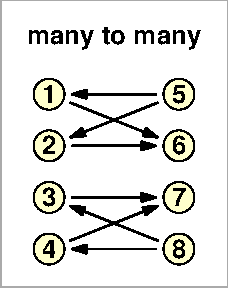
Aristotle points out that we reason with "
names" that represent "
things" and not the "
things" themselves.
More than one name can represent the same thing.
Names can represent more than one thing.
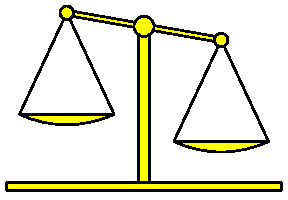
This leaves room for deception using words and "
apparent logic". When you "
drink" a "
cup" you are not literally drinking the cup itself.
The English word
"equivocation" means a deception by means of making names (or things) equal that are not actually equal. This is sometimes called "
doublespeak".
39. Equivocation
Example:
All men are created equal. Women are not men, so all women are not created equal.
Sometimes equivocation is used to "
obfuscate" by using another word.
 |
Details are left as a future topic.
|
40. Nature and law and justice
In his
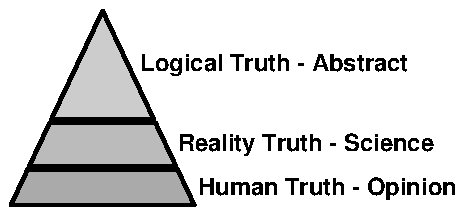
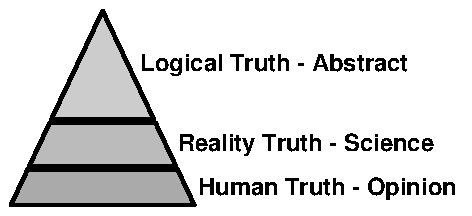
On Sophistic Refutations, Aristotle says that from ancient times, nature (truth) and law (opinion) are opposites and that justice goes with the law (opinion) but not with nature (truth).
English: Nature and Law are opposites, and justice is a good thing according to the law but not according to nature. Loeb #400, p. 73.
Greek: ἐναντία γὰρ εἶναι φύσιν καὶ νόμον, καὶ τὴν δικαιοσύνην κατὰ νόμον μὲν εἶναι καλόν, κατὰ φύσιν δ´ οὐ καλόν Sophistic Refutations [173b]
"φύση" ≈ "nature, reality" (reality truth) as in "physics".
"νόμος" ≈ "custom, law" (opinion truth) as in "Deuteronomy" as in "second law". The Greek for "iniquity" is "against the law".
"δικαιοσύνη" ≈ "righteousness, justice".
Whenever Jesus, Paul, etc., use the word for
"righteousness" one must determine from context what is meant. There may be double meanings.
☐ God's
"righteousness" (opinion, glory, etc.).
☐ man's
"righteousness" (opinion, glory, etc.).
41. Truth and opinion
42. Aristotle: Sophistic Refutations
English: Again, Is what the learner learns that which he learns? A man learns a slow march quick; it is not then what he learns that is meant but how he learns it. Again, Does a man trample on that through which he walks? But he walks through the whole day. Was not what was meant not what he walks through but when he walks? Just as when we talk of a man drinking a cup, we refer not to what he drinks but to that out of which he drinks. (Loeb#100, p. 115-117)
Greek: Καὶ "Ἆρ´ ὃ μανθάνει ὁ μανθάνων, τοῦτ´ ἔστιν ὃ μανθάνει; μανθάνει δέ τις τὸ βραδὺ ταχύ. " Οὐ τοίνυν ὃ μανθάνει ἀλλ´ ὡς μανθάνει εἴρηκεν. Καὶ "Ἆρ´ ὃ βαδίζει τις πατεῖ; βαδίζει δὲ τὴν ἡμέραν ὅλην. " Ἢ οὐχ ὃ βαδίζει ἀλλ´ ὅτε βαδίζει εἴρηκεν, οὐδὲ τὸ τὴν κύλικα πίνειν ὃ πίνει ἀλλ´ ἐξ οὗ. Aristotle: Sophistic Refutations [189a]
I had a funny hot coffee cup joke but I was told to put a lid on it.
43. Diminutive: cup
44. Aristotle: Physics
In his work on
Physics, Aristotle is refuting a claim by
Anaxagoras.
English: Besides, since the subtraction of anything from a given body must reduce the size of that body, and since a mass of flesh cannot be indefinitely great or small, it is clear that from the minimum of flesh no other body can be extracted, for that would reduce it below its minimum. (Loeb #228, p. 47)
Greek: πρὸς δὲ τούτοις, εἰ ἅπαν μὲν σῶμα ἀφαιρεθέντος τινὸς ἔλαττον ἀνάγκη γίγνεσθαι, τῆς δὲ σαρκὸς ὥρισται τὸ ποσὸν καὶ μεγέθει καὶ μικρότητι, φανερὸν ὅτι ἐκ τῆς ἐλαχίστης σαρκὸς οὐθὲν ἐκκριθήσεται σῶμα· ἔσται γὰρ ἐλάττων τῆς ἐλαχίστης. [188a]
"ἐλάχιστος" ≈ "fewest, least, smallest". The usage of this word appears to be more abstract (according to some criteria) than concrete.
"μικρότερος" ≈ "smallest" and is the source of the English prefix "micro". The usage of this word appears to be more concrete than abstract.
"μεγας" ≈ "great" and is the source of the English prefix "mega".
"ανάγκη" ≈ "necessity, constraint, compulsion, force" and is used by Amos, Jesus, Barnabas, etc., as the word "compulsion" in "yoke" of "compulsion".
45. Matthew 5:14 Hill climbing potential
Matthew 5:14 Ye are the light of the world. A city that is set on an hill cannot be hid. [kjv]
υμεις εστε το φως του κοσμου ου δυναται πολις κρυβηναι επανω ορους κειμενη [gnt]
In Greek philosophy (e.g., Aristotle), the word in the
GNT often translated as "
energy" or "
work" is that of
"actuality". In the same manner, the word often translated as "
power" is that of
"potentiality". In modern
OOP (Object Oriented Programming) programming terms:
"potentially" relates to the idea of a class (abstract idea) [Plato's original sense]
"actuality" relates to the idea of an object (concrete reality) [Aristotle's added sense]
This is especially true for the writings of Paul since he was writing to a Greek audience who would have understood those parts of Greek philosophy.
46. Things
Aristotle talks about the difference between "
things" such as "
counters" and the "
words" used to talk about those "
things".
 |
Details are left as a future topic.
|
There is a difference between a thing and talking about a thing. Kurt Gödel (Austrian logician, mathematician, philosopher)
47. Aristotle: Early decisions
The idea that early decisions are more important than later decisions predates Aristotle.
English: It is perhaps a true proverb which says that the beginning of anything is the most important. (Loeb#100, p. 153)
Greek: μέγιστον γὰρ ἴσως ἀρχὴ παντός, ὥσπερ λέγεται. Aristotle: Sophistic Refutations [184a]
That is, if a bad decision is made early, any later decisions depend on that bad decision.
The translator appears to reverse the order of the thoughts expressed by Aristotle. That is, Aristotle is using a top-down, backward-chaining, approach but the translator has changed it to a bottom-up, forward-chaining, approach. The English word "
proverb" is added. Aristotle just says that some say this.
[correctness vs. speed]
48. Aristotle: Posterior Analytics
English: Quickness of wit is a sort of flair for hitting upon the middle term without a moment's hesitation. A man sees that the moon always has its bright side facing the sun, and immediately realizes the reason: that it is because the moon derives its brightness from the sun; or he sees someone talking to a rich man, and decides that it is because he is trying to borrow money; or he understands why people are friends, because they have a common enemy. (Loeb#391, p. 171)
Greek: Ἡ δ' ἀγχίνοιά ἐστιν εὐστοχία τις ἐν ἀσκέπτῳ χρόνῳ τοῦ μέσου, οἷον εἴ τις ἰδὼν ὅτι ἡ σελήνη τὸ λαμπρὸν ἀεὶ ἔχει πρὸς τὸν ἥλιον, ταχὺ ἐνενόησε διὰ τί τοῦτο, ὅτι διὰ τὸ λάμπειν ἀπὸ τοῦ ἡλίου· ἢ διαλεγόμενον πλουσίῳ ἔγνω διότι δανείζεται· ἢ διότι φίλοι, ὅτι ἐχθροὶ τοῦ αὐτοῦ. Aristotle: Posterior Analytics [89b]
[Churchill]
49. Aristotle: Posterior Analytics
English: In all these cases, perception of the extreme terms enables him to recognize the cause or middle term. A stands for "bright side facing the sun", and C for "moon". Then B, "deriving brightness from the sun", applies to C, "moon" and "A", "having the bright side facing the source of its brightness", applies to B. Thus A applies to C through B. (Loeb#391, p.172)
Greek: πάντα γὰρ τὰ αἴτια τὰ μέσα [ὁ] ἰδὼν τὰ ἄκρα ἐγνώρισεν. τὸ λαμπρὸν εἶναι τὸ πρὸς τὸν ἥλιον ἐφ' οὗ Α, τὸ λάμπειν ἀπὸ τοῦ ἡλίου Β, σελήνη τὸ Γ. ὑπάρχει δὴ τῇ μὲν σελήνῃ τῷ Γ τὸ Β, τὸ λάμπειν ἀπὸ τοῦ ἡλίου· τῷ δὲ Β τὸ Α, τὸ πρὸς τοῦτ' εἶναι τὸ λαμπρόν, ἀφ' οὗ λάμπει· ὥστε καὶ τῷ Γ τὸ Α διὰ τοῦ Β. Aristotle: Posterior Analytics [89b]
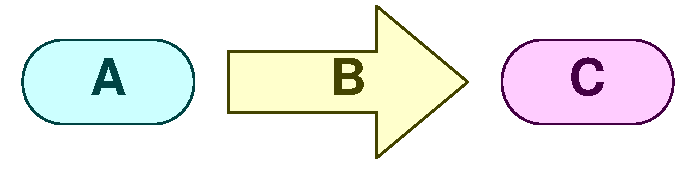 |
"A", "B", "C" sequence.
Middle term is "B".
|
 |
"Ask", "seek", "knock" sequence.
Middle term is "seek".
|
50. Aristotle: Metaphysics
Reality, as in physics, is subject to probabilities and errors in measurement, etc.
Logic is not subject to such errors but is subject to undecidability, etc., as in giving up completeness to get consistency (for predicate logic).
English: ... physics also is a kind of wisdom, but it is not the first kind. (Hermes Language Reference, p. 121)
Greek: … ἔστι δὲ σοφία τις καὶ ἡ φυσική, ἀλλ' οὐ πρώτη. Aristotle: Μεταφυσικά/βιβλίο α 6:1 [1005b]
To relate science (reality) and logic (via coded information interpretation):
Science cannot prove that God exists but neither can science disproved that God does not exist.
To go outside the system, one can use a coded information argument (coded information exists, coded information cannot arise by chance).
51. Aristotle: Circular reasoning
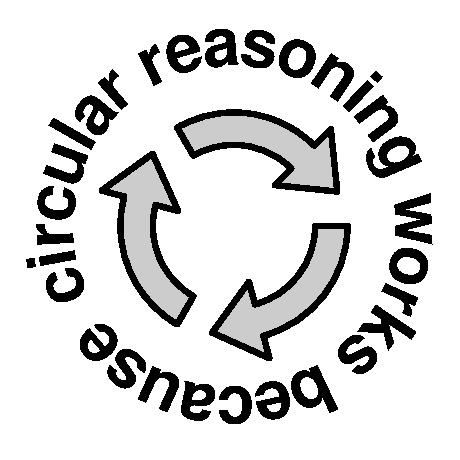
English: Circular or reciprocal proof consists in using the conclusion and the simple conversion of one premise to demonstrate the remaining premises, which was assumed in the original syllogism. (Loeb#325, p. 437)
Greek: Τὸ δὲ κύκλῳ καὶ ἐξ ἀλλήλων δείκνυσθαί ἐστι τὸ διὰ τοῦ συμπεράσματος καὶ τοῦ ἀνάπαλιν τῇ κατηγορίᾳ τὴν ἑτέραν λαβόντα πρότασιν συμπεράνασθαι τὴν λοιπήν, ἣν ἐλάμβανεν ἐν θατέρῳ συλλογισμῷ. Aristotle: Prior Analytics [57b]
In the 1960's the speed of light was redefined to be based on certain atomic measurements. These measurements are themselves based on the speed of light.
Recursive: referring to itself. See recursive.
So, using
circular reasoning, the speed of light is defined in terms of the speed of light such that it never changes. This is like using a "
rubber ruler" that can adapt to whatever it is that one is measuring.
52. Aristotle: Begging the question
English: Begging or assuming the point at issue consists (to take the expression in its widest sense) in failing to demonstrate the required proposition. (Loeb#325,485)
Greek: Τὸ δ' ἐν ἀρχῇ αἰτεῖσθαι καὶ λαμβάνειν ἐστὶ μέν, ὡς ἐν γένει λαβεῖν, ἐν τῷ μὴ ἀποδεικνύναι τὸ προκείμενον, … Aristotle: Prior Analytics [64b]
The Latin word
"petitio principii" ≈ "an assumption from the beginning" comes from the ancient Greek word
"ἐν ἀρχῇ αἰτεῖσθαι" ≈ "in the beginning take as an assumption".
This is called
"begging the question" from an inaccurate translation of
"assuming the initial point" and then a change in meaning of "
beg" as in "
raise a question". In modern English, the meaning of
"begging the question" has
changed to that of "
avoid the question" or "
evade the issue".
53. John 1:1-5 Four causes in a design and implementation model

The ancient Greek word
"αἰτία" ≈ "cause, reason". Aristotle often used this word as
"explanation". Each
"cause" is a "
why" question. These are briefly summarized here using the Aristotle's example of a "
table". The more formal Latin and the less formal English words describing the Greek words are provided.
| αίτια |
cause |
Latin |
Informal |
table |
cooking |
computer |
| ὕλη |
matter |
material |
substance |
wood |
ingredients |
data |
| εἶδος |
form |
formal |
pattern |
design |
recipe |
code |
| κινοῦν |
movement |
efficient |
agent |
carpentry |
making |
run |
| τέλος |
end |
final |
purpose |
dining |
eating |
result |
Paul appears to use the four causes in writing to the Philippians. John appears to think in a top-down backward-chaining manner (much as a modern computer scientist). A top-down view of the four causes appears to fit John 1:1-5.
54. Aristotle: Sophistic Refutations
English: To take a single point of comparison, it is the task of the man who has knowledge of a particular subject himself to refrain from fallacious arguments about the subjects of his knowledge and to be able to expose him who uses them. (Loeb#100, p. 15)
Greek: Ἔστι δ´ ὡς ἓν πρὸς ἓν εἰπεῖν ἔργον περὶ ἕκαστον τοῦ εἰδότος ἀψευδεῖν μὲν αὐτὸν περὶ ὧν οἶδε, τὸν δὲ ψευδόμενον ἐμφανίζειν δύνασθαι. Aristotle: Sophistic Refutations [165a]
The ancient Greek word
"ψευδής" ≈ "lying, false, untrue".
The ancient Greek word
"ἀψευδής" ≈ "without falsehood, truthful". Aristotle uses this word as one who refrains from arguments that are
not entirely true. That is, do not speak falsely.
55. Opposite
The ancient Greek word
"ἀντίκειμαι" ≈ "opposite, contrast" and comes from two parts meaning, literally "
in place of" and "
placed" or "
situated". The context determines if the meaning is that of "
opposite" (two choices) or that of just a "
contrast" (more than two choices).
The modern Greek word
"αντικείμενο" (an-tee-KEE-meh-no) ≈ "object, subject" as in a physical object, a grammar object, a computing object, etc., that is used "
in place" of the actual object. The prefix
"ἀντῐ" ≈ "in place of" as in instead of. When there are two choices, the other choice is the one
"opposite" or "
against".
The word
"κεῖμαι" ≈ "lie, placed" as in laying down or something placed somewhere such as a baby lying in a manger. Would such a baby tell the truth? Or would the baby lie (like a rug)?
56. Aristotle: opposites

Aristotle in his writings on logic and reasoning and refuting bad reasoning will often use this Greek word in the sense of "
opposite".
English:
To sum up, in dealing with arguments which turn on language the solution will always depend on the opposite of that on which the argument turns. Loeb Classical Library, Vol. 400, p. 117.
Greek:
Ὅλως δ´ ἐν τοῖς παρὰ τὴν λέξιν λόγοις ἀεὶ κατὰ τὸ ἀντικείμενον ἔσται ἡ λύσις ἢ παρ´ ὅ ἐστιν ὁ λόγος. Sophistic Refutations 23.1.
Consider the phrase
"in opposition" that may mean
"opposite" or it may have the additional idea of
"adversarial".
The ancient Greek word
"ἀντίκειμαι" ≈ "opposite, contrast" and comes from two parts meaning, literally "
in place of" and "
placed" or "
situated". The context determines if the meaning is that of "
opposite" (two choices) or that of just a "
contrast" (more than two choices).
57. Aristotle: Topica
English: For, as the species is predicated, so also is the genus, as, for example, in the case of the double and its higher genera; for both the double and the multiple are predicated of something. Similarly, too, in the case of knowledge; (Loeb#391, p. 451,453)
Greek: Ὡς γὰρ τὸ εἶδος, καὶ τὸ γένος, καθάπερ ἐπὶ τοῦ διπλασίου καὶ τῶν ἐπάνω· τινὸς γὰρ καὶ τὸ διπλάσιον καὶ τὸ πολλαπλάσιον. Ὁμοίως δὲ καὶ ἐπὶ τῆς ἐπιστήμης· Aristotle: Topica [125a]
As Aristotle points out, the
"double" and the
"multiple" must be of
something. You can
"double" the value of
x, but one needs to know what is
x.
The
ancient Greek word
"ἐπιστήμη" ≈ "understanding (of a skill), knowledge" and is the source of the English word
"epistemology" as the
"theory of knowledge".
58. Aristotle: Categories
Matthew 5:45 That ye may be the children of your Father which is in heaven: for he maketh his sun to rise on the evil and on the good, and sendeth rain on the just and on the unjust. [kjv]
οπως γενησθε υιοι του πατρος υμων του εν ουρανοις οτι τον ηλιον αυτου ανατελλει επι πονηρους και αγαθους και βρεχει επι δικαιους και αδικους [gnt]
There are different Greek words for what as translated as
"evil".
Jesus uses the Greek word for "oppression" for "evil". Is "oppression" an opposite of "good"?
Aristotle uses the Greek word for "bad" for "evil". Jesus uses this word for the "harmed".
English: The contrary of good must be evil, and this can be proved by induction. (Loeb#325, p. 97)
Greek: Ἐναντίον δέ ἐστιν ἀγαθῷ μὲν ἐξ ἀνάγκης κακόν, τοῦτο δὲ δῆλον τῇ καθ' ἕκαστον ἐπαγωγῇ, … Aristotle: Categories [14a]
59. Meta and after
The ancient Greek word
"μετά" ≈ "after" has the primary idea of being
"after" something. The modern Greek word
"μετά" (meh-TA) ≈ "after".
Metaphysics is named because of the way the writings of Aristotle were organized. The writings that were hard to categorize and were placed together
"after" the writings on "
physics" and became known as "
metaphysics" or the writings
"after" the "
physics".
The ancient Greek word
"μεταβολή" ≈ "change, transition" is defined as a transition from what was
before to what is
after.
60. Aristotle: Transitional change
English: Well then, since every transition is from something to something else (for the very word transition implies a going across from where you were before to where you are afterwards) there seem to be four ways to of transit, as follows. (Loeb#255, p. 14)
Greek: ἐπεὶ δὲ πᾶσα μεταβολή ἐστιν ἔκ τινος εἴς τι (δηλοῖ δὲ καὶ τοὔνομα μετ' ἄλλο γάρ τι καὶ τὸ μὲν πρότερον δηλοῖ, τὸ δ' ὕστερον), μεταβάλλοι ἂν τὸ μεταβάλλον τετραχῶς Aristotle: Physics 5 [225a]
To make the idea clear, Aristotle does not use
"meta" to define itself. Rather, he uses another Greek word that also means
"after".
"μετά" ≈ "after".
"ὔστερος" ≈ "after, later".
"πρότερος" ≈ "before, earlier".
Matthew 4:2 And when he had fasted forty days and forty nights, he was afterward an hungred. [kjv]
και νηστευσας ημερας τεσσαρακοντα τεσσερακοντα και νυκτας τεσσαρακοντα τεσσερακοντα υστερον επεινασεν [gnt]
61. Acts 20:29 Grievous wolves
Acts 20:29 For I know this, that after my departing shall grievous wolves enter in among you, not sparing the flock. [kjv]
εγω γαρ οιδα τουτο οτι εισελευσονται μετα την αφιξιν μου λυκοι βαρεις εις υμας μη φειδομενοι του ποιμνιου [gnt]
… scio … discessionem … lupi graves … parcentes gregi [v]
The ancient Greek
"Λύκειον" ≈ "Lyceum" was a temple in Athens dedicated to
"Ἀπόλλων Λύκειος" ≈ "Apollo the wolf-god". The
Lyceum is known for
Aristotle's Peripatetic school of philosophy founded in 334 BC, although it was used in prior times for philosophical debate.
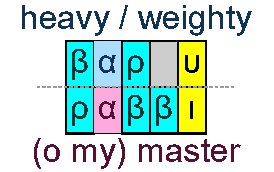
Might these ideas have influenced what Paul warns of in terms of
"heavy" or
"Rabbi" or
"master" types of
teaching influences from Greek philosophy?
62. Aristotle: word order
Some will say that
word order matters. Some will say this for the Greek of the
GNT (e.g. Paul, Jesus, etc.). The added meaning of a word order needs to be inferred (guessed) from context.
Aristotle points this out. Note:
English: You can transpose the subject and predicate. No change in the meaning, however, of the sentence is thereby involved. Thus we say 'man is white', 'white is man'. (Loeb#325, p. 149)
Greek: Μετατιθέμενα δὲ τὰ ὀνόματα καὶ τὰ ῥήματα ταὐτὸν σημαίνει, οἷον ἔστι λευκὸς ἄνθρωπος—ἔστιν ἄνθρωπος λευκός· Aristotle: On Interpretation [20b]
English: To transpose the subject and predicate, therefore, makes no alteration in the sense of affirmations and denials. (Loeb#325, p. 151)
Greek: ὅτι μὲν οὖν μετατιθεμένου τοῦ ὀνόματος καὶ τοῦ ῥήματος ἡ αὐτὴ γίγνεται κατάφασις καὶ ἀπόφασις, δῆλον. Aristotle: On Interpretation [20b]
Word order may be important for any play on words being made.
63. Aristotle and pickles
The are many references to Aristotle and pickles. However, these appear to be anecdotal or tradition. I could not find any references to the written work of Aristotle that mentions pickles let alone a recipe for pickles. That puts those using such references in a pickle, so to speak.
Dill is mentioned in Matthew 23:23. Vinegar is mentioned in several places such as Mark 15:23. Onions appear to be mentioned in Numbers 11:5.
... more to be added ...
Some references are in
https://stellinamarfa.com/vegetables/where-are-pickles-mentioned-in-the-bible/.
64. Aristotle: Sophistic Refutations
English: We have now dealt with the sources of questions and how they ought to be asked in competitive arguments. We must next treat of answering and how solutions are brought about, and what are their subjects, and for what purpose such arguments are useful. (Loeb#100. p 87)
Greek: Ἐξ ὧν μὲν οὖν αἱ ἐρωτήσεις καὶ πῶς ἐρωτητέον ἐν ταῖς ἀγωνιστικαῖς διατριβαῖς, εἴρηται. ΄ Περὶ δὲ ἀποκρίσεως καὶ πῶς χρὴ λύειν καὶ τί, καὶ πρὸς τίνα χρῆσιν οἱ τοιοῦτοι τῶν λόγων ὠφέλιμοι, μετὰ ταῦτα λεκτέον. Aristotle: Sophistic Refutations [175a]
Aristotle covers how to handle "
questions" and "
answers" in "
competitive" "
arguments" (literally, "
through friction") and "
reasoning" (both translated as "
arguments").
The Greek word translated as "
solve" is often translated in the
GNT as "
destroy" or "
dissolve". The word means to "
loosen" and is often in the context of "
solving" a "
problem".
65. Aristotle: Sophistic Refutations
English: They are useful for philosophy for two reasons. In the first place, as the generally turn on language, they put us in a better position to appreciate the various meanings which a term can have and what similarities and differences attach to things and their names. (Loeb#100, p. 87)
Greek: Χρήσιμοι μὲν οὖν εἰσι πρὸς μὲν φιλοσοφίαν διὰ δύο. Πρῶτον μὲν γὰρ ὡς ἐπὶ τὸ πολὺ γινόμενοι παρὰ τὴν λέξιν ἄμεινον ἔχειν ποιοῦσι πρὸς τὸ ποσαχῶς ἕκαστον λέγεται καὶ ποῖα ὁμοίως καὶ ποῖα ἑτέρως ἐπί τε τῶν πραγμάτων συμβαίνει καὶ ἐπὶ τῶν ὀνομάτων. Aristotle: Sophistic Refutations [175o]
Abstraction involves "
similarities" and "
differences". The two Greek words are often translated in English as "
other" without distinguishing "
similar" or "
different".
As Aristotle explains, "
names" are attached to "
things". An
equivocation attempts to confuse the "
meaning" of "
things" by attaching similar "
names".
66. Aristotle: Sophistic Refutations
English: Secondly, they are useful for the questions which arise in one's own mind; for he who is easily led astray by another person into false reasoning and does not notice his error, might also often fall into this error in his own mind. (Loeb#100), p. 97
Greek: Δεύτερον δὲ πρὸς τὰς καθ´ αὑτὸν ζητήσεις· ὁ γὰρ ὑφ´ ἑτέρου ῥᾳδίως παραλογιζόμενος καὶ τοῦτο μὴ διαισθανόμενος κἂν αὐτὸς ὑφ´ αὑτοῦ τοῦτο πάθοι πολλάκις. Aristotle: Sophistic Refutations [175b]
67. Aristotle: Sophistic Refutations
English: The third and last reason is that they establish our reputation, by giving us the credit of having received a universal training and of having left nothing untried. (Loeb#100, p. 87)
Greek: Τρίτον δὲ καὶ τὸ λοιπὸν ἔτι πρὸς δόξαν, τὸ περὶ πάντα γεγυμνάσθαι δοκεῖν καὶ μηδενὸς ἀπείρως ἔχειν· Aristotle: Sophistic Refutations [175b]
Aristotle had said there were "
two" reasons, but here he provides another "
third" reason. But wait, there's more.
The ancient Greek name
"Εὐριπίδης" ≈ "Euripedes", a Greek author (480-406 BC), said the following in his work
Heraclidae (about 428 BC):
Leave no stone unturned.
The story goes back to a general, Mardonius, one of the generals of Xerxes, who is said to have buried treasure near his tent before being defeated (battle of Plataea about 477 BC). The Oracle at Delphi advised those asking to "
move every stone". The modern English terminology is from the 1500's.
68. Aristotle: Reasoning
Aristotle, in his
Sophistic Refutations (and other works) covers ways that can be used to deceive, how to detect them, etc. He has (at least) three main points for a deception that are relevant here.
One may be able to demonstrate that a conclusion is incorrect.
One may be able to show the logic used is incorrect.
One should then show why the faulty logic appeared to be correct.
For the above problem, we can do all three.
69. Zeno's paradox
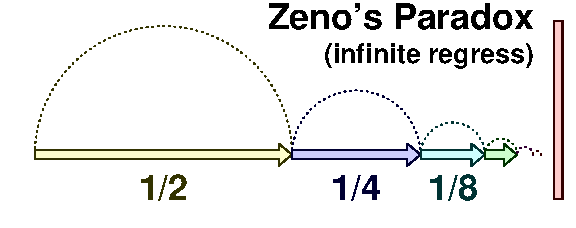
In ancient times, Aristotle relates how Zeno's proof that "
motion is impossible", called Zeno's paradox, is flawed since it can easily be demonstrated incorrect by moving.
When Greek philosopher
"Διογένης Λαέρτιος," ≈ "Diogenes Laertius" heard the claim, he got up and walked away to demonstrate that the claim was invalid. [math class and limits]. It took over 2,000 years, with the discovery and use of calculus, to be able to actually prove that what Zeno claimed to proved was not valid.
English: For it is possible for a man to show that a false conclusion has been reached without showing on what point it turns, as, for instance, in Zeno's argument that motion is impossible. (Loeb #400, p. 123)
Greek: ἐγχωρεῖ γὰρ ὅτι μὲν ψεῦδος συλλελόγισται δεῖξαί τινα, παρ´ ὃ δὲ μὴ δεῖξαι, οἷον τὸν Ζήνωνος λόγον, ὅτι οὐκ ἔστι κινηθῆναι. [179b]
70. Aristotle: one and many
In his
Sophistic Refutations where he deals with false reasoning, Aristotle describes the fallacy made in some translations for what Paul said. The one as "
you" is obscured by the "
many" in the list and the "
us" in the verse.
English: In fallacies connected with accident the deception is due to inability to distinguish the identical and the different, the one and the many, and what kinds of predicates have all the same accidents as their subject. (Loeb #400, p. 45)
Greek: Τῶν δὲ παρὰ τὸ συμβεβηκὸς διὰ τὸ μὴ δύνασθαι διακρίνειν τὸ ταὐτὸν καὶ τὸ ἕτερον, καὶ ἓν καὶ πολλά, μηδὲ τοῖς ποίοις τῶν κατηγορημάτων πάντα ταὐτὰ καὶ τῷ πράγματι συμβέβηκεν. [189b]
The Greek word for "
different" used by Aristotle is the same word used by Paul for "
other (different)". The word for
"distinguish" is sometimes translated as
"doubt" in the
GNT.
71. Aristotle
A few sentences later, Aristotle provides more detail that is relevant to the mistranslation of changing a "
qualified" statement into an "
absolute" statement and hoping no one will recognize the "
micro" (in Greek) difference. In Paul's case, the "
you" is the difference and makes a big difference in meaning.
English: In fallacies connected with the defect in the definition of refutation and with the distinction between a qualified and an absolute statement the deception is due to the minuteness of the difference. (Loeb #400, p. 47)
Greek: Τῶν δὲ παρὰ τὴν ἔλλειψιν τοῦ λόγου καὶ τῶν παρὰ τὸ πῂ καὶ ἁπλῶς ἐν τῷ παρὰ μικρὸν ἡ ἀπάτη· ὡς γὰρ οὐδὲν προσσημαῖνον τὸ τὶ ἢ πῂ ἢ τὸ πὼς ἢ τὸ νῦν καθόλου συγχωροῦμεν. [189b]
72. Aristotle: Meteorology
The ancient Greek word
"διάκρινω" ≈ "separate, distinguish, discern"
Aristotle uses this word often in his work
Meteorologica. In this case, the
"through separation" is that of
"evaporation" or
"separation of elements".
English: ... then it must be air and the water that surrounds the earth - for vapour is evaporated water. (Loeb #397, p. 19)
Greek: ...λείπεται δ' ἀέρος καὶ τοῦ περὶ τὴν γῆν πᾶσαν ὕδατος· ἡ γὰρ ἀτμὶς ὕδατος διάκρισίς ἐστιν. [340b]
73. Aristotle: Meterorologica
English: For it is reasonable to suppose that, if the motion of a single star can produce this effect and set the air on fire or disintegrate it because of the size of the circle, (Loeb#397, p. 65)
Greek: εὔλογον γάρ, εἴπερ ἡ ἑνὸς ἄστρου κίνησις, καὶ τὴν τῶν πάντων ποιεῖν τι τοιοῦτον καὶ ἐκριπίζειν ἀέρα τε καὶ διακρίνειν διὰ τὸ τοῦ κύκλου μέγεθος. Aristotle: Μετεωρολογικά/α [346a]
English: In the zodiac circle any such mixture is dissolved because of the movement of the sun and the planets - and consequently the majority of comets fall outside the tropics. (Loeb#397, p. 65)
Greek: ὁ μὲν οὖν τῶν ζῳδίων διὰ τὴν τοῦ ἡλίου φορὰν καὶ τὴν τῶν πλανητῶν διαλύει τὴν τοιαύτην σύστασιν· διόπερ οἱ πολλοὶ τῶν κομητῶν ἐκτὸς γίγνονται τῶν τροπικῶν. Aristotle: Μετεωρολογικά/α [346a]
English: Besides, no tail appears around the sun or moon because they dissolve any such mixture before it can form. (Loeb#397, p. 65)
Greek: ἔτι δ' οὔτε περὶ τὸν ἥλιον οὔτε περὶ σελήνην γίγνεται κόμη· θᾶττον γὰρ διακρίνουσιν ἢ ὥστε συστῆναι τοιαύτην σύγκρισιν. Aristotle: Μετεωρολογικά/α [346a]
v6: "διάκρινω" ≈ "separate, distinguish, discern". KJV has "waver".
74. Aristotle: Posterior Analytics
Aristotle discusses logic and opinion and then makes the following claim.
English: Therefore we are left with the conclusion that it is opinion that is concerned with that which is true or false and which may be otherwise. (Loeb#391, p 167)
Greek: ὥστε λείπεται δόξαν εἶναι περὶ τὸ ἀληθὲς μὲν ἢ ψεῦδος, ἐνδεχόμενον δὲ καὶ ἄλλως ἔχειν. Aristotle: Posterior Analytics [89a]
Aristotle then continues with the discussion and then makes the following remark.
English: These considerations make it clear that it is impossible to have opinion and knowledge at the same time about the same object. (Loeb#391, 171)
Greek: Φανερὸν δ' ἐκ τούτων ὅτι οὐδὲ δοξάζειν ἅμα τὸ αὐτὸ καὶ ἐπίστασθαι ἐνδέχεται. Aristotle: Posterior Analytics [89a]
Most people
prefer opinion, which requires no real skill,
over logic, which requires more skill, is more constraining, and may result in conclusions that are not desired.
75. Aristotle: Opinion and knowledge
English: These considerations make it clear that it is impossible to have opinion and knowledge at the same time about the same object; otherwise one would apprehend that the same thing both could and could not be otherwise. (Loeb#391, p. 171)
Greek: Φανερὸν δ' ἐκ τούτων ὅτι οὐδὲ δοξάζειν ἅμα τὸ αὐτὸ καὶ ἐπίστασθαι ἐνδέχεται.ἅμα γὰρ ἂν ἔχοι ὑπόληψιν τοῦ ἄλλως ἔχειν καὶ μὴ ἄλλως τὸ αὐτό· Aristotle: Posterior Analytics [89a]
One destroys an opinion posing as knowledge by pointing out reality, invalid logic, assumptions, etc. If a model explains some, but not all, phenomena, one cannot discredit the model by pointing out what it does not explain. One really needs to come up with a better model. Example:
Older model: Newtonian physics (still valid in many respects)
Newer model: quantum and/or relativistic physics
Is a model an opinion? Is quantum mechanics an opinion?
76. Aristotle: Learning expectations
English: ... And some want to have everything done accurately, while others are annoyed by accuracy, either because they cannot follow the connexion of thought or because they regard it as pettifoggery ...
Aristotle: Metaphyics 2 3:8 … καὶ οἱ μὲν πάντα ἀκριβῶς, τοὺς δὲ λυπεῖ τὸ ἀκριβὲς ἢ διὰ τὸ μὴ δύνασθαι συνείρειν ἢ διὰ τὴν μικρολογίαν [metaphysics]
Some have trouble following precise and accurate logical details or regard it as
"hairsplitting". They are
"λύπη" ≈ "annoyance, distress". Might they be
"sad" or
"sorrowful"?
GNT:
"invalid logic" ⇒ "strife".
"personal opinion" ⇒ "vain glory".
If you ask an engineer for an explanation, be ready to listen for a while. Just nod your head and pretend you understand what he is saying. You'll wish you had never asked.
77. Aristotle: How people learn
English: Thus, some people do not listen to a speaker unless he speaks mathematically, others unless he gives instances, while others expect him to cite a poet as witness.
Greek: … οἱ μὲν οὖν ἐὰν μὴ μαθηματικῶς λέγῃ τις οὐκ ἀποδέχονται τῶν λεγόντων, οἱ δ᾿ ἃν μὴ παραδειγματικῶς, οἱ δὲ μάρτυρα ἀξιοῦσιν ἐπάγεσθαι ποιητή… Aristotle: Metaphysics.
This statement by Aristotle follows the three general types of truth.
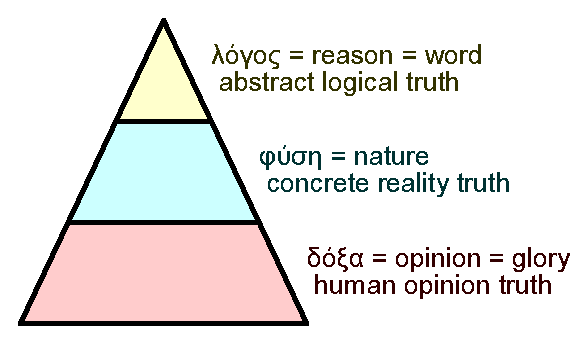 logic : mathematically using precise logic and meticulous detail (deductive top-down)
reality : scientific real world examples/instances (empirical bottom-up)
opinion : witness of others (sports heroes, actors, politicians, pastors, etc.)
logic : mathematically using precise logic and meticulous detail (deductive top-down)
reality : scientific real world examples/instances (empirical bottom-up)
opinion : witness of others (sports heroes, actors, politicians, pastors, etc.)
[logic: six pack; reality: 12 oz. each; opinion: tastes great, less filling]
The Greek and Hebrew words for
"truth" are that of
"reality" and
not "logic" or
"opinion".
78. Mathematics
Aristotle: Metaphyics 2 3:8 … οἱ μὲν οὖν ἐὰν μὴ μαθηματικῶς λέγῃ … [metaphysics]
English: ... Thus, some people do not listen to a speaker unless he speaks mathematically….
The idea here appears to be of precise logical detail.
Is God a Mathematician?
 |
Details are left as a future topic.
|
79. Aristotle: Meteorologica
English: Plato's description of rivers and the sea in the Phaedro is impossible. He says they all flow into each other beneath the earth through channels pierced through it, and that their original source is a body of water at the center of the earth called Tartarus, from which all waters running and standing are drawn. (Loeb#397, p. 139)
Greek: τὸ δ' ἐν τῷ Φαίδωνι γεγραμμένον περί τε τῶν ποταμῶν καὶ τῆς θαλάττης ἀδύνατόν ἐστιν. λέγεται γὰρ ὡς ἅπαντα μὲν εἰς ἄλληλα συντέτρηται ὑπὸ γῆν, ἀρχὴ δὲ πάντων εἴη καὶ πηγὴ τῶν ὑδάτων ὁ καλούμενος Τάρταρος, περὶ τὸ μέσον ὕδατός τι πλῆθος, ἐξ οὗ καὶ τὰ ῥέοντα καὶ τὰ μὴ ῥέοντα ἀναδίδωσιν πάντα· Aristotle: Meteorologica [356a]
80. Aristotle: Meteorologica
English: But an this account rivers do not always flow in the same sense. For if they flow towards the centre and also away from it, they will flow uphill as much as down, according to the direction in which the surge of Tartarus inclines. And if this is so we have the proverbial impossibility of rivers flowing uphill. (Loeb#397, p. 141)
Greek: συμβαίνει δὲ τοὺς ποταμοὺς ῥεῖν οὐκ ἐπὶ ταὐτὸν ἀεὶ κατὰ τὸν λόγον τοῦτον· ἐπεὶ γὰρ εἰς τὸ μέσον εἰσρέουσιν ἀφ' οὗπερ ἐκρέουσιν, οὐδὲν μᾶλλον ῥευσοῦνται κάτωθεν ἢ ἄνωθεν, ἀλλ' ἐφ' ὁπότερ' ἂν ῥέψῃ κυμαίνων ὁ Τάρταρος. καίτοι τούτου συμβαίνοντος γένοιτ' ἂν τὸ λεγόμενον ἄνω ποταμῶν· ὅπερ ἀδύνατον. Aristotle: Meteorologica [356a]
81. Aristotle: Posterior Analytics
In his Posterior Analytics, Aristotle is providing some examples of (his four) causes and uses Tartarus in one of them.
English: If, then, an effect can obtain for two causes, can it also be brought about by two causes? e.g., if it thunders both because there must be a hissing and roaring as the fire is extinguished, and also (as the Pythagoreans hold) to threaten the souls in Tartarus and make them fear. (Loeb#391, p. 217)
Greek: ἆρ' οὖν εἰ εἶναι ἐνδέχεται, καὶ γίνεσθαι ἐνδέχεται· ὥσπερ εἰ βροντᾷ <ὅτι> ἀποσβεννυμένου τε τοῦ πυρὸς ἀνάγκη σίζειν καὶ ψοφεῖν καί, εἰ ὡς οἱ Πυθαγόρειοί φασιν, ἀπειλῆς ἕνεκα τοῖς ἐν τῷ ταρτάρῳ, ὅπως φοβῶνται; Aristotle: Αναλυτικών υστέρων/1 10:25 [94b]
82. Aristotle: Insects
Aristotle coined the word
"insect" from the idea that their bodies were
"in sections". The Latin word
"inseco" ≈ "cut up, incise" is a
calque of the Greek word.
Greek:
Καλῶ δ’ ἔντομα ὅσα ἔχει κατὰ τὸ σῶμα ἐντομάς.
English:
I call notched all those that have below/under the body notches.
English:
I call in section all those that have below/under the body in sections.
Aristotle, History of Animals 1.487a.33.
"ὅσα" ≈ "as far as" and "ἔχει" ≈ "have" (third person singular active indicative).
83. Aristotle: Prior Analytics
In his
Prior Analytics, Aristotle uses the word
"ὑπάρχω" ≈ "begin, take the initiative, act first" twice, as noun (participle) and verb, in the same sentence.
English: … We must look for the attributes and subjects of both our terms, … (Loeb#325, p 357)
Greek: δεῖ γὰρ τὰ ὑπάρχοντα καὶ οἷς ὑπάρχει περὶ ἑκάτερον ἀθρεῖν, … Aristotle: Prior Analytics [46a]
The ancient Greek word
"ὑπάρχω" ≈ "begin, take the initiative, act first".
The "attributes" as in "essential attributes" and are abstract and potential.
The "subjects", using a variation of the same word, are realized actualities and concrete.
84. Projection
Aristotle, in his
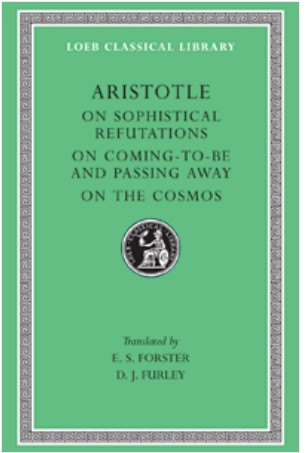
On Sophistical Refutations, details (at least)
12 ways to use bad or "
sophistic" logic.
Eristic reasoning is one of them.
One technique of "
eristic" (faulty and contentious) logic is to accuse the other side of what you are doing. This tends to confuse those who cannot determine what is valid logic and what is not valid logic.
A name for this in psychology is "
projection" as one projects one's own ideas, faults, etc., onto others.
85. End of page





















 Aristotle continues about "nature" as "truth" and "law" as "opinion".