Send Close Add comments: (status displays here)
Got it!  This site "creationpie.org" uses cookies. You consent to this by clicking on "Got it!" or by continuing to use this website.  Note: This appears on each machine/browser from which this site is accessed.
Translation issues in the GNT involving negation
by RS  admin@creationpie.org : 1024 x 640


1. Translation issues in the GNT involving negation
This content is being developed.

2. Do not no way use double negatives
In "correct" English, one is not to use double negatives. Most languages of the world use double negatives to emphasize the negative aspect of what is being said. So too does Ancient (and modern) Greek. This can create certain translation issues in the GNT (Greek New Testament).

A double negative, translated as "no wise", is used in Greek to be an emphatic negative as in "absolutely no way".

3. Logical negation
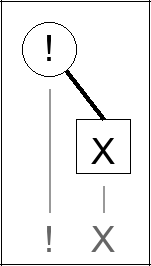
Expression tree for ! X
! X


X | ! X ------- 0 | 1 0 1 | 0 1

  • Not True is False
  • Not False is True
Some other symbols for Not:
  • ¬ (math notation)
  • ! (C-based languages)
  • not (Python, Lua, Pascal, etc.)

X = not (not X)
not X = not (not (not X))
Set complement Logical negation is related to the set complement operation.
Complement equation

 
What is the opposite of not in?
[inside out]

Information sign More: Two-valued logic: Operators

4. Translation issues in the GNT involving negation
Reasoning correctly about logical negation is difficult for beginning students in computer science, and even for some professional programmers. It is even more difficult for pastors, commentators, theologians, etc.

The content here covers some translation issues in the GNT involving logical negation.

Since ideas such as "negation" can become confusing, it is best to use logic rules as one does algebra - to transform equations and get results without having to think about what it means until the final result.

... more to be added ...

Information sign More: Do not no way use double negatives

5. Matthew 23:3 Negation
Matthew 23:3 All therefore whatsoever they bid you observe, that observe and do; but do not ye after their works: for they say, and do not. [kjv]
παντα ουν οσα εαν ειπωσιν υμιν ποιησατε και τηρειτε κατα δε τα εργα αυτων μη ποιειτε λεγεουσιν γαρ και ου ποιουσιν [gnt]

Three Greek words for negation appear in this verse.

6. Matthew 23:3 Negation
Matthew 23:3 All therefore whatsoever they bid you observe, that observe and do; but do not ye after their works: for they say, and do not. [kjv]
παντα ουν οσα εαν ειπωσιν υμιν ποιησατε και τηρειτε κατα δε τα εργα αυτων μη ποιειτε λεγεουσιν γαρ και ου ποιουσιν [gnt]

What does Jesus think of their "works" (abstract and potential) compared to their "say" (physical and actual)? Greek, as most languages except English, use the double negative for an emphatic "not". The English requires that the middle "not" not be translated. Greek, as most languages, uses the logical negation when both words are not a plain "not".

Information sign More: Do not no way use double negatives
Information sign More: Matthew 23:1-4 Jesus fingers the talk about works

7. John 12:24 Negation
John 12:24 Verily, verily, I say unto you, Except a corn of wheat fall into the ground and die, it abideth alone: but if it die, it bringeth forth much fruit. [kjv]
αμην αμην λεγω υμιν εαν μη ο κοκκος του σιτου πεσων εις την γην αποθανη αυτος μονος μενει εαν δε αποθανη πολυν καρπον φερει [gnt]

The KJV (King James Version) translates the Greek words for "if/when" "not" as "except". Does the abstract meaning of "not" make sense here?

Information sign More: Do not no way use double negatives
Information sign More: John 12:20-30 Conditionally fallen grain of wheat

8. Strongs - yet if not
*G2089 *94 ἔτι (et'-ee) : perhaps akin to G2094; "yet," still (of time or degree):--after that, also, ever, (any) further, (t-)henceforth (more), hereafter, (any) longer, (any) more(-one), now, still, yet.
*G1487 *0 εἰ (i) : a primary particle of conditionality; if, whether, that, etc.:--forasmuch as, if, that, (al-)though, whether. Often used in connection or composition with other particles.
*G3361 *0 μή (may) : a primary particle of qualified negation (whereas G3756 expresses an absolute denial); (adverb) not, (conjunction) lest; also (as an interrogative implying a negative answer (whereas G3756 expects an affirmative one)) whether:--any but (that), X forbear, + God forbid, + lack, lest, neither, never, no (X wise in), none, nor, (can-)not, nothing, that not, un(-taken), without. Often used in compounds in substantially the same relations.
The Strongs definitions of the three words are "yet", "if" and "not", just as used many times by Aristotle. Usage: However, this does not come through in translation. A modern Greek translation of this verse (omitted) appears to be translation not of the original Greek but of the KJV.

Information sign More: Matthew 5:13: Salt of the earth

9. Matthew 5:13 Yet whether not
Matthew 5:13 Ye are the salt of the earth: but if the salt have lost his savour, wherewith shall it be salted? it is thenceforth good for nothing, but to be cast out, and to be trodden under foot of men. [kjv]
υμεις εστε το αλας της γης εαν δε το αλας μωρανθη εν τινι αλισθησεται εις ουδεν ισχυει ετι ει μη βληθεν εξω καταπατεισθαι υπο των ανθρωπων [gnt]

The words for "yet" "if" "not" it translated as "but" in the KJV (and elsewhere). To what does the ambiguous implied "it" refer? The statement is in the form of a "counter-factual" in that this division does not exist. The "trodden" happens without the split since the split never happens.

Information sign More: Profitable and expedient counterfactual logic
Information sign More: Word and parsing ambiguity
A possible play on words for "if not" might be "εἰμί""to be, happen".

Information sign More: Matthew 5:13: Salt of the earth

10. Compare Matthew and Luke
Matthew 10:37 He that loveth father or mother more than me is not worthy of me: and he that loveth son or daughter more than me is not worthy of me. [kjv]
ο φιλων πατερα η μητερα υπερ εμε ουκ εστιν μου αξιος και ο φιλων υιον η θυγατερα υπερ εμε ουκ εστιν μου αξιος [gnt]

Luke 14:26 If any man come to me, and hate not his father, and mother, and wife, and children, and brethren, and sisters, yea, and his own life also, he cannot be my disciple. [kjv]
ει τις ερχεται προς με και ου μισει τον πατερα εαυτου και την μητερα και την γυναικα και τα τεκνα και τους αδελφους και τας αδελφας ετι τε και την ψυχην εαυτου ου δυναται ειναι μου μαθητης [gnt]

Now we have a context for the verse in Luke about "hate" and the verse in Matthew about "love". What do each of these verses mean and how do they relate?

The key to the connection is to understand the logical meaning "more than" in Matthew 10:37. The Greek word is that of "over" which has the same logical meaning as "more than".

Information sign More: Do not no way use double negatives
Information sign More: The shock and awe deception

11. Table comparison
Book Spoken by Jesus Same meaning Status
Matthew not (family > Jesus) family ≤ Jesus  correct 
Luke not (family > Jesus) family < Jesus incorrect

Correct logic: Matthew writes down and reports what Jesus spoke. The incorrect logic goes as follows. Luke reports what was remembered.

12. Matthew 13:57 Not without honor
Matthew 13:57 And they were offended in him. But Jesus said unto them, A prophet is not without honour, save in his own country, and in his own house. [kjv]
και εσκανδαλιζοντο εν αυτω ο δε ιησους ειπεν αυτοις ουκ εστιν προφητης ατιμος ει μη εν τη πατριδι και εν τη οικια αυτου [gnt]

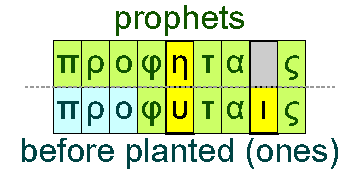
Prophets and planted before (ones) Without honor and steam/odor
The "not" is needed to make the play on words work.
Greek: ... a prophet is not without value if ...
Greek: ... a prophet is of value if ...
Play on words: ... a prophet is not steam/odor if ...

Information sign More: Matthew 13:53-58 Prophets and honor

13. Matthew 13:57 Father customs
Matthew 13:57 And they were offended in him. But Jesus said unto them, A prophet is not without honour, save in his own country, and in his own house. [kjv]
και εσκανδαλιζοντο εν αυτω ο δε ιησους ειπεν αυτοις ουκ εστιν προφητης ατιμος ει μη εν τη πατριδι και εν τη οικια αυτου [gnt]

if not in country in and I am in the father righteous


14. Matthew 24:22 Greek word order
Matthew 24:22 And except those days should be shortened, there should no flesh be saved: but for the elect's sake those days shall be shortened. [kjv]
και ει μη εκολοβωθησαν αι ημεραι εκειναι ουκ αν εσωθη πασα σαρξ δια δε τους εκλεκτους κολοβωθησονται αι ημεραι εκειναι [gnt]

Greek word order: and if not (potential) curtailed/shortened the days those not (actual) if saved all flesh through/by then/however of the elect curtailed/shortened the days those.

Jesus appears to be making a logical statement. Some do not like the use of logic on what Jesus says but, instead, prefer opinion. Everyone can have one or more of a large number of opinions on a matter. There are many fewer logical views of that same matter.

To support the idea of the "elect" or "chosen" being good, the Greek word "by" or "through" was translated as "for".

Let us, however, here consider the logic of what Jesus is saying. To do that, we need to review some logic rules.

Information sign More: Matthew 24:21-24 Short day cutoff

15. Matthew 24:22 Variable operands and operators
Matthew 24:22 And except those days should be shortened, there should no flesh be saved: but for the elect's sake those days shall be shortened. [kjv]
και ει μη εκολοβωθησαν αι ημεραι εκειναι ουκ αν εσωθη πασα σαρξ δια δε τους εκλεκτους κολοβωθησονται αι ημεραι εκειναι [gnt]

Variable operands for the verse
X  εκολοβωθησαν αι ημεραι εκειναι  those days be shortened
X  κολοβωθησονται αι ημεραι εκειναι  those days be shortened
Y  εσωθη πασα σαρξ  saved all flesh
E  δια (τους) εκλεκτους  by the elect

Connective operators for the verse
if not  ει μη  if not
if not  ουκ αν  if not
but by  δια δε  through but
To support the idea of a good "elect". the Greek for "by" or "through" needs to be changed to "for".

Information sign More: Matthew 24:21-24 Short day cutoff

16. Matthew 24:22 Abstracted logic
Matthew 24:22 And except those days should be shortened, there should no flesh be saved: but for the elect's sake those days shall be shortened. [kjv]

Let X be "those days/parts be shortened or cut off", Y be "flesh saved", E be "elect". In three verses, Jesus will remind us that he had told us this before.

Information sign More: Converse fallacy: If A then B does not mean If B then A
Information sign More: Fact check fallacy: bad logic and conclusions
Information sign More: Equivocation deception between names and meanings
Information sign More: Matthew 24:21-24 Short day cutoff

17. Matthew 24:22 Paraphrase
Matthew 24:22 And except those days should be shortened, there should no flesh be saved: but for the elect's sake those days shall be shortened. [kjv]
και ει μη εκολοβωθησαν αι ημεραι εκειναι ουκ αν εσωθη πασα σαρξ δια δε τους εκλεκτους κολοβωθησονται αι ημεραι εκειναι [gnt]

Paraphrase using the above logic: And if those days [parts there yes] were not cut off (horns/rules removed) no flesh would be saved, but though the (deceived) elect's (false) ideas, those days [parts there yes] will be cut off (horns/rules removed) in order to (invalid logic) save all flesh. Discuss: Has it ever happened that false teachers want to "cut off" all horns/rules/parts in order that all "flesh" might be "saved"? Does it help fill the pews (or their own salary)?

Information sign More: Matthew 24:21-24 Short day cutoff

18. Matthew 24:36 The Son and Father
Jesus makes the following statement in the Olivet Discourse in Matthew 24.
Matthew 24:36 But of that day and hour knoweth no man, no, not the angels of heaven, but my Father only. [kjv]
περι δε της ημερας εκεινης και ωρας ουδεις οιδεν ουδε οι αγγελοι των ουρανων ουδε ο υιος ει μη ο πατηρ μονος [gnt]

The Greek says that the son does not know. This was removed in the TR (Textus Receptus) and does not appear in the KJV. Does Jesus not know? Does the Father know?

Paraphrase: Around then (of) that day and hour, no one sees (with understanding) neither the angels in the heavens neither the son if not [I am] the Father only.
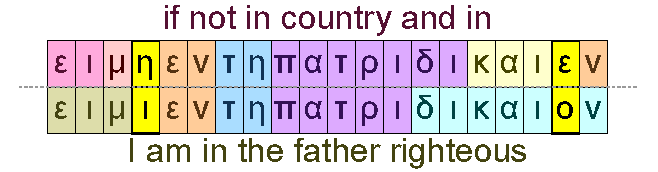
The logic of this statement appears to be not that the father only knows, but that, if anyone would know, it would be the father only.

The TR adds "my" which breaks the play on words.

Information sign More: Matthew 24:36 Day and hour

19. Matthew 12:39 If not
Matthew 12:39 But he answered and said unto them, An evil and adulterous generation seeketh after a sign; and there shall no sign be given to it, but the sign of the prophet Jonas: [kjv]
ο δε αποκριθεις ειπεν αυτοις γενεα πονηρα και μοιχαλις σημειον επιζητει και σημειον ου δοθησεται αυτη ει μη το σημειον ιωνα του προφητου [gnt]

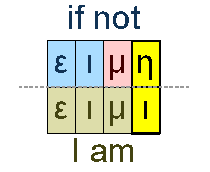
If not and I am


Information sign More: Jesus as Messiah and King
The Greek word translated as "but" is that of "if" "not" (potentially).

Greek: ... if not the sign (of) Jonah of the prophets.
Play: ... I am the Messiah (of) ages of the before planted ones

A similar translation issue involving negation arises in the "salt" verse in the Sermon on the Mount.

Information sign More: Jesus as Messiah and King
Information sign More: The one drop of blood salvation fallacy
Information sign More: Miraculous signs of the Messiah
Information sign More: Matthew 12:38-40 Sign sign everywhere a sign

20. Negation analysis
Assume the pronoun "you" refers to "fasting" as in "not eating". Let the "food" be the "bread" of "life". Do not eat the fruit! Do not feed the birds!

6:19: On earth: (you opened the tunnel) 6:20: In heaven: (you closed the tunnel) The appears to be a causal relationship in that "eating" or "not" "eating" the "fruit" determines the "appearance" or "disappearance" of the "bread" as "food". You then either open or close the "tunnel" for the "thieves". [type 1 and 2 thinking]

Information sign More: Daniel Kahneman
Information sign More: Matthew 6:19-21: A treasury of treasures of which to treasure

21. DeMorgan's Laws of logical negation

22. End of page

by RS  admin@creationpie.org : 1024 x 640