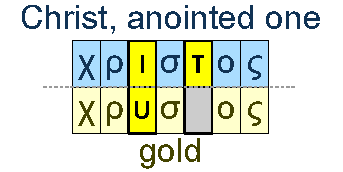
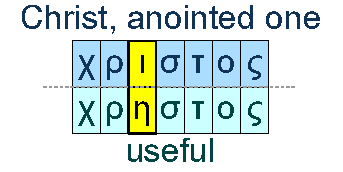
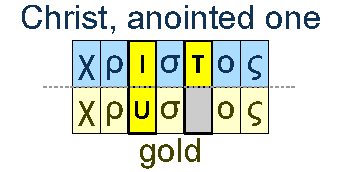
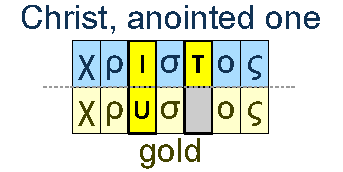
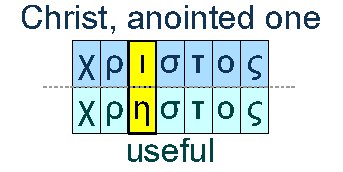
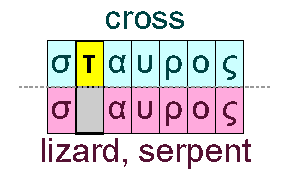
- *G2930 *2 κρύσταλλος (kroos'-tal-los) : from a derivative of kruos (frost); ice, i.e. (by analogy) rock "crystal":--crystal.
κρυσταλλω
κρυσταλλον
Revelation 22:1 ... of life, clear as crystal, proceeding out of the throne ...
- *G2929 *1 κρυσταλλίζω (kroos-tal-lid'-zo) : from G2930 κρύσταλλος; to make (i.e. intransitively, resemble) ice ("crystallize"):--be clear as crystal.
10. Goat salt
11. Revelation 4:6
Revelation 4:6 And before the throne there was a sea of glass like unto crystal: and in the midst of the throne, and round about the throne, were four beasts full of eyes before and behind. [kjv]
και ενωπιον του θρονου ως θαλασσα υαλινη ομοια κρυσταλλω και εν μεσω του θρονου και κυκλω του θρονου τεσσαρα ζωα γεμοντα οφθαλμων εμπροσθεν και οπισθεν [gnt]
… tamquam mare vitreum … cristallo … [v]
The
ancient Greek word
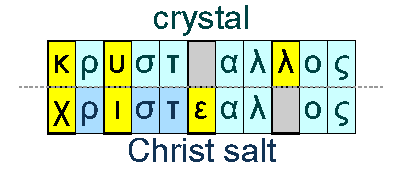
"ὕαλος" ≈ "crystalline stone, glass" and contains the word
"αλός" ≈ "salt". The
Latin word
"vitreus" ≈ "glassy".
The
ancient Greek word
"κρύσταλλος" ≈ "ice, rock crystal" and is the source, through Latin and then French, of the English word
"crystal".
This is a strange description.
12. Revelation 21:11 Crystal clear
Revelation 21:11 Having the glory of God: and her light was like unto a stone most precious, even like a jasper stone, clear as crystal; [kjv]
εχουσαν την δοξαν του θεου και ο φωστηρ αυτης ομοιος λιθω τιμιωτατω ως λιθω ιασπιδι κρυσταλλιζοντι [gnt]
The
ancient Greek word
"κρύσταλλος" ≈ "ice, rock crystal" and is the source, through Latin and then French, of the English word
"crystal".
13. Revelation 22:1
Revelation 22:1 And he shewed me a pure river of water of life, clear as crystal, proceeding out of the throne of God and of the Lamb. [kjv]
και εδειξεν μοι καθαρον ποταμον υδατος ζωης λαμπρον ως κρυσταλλον εκπορευομενον εκ του θρονου του θεου και του αρνιου [gnt]
The
ancient Greek word
"κρύσταλλος" ≈ "ice, rock crystal" and is the source, through Latin and then French, of the English word
"crystal".
The
TR (Textus Receptus) adds "
pure". A
"pure" or
"clean" "
river" would be empty of "
water". The
ancient Greek word
"καθαρός" ≈ "clean, clear, pure" which is negated with an alpha prefix as
"ἀκάθαρτος" ≈ "unclean, impure". The Greek word
"clean" is often given a positive connotation. What happens when a "
bird"
"cleans" out your blueberry bush of every piece of "
fruit" on the bush? The bush is
"clean". Is that
good or
not good?
14. Matthew 22:14 The cold and frozen elect
Matthew 22:14 For many are called, but few are chosen. [kjv]
πολλοι γαρ εισιν κλητοι ολιγοι δε εκλεκτοι [gnt]
The Greek word translated as "called" is part of the Greek word for "church" as in those believers "called out".
The Greek word translated as "chosen" is that of "elected".
There is an old line, in or about
denominational churches (that have a
name), that goes as follows.
Instead of "many are called, but few are chosen",
the line is "many are cold, a few are frozen".
The line brings to mind the reference to
cold and
hot in the letter of Jesus to the Church of
Laodicea in Revelation.
15. Matthew 22:14 The chosen elect
16. Revelation 3:15-16
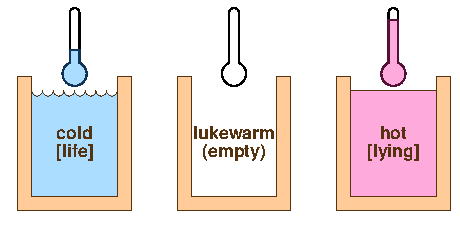
Revelation 3:15 I know thy works, that thou art neither cold nor hot: I would thou wert cold or hot. [kjv]
οιδα σου τα εργα οτι ουτε ψυχρος ει ουτε ζεστος οφελον ψυχρος ειης ης η ζεστος [gnt]
3:16 So then because thou art lukewarm, and neither cold nor hot, I will spue thee out of my mouth. [kjv]
ουτως οτι χλιαρος ει και ουτε ψυχρος ουτε ζεστος ουτε ψυχρος μελλω σε εμεσαι εκ του στοματος μου [gnt]
"ζεστός" ≈ "seethed, boiled, hot" and is the source of the English word "zesty".
"ψυχρός" ≈ "cold, frigid, cold-hearted, lifeless, ineffectual"
"χλιαρός" ≈ "lukewarm, tepid" from "χλιαίνω" ≈ "to warm, warm up, grow warm".
Is there a pattern to how
"hot" and
"cold" are used in the Bible as far as being "
good", "
bad", etc.?
17. The heart problem of clean and unclean
Psalms 51:10 Create in me a clean heart, O God; and renew a right spirit within me. [kjv]
καρδιαν καθαραν κτισον εν εμοι ο θεος και πνευμα ευθες εγκαινισον εν τοις εγκατοις μου [lxx]
What does it mean to have a
clean heart? What does it mean to have an
unclean heart? Are they
opposites?
What about the
"heart"? How does Jesus use the word for
"heart" in Matthew?
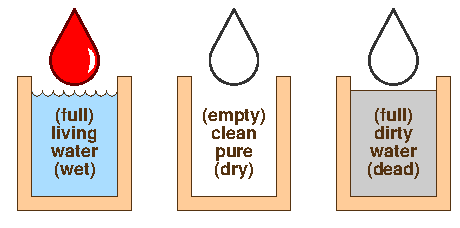
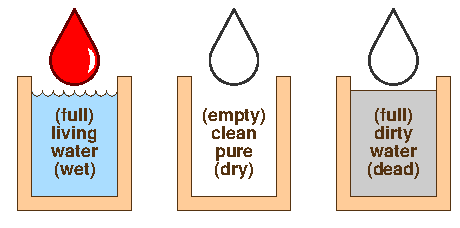
Would you rather be full of living water and wet? How many choices are there? It appears that there are (at least) three choices. The
OT (Old Testament) has many verses on
clean and
unclean. Here, we are interested in how Jesus uses the word in Matthew.
18. Psalms 51:10
Psalms 51:10 Create in me a clean heart, O God; and renew a right spirit within me. [kjv]
καρδιαν καθαραν κτισον εν εμοι ο θεος και πνευμα ευθες εγκαινισον εν τοις εγκατοις μου [lxx]
Are
"clean" and
"unclean" opposites? What is the difference between being empty and clean and pure and dry compared to being full of dirty water and dead? There are two states mentioned in this verse and one implied.
1. Implied: One has a heart filled with what is not good.
2. Clean the heart out of not good so it is empty.
3. Desire: Fill that heart with good.
One implication is that one must get rid of the not good to become clean. Then one can be filled with good.
[Monty Hall problem]
19. Revelation 3:15-16 Three choices
Revelation 3:15 I know thy works, that thou art neither cold nor hot: I would thou wert cold or hot. [kjv]
οιδα σου τα εργα οτι ουτε ψυχρος ει ουτε ζεστος οφελον ψυχρος ειης ης η ζεστος [gnt]
3:16 So then because thou art lukewarm, and neither cold nor hot, I will spue thee out of my mouth. [kjv]
ουτως οτι χλιαρος ει και ουτε ψυχρος ουτε ζεστος ουτε ψυχρος μελλω σε εμεσαι εκ του στοματος μου [gnt]
"ζεστός" ≈ "seethed, boiled, hot" and is the source of the English word "zesty".
"ψυχρός" ≈ "cold, frigid, cold-hearted, lifeless, ineffectual"
"χλιαρός" ≈ "lukewarm, tepid" from "χλιαίνω" ≈ "to warm, warm up, grow warm".
To which might each of the word refer using
three choices. It appears that
"cold" as
good and
"hot" as
not good are easily
decidable. The
"lukewarm" requires more discernment/refinement for decision purposes by the householder.
20. Revelation 3:16
Revelation 3:16 So then because thou art lukewarm, and neither cold nor hot, I will spue thee out of my mouth. [kjv]
ουτως οτι χλιαρος ει και ουτε ψυχρος ουτε ζεστος ουτε ψυχρος μελλω σε εμεσαι εκ του στοματος μου [gnt]
The decisions for each appear to be the following. The church at Laodicea is
"lukewarm".
For "lukewarm": spit out of the mouth.
For "cold": not specified. Is it good or not good?
For "hot": not specified. Is it good or not good?
One should not assume that the results not specified are the same in general and all good in particular.
21. Four elements and vials
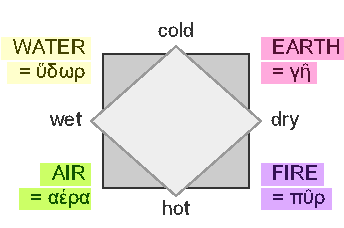
"water"
wet and cold
|
"earth"
cold and dry
|
"air"
hot and wet
|
"fire"
hot and dry
|
|
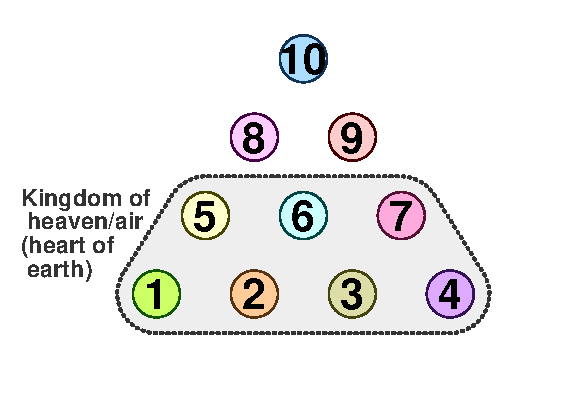
Vial 3 at
node 5: "water".
|
Vial 1 at
node 7: "earth".
|
Vial 7 at
node 1: "air".
|
Vial 4 at
node 4: "fire".
|
|
Is this correspondence a coincidence?
What a strange idea for the Greek philosophers to develop.
|
The path from "air" to "water" would end up being "wet" and "cold". Is "cold" good?
The path from "air" to "fire" to "earth" would end up being "hot" and "dry". Is "hot" good?
The path from "air" to "water" to "earth" with a touch of "fire" would appear to be neither "hot" nor "cold". Is this good?
22. Strongs - lukewarm
23. Proverbs 31:22
24. Proverbs 31:22
KJV: She maketh herself coverings of tapestry; her clothing is silk and purple.
Hebrew: מרבדים עשתה לה שש וארגמן לבושה׃
Greek: δισσας χλαινας εποιησεν τω ανδρι αυτης εκ δε βυσσου και πορφυρας εαυτη ενδυματα
Brenton: She makes for her husband clothes of double texture, and garments for herself of fine linen and scarlet.
25. Revelation 3:15 English and German
Revelation 3:15 I know thy works, that thou art neither cold nor hot: I would thou wert cold or hot. [kjv]
… werkis… cold… hoot… could… hoot… [wy]
… workes … colde … hot… colde … hotte. [ty]
… Werke… kalt … warm … kalt … warm … [lu]
Note the variations of
"cold" and
"hot" in the
Wycliffe and
Tyndale versions.
26. Revelation 3:16
Revelation 3:16 So then because thou art lukewarm, and neither cold nor hot, I will spue thee out of my mouth. [kjv]
… lew… cold… hoot… [wy]
… bitwene bothe … colde … hot … [ty]
… lau … kalt … warm… Munde. [lu]
Wycliffe: cold, hoot, could, hoot, lew.
Tyndale: colde, hot, cold, hotte, bitwene bothe.
The German words "kalt" ≈ "cold" and "warm" ≈ "hot", "lau" ≈ "lukewarm, tepid", "lauwarm" ≈ "lukewarm, tepid".
27. Revelation 3:15-16 Latin
Revelation 3:15 I know thy works, that thou art neither cold nor hot: I would thou wert cold or hot. [kjv]
scio opera tua quia neque frigidus es neque calidus utinam frigidus esses aut calidus [v]
3:16 So then because thou art lukewarm, and neither cold nor hot, I will spue thee out of my mouth. [kjv]
… tepidus … frigidus … calidus … [v]
The Latin word
"fridigus" ≈ "cold" and is the source of the English word
"frigid".
The Latin word
"calidus" ≈ "warm, hot".
The Latin word
"tepidus" ≈ "lukewarm, tepid" and is the source of the English word
"tepid".
The
modern Greek word
"ζεστός" (zeh-STOS) ≈ "hot".
28. Matthew 14:28 Walking on water
Matthew 14:28 And Peter answered him and said, Lord, if it be thou, bid me come unto thee on the water. [kjv]
αποκριθεις δε αυτω ο πετρος ειπεν αυτω κυριε ει συ ει κελευσον με ελθειν προς σε ελθειν επι τα υδατα [gnt]
Peter "
answers". What was the question? Then, Peter does ask a
question.
Anyone can walk on water if the water is frozen. This was a favorite battle technique of the Russians against the Germans on the Eastern Front of World War II. Walking on water is not easy if the water is liquid rather than solid.
[states of matter]
29. Hot springs
Revelation 3:16 So then because thou art lukewarm, and neither cold nor hot, I will spue thee out of my mouth. [kjv]
ουτως οτι χλιαρος ει και ουτε ψυχρος ουτε ζεστος ουτε ψυχρος μελλω σε εμεσαι εκ του στοματος μου [gnt]
The "
hot springs" in
Hierapolis (to the north of
Laodicea) are alluded to by Jesus in Revelation 3. This is the literal view which could be a distractor.
Colossae, to the south, had cold springs, from which an aqueduct brought cold water to
Laodicea that was then somewhat lukewarm.
"Hot" is often good (coffee, cocoa, etc.).
"Cold" is often good (coffee, cocoa, etc.).
"Lukewarm" is "tepid" and tends to be not good.
Are there exceptions to this rule? Why might this be claimed?
30. City: Colossae
The ancient Greek city
"Κολοσσαί" ≈ "Colossae" was in Phrygia in Asia Minor in what is now Turkey. A letter from Paul was written to this city - notable for its angel cult - which Paul mentions.
From Colossae:
Laodicea was about 12 miles.
Ephesus was about 120 miles.
31. Revelation and Laodicea
Revelation 3:16 So then because thou art lukewarm, and neither cold nor hot, I will spue thee out of my mouth. [kjv]
ουτως οτι χλιαρος ει και ουτε ψυχρος ουτε ζεστος ουτε ψυχρος μελλω σε εμεσαι εκ του στοματος μου [gnt]

Consider what Jesus said to the Church at Laodicea as far as being "
yes" or "
no", as in
"hot" or
"cold". There are (at least) two ways to take what Jesus said.
Impose the current view that "hot" means doing what Jesus wants (as in "on fire" for the Lord) and "cold" means not doing what Jesus wants (as in a "cold shoulder"). That leaves the "lukewarm" meaning somewhat unclear.
Take both being "refreshing" (as were the cold and hot water sources at Laodicea) and "lukewarm", as not refreshing, being what is to be avoided.
32. Strongs - hot
*G2200 *3 ζεστός (dzes-tos') : from G2204; boiled, i.e. (by implication) calid (figuratively, fervent):--hot.
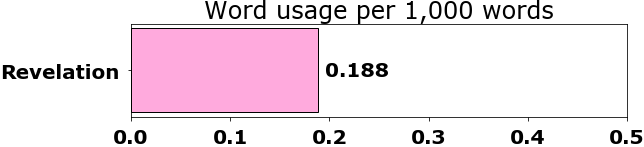 |
Words: ζεστος=3
|
The ancient Greek word
"ζεστός" ≈ "seethed, boiled, hot" and is the source of the English word
"zesty".
This word only appears in Revelation (3 times in 2 verses) in the
GNT. The word does not appear in the
LXX.
33. Usage - hot
- *G2200 *3 ζεστός (dzes-tos') : from G2204; boiled, i.e. (by implication) calid (figuratively, fervent):--hot.
- ζεστος *3
- Revelation 3:15 ... cold nor hot: I would thou wert cold or hot.
- Revelation 3:16 ... neither cold nor hot, I will spue thee ...
34. Strongs - cold
35. Usage - cold
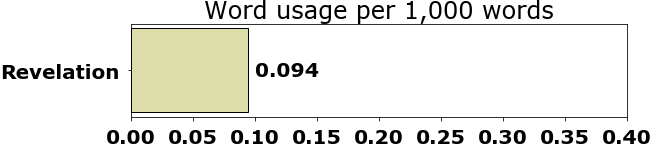
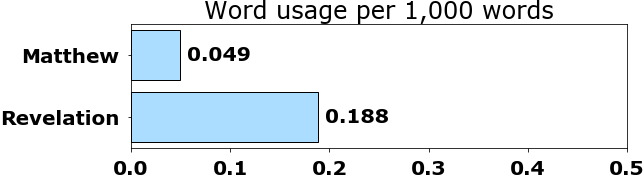
- *G5593 *4 ψυχρός (psoo-chros') : from G5592; chilly (literally or figuratively):--cold.
- ψυχρος *3
- Revelation 3:15 ... thou art neither cold nor hot: I would thou wert cold or hot.
- Revelation 3:16 ... lukewarm, and neither cold nor hot, I will ...
- ψυχρου
- Matthew 10:42 ... these little ones a cup of cold water only in the name ...
36. Proverbs 25:25 Cold waters
Proverbs 25:25 As cold waters to a thirsty soul, so is good news from a far country. [kjv]
ωσπερ υδωρ ψυχρον ψυχη διψωση προσηνες ουτως αγγελια αγαθη εκ γης μακροθεν [lxx]
The
ancient Greek word
"ἀγγελία" ≈ "message, news, report" and the source of the word for "
angel".
37. Proverbs 25:25
KJV: As cold waters to a thirsty soul, so is good news from a far country.
Hebrew: מים קרים על נפש עיפה ושמועה טובה מארץ מרחק׃
Greek: ωσπερ υδωρ ψυχρον ψυχη διψωση προσηνες ουτως αγγελια αγαθη εκ γης μακροθεν
38. Matthew 10:42 Drink a cup
Matthew 10:42 And whosoever shall give to drink unto one of these little ones a cup of cold water only in the name of a disciple, verily I say unto you, he shall in no wise lose his reward. [kjv]
και ος εαν αν ποτιση ενα των μικρων τουτων ποτηριον ψυχρου μονον εις ονομα μαθητου αμην λεγω υμιν ου μη απολεση τον μισθον αυτου [gnt]
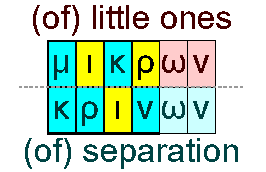
"ψυχροῦ" ≈ "(of) cold" (genitive).
Jesus uses the idea of
"little ones" to refer to believers of all ages. The play on words is a believer who has been
"separated".
The
"water" is inferred in the Greek as
"cold" "
water" from
"cold" and the word "
drink".
What exactly does this verse mean?
What does a "cup" of "cold", perhaps water, mean?
Is giving a "little one" a "cup" of "cold", perhaps water, good or not good?
39. Matthew 10:42
KJV: And whosoever shall give to drink unto one of these little ones a cup of cold water only in the name of a disciple, verily I say unto you, he shall in no wise lose his reward.
Greek: και ος εαν αν ποτιση ενα των μικρων τουτων ποτηριον ψυχρου μονον εις ονομα μαθητου αμην λεγω υμιν ου μη απολεση τον μισθον αυτου
40. Matthew 24:12 Cold devotion
41. Matthew 24:11-13 Prophets
Matthew 24:11 And many false prophets shall rise, and shall deceive many. [kjv]
και πολλοι ψευδοπροφηται εγερθησονται και πλανησουσιν πολλους [gnt]
24:12 And because iniquity shall abound, the love of many shall wax cold. [kjv]
και δια το πληθυνθηναι την ανομιαν ψυγησεται η αγαπη των πολλων [gnt]
24:13 But he that shall endure unto the end, the same shall be saved. [kjv]
ο δε υπομεινας εις τελος ουτος σωθησεται [gnt]
In Matthew 24 Jesus talks of "
all of it" about the "
end times" in the Olivet Discourse.
The "deceive" means "wander" as does a "planet".
The "iniquity" is that of going "against the law".
42. Matthew 24:11
KJV: And many false prophets shall rise, and shall deceive many.
Greek: και πολλοι ψευδοπροφηται εγερθησονται και πλανησουσιν πολλους
43. Matthew 24:12
KJV: And because iniquity shall abound, the love of many shall wax cold.
Greek: και δια το πληθυνθηναι την ανομιαν ψυγησεται η αγαπη των πολλων
44. Matthew 24:13
KJV: But he that shall endure unto the end, the same shall be saved.
Greek: ο δε υπομεινας εις τελος ουτος σωθησεται
45. Strongs - cold