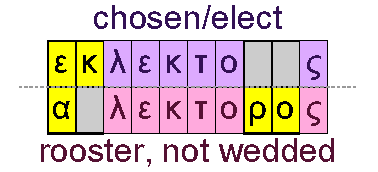
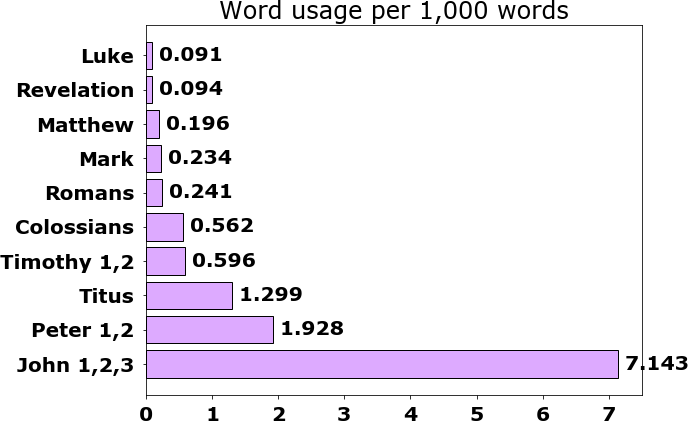
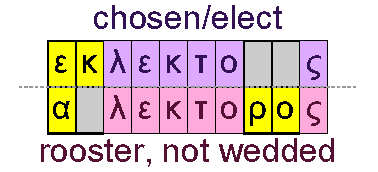
- *G1588 *22 ἐκλεκτός (ek-lek-tos') : from G1586; select; by implication, favorite:--chosen, elect.
- εκλεκτους *7
- Matthew 24:22 ... be saved: but for the elect's sake those days shall be shortened.
- Matthew 24:24 ... it were possible, they shall deceive the very elect.
- Matthew 24:31 ... and they shall gather together his elect from the four ...
- Mark 13:20 ... should be saved: but for the elect's sake, whom he hath chosen, he hath shortened the days.
- Mark 13:22 ... if it were possible, even the elect.
- Mark 13:27 ... and shall gather together his elect from the four winds, ...
- 2 Timothy 2:10 Therefore I endure all things for the elect's sakes, that they ...
- εκλεκτων *4
- Luke 18:7 ... God avenge his own elect, which cry day ...
- Romans 8:33 Who shall lay any thing to the charge of God's elect? It is God that justifieth.
- 1 Timothy 5:21 ... Jesus Christ, and the elect angels, that thou observe ...
- Titus 1:1 ... according to the faith of God's elect, and the acknowledging ...
- εκλεκτον *4
- Romans 16:13 Salute Rufus chosen in the Lord, and ...
- 1 Peter 2:4 ... of men, but chosen of God, and precious,
- 1 Peter 2:6 ... Sion a chief corner stone, elect, precious: and he that believeth ...
- 1 Peter 2:9 But ye are a chosen generation, a royal priesthood, ...
- εκλεκτοι *3
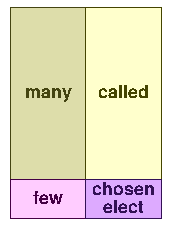
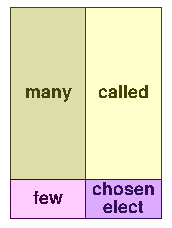
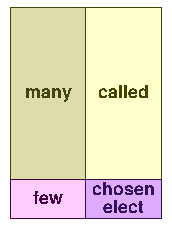
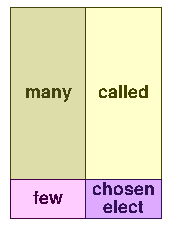
- Matthew 22:14 ... called, but few are chosen.
- Colossians 3:12 Put on therefore, as the elect of God, holy and ...
- Revelation 17:14 ... him are called, and chosen, and faithful.
- εκλεκτος
- Luke 23:35 ... he be Christ, the chosen of God.
- εκλεκτοις
- 1 Peter 1:1 ... Cappadocia, Asia, and Bithynia,
- εκλεκτη
- 2 John 1:1 The elder unto the elect lady and her children, ...
- εκλεκτης
- 2 John 1:13 The children of thy elect sister greet thee. Amen.
15. Gather the stones from the bed
The ancient Greek word
"ἐκλεκτός" ≈ "picked out, selected" and is the source of the English word
"eclectic" and
"election" as in someone who is
"chosen". The Greek word comes from
"ἐκλέγω" ≈ "pick out, select".
From the definition and use of the Greek word for
"elect" the selection process is discrete as in "
mutually exclusive". An element cannot belong both to the
"selected" and
not "selected" groups. There is no partial selection. The idea is "
collectively exhaustive" in that, given a group (i.e., universe of items) each item is either
"selected" or
not "selected".
Here are some words that are related or have similar sounds.
"ἐκλεκτός" ≈ "picked out, selected" (word used)
"εκ" ≈ "out of" and: (none of these are good)
"λεχτός" ≈ "(as stones) gathered, hand-picked". (play on words)
"λέχος" ≈ "bed, spouse, bier, nest". (play on words)
"λέκτρον" ≈ "bed, liaison, offspring".
16. Counts and measures
A count is an exact (nonnegative integer) number such as 6 (integer).
A measure is an approximation such as 6.0 (floating point approximation).
The ancient Greek word
"μέτρον" ≈ "measure, distance". The process of
measuring is used to determine which is
greater.
Example: 6 pack of Coke
You can count the number of bottles of Coke (i.e., six).
You measure how much is in each bottle (e.g., 12 ounces).
The idea of
"selected" is that of a
count and
not a
measure.
count: discrete : quantum [soul]
measure: continuous [height, weight, etc.]
17. Gather the stones from the bed
In Greek democracy, voters would place
stones in a
cup to see who would be
"chosen".
[Aristotle - cup and drinking]
Those
stones were
"gathered out" of the cups on the voting stand and counted.
Might those
"chosen" be
stones, as big pieces of
sand (e.g., stones of the temple) that have been hand-picked for some end or purpose?
Might those
"chosen" have any connection with a
bed,
liaison,
nest, etc.?
[Jesus Seminar from 1985 - vote on the Bible]
18. Ancient voting stands
The ancient Greeks used empty open
"lamps" on a
"lamp stand" or "
table" to hold
"pebbles" for
"voting" purposes.
"λυχνος" ≈ "lamp".
"λυχνεῖον" ≈ "ballot stand" sometimes used by jurors.
"ψῆφος" ≈ "pebble, counter, vote" and many variations of meaning having to do with a "vote" where a "pebble" was used to "vote" by placing it in a container, sometimes an oil lamp (without the oil) on a "lamp stand"
"ψηφίζω" ≈ "calculations (abacus), cast one's vote" and many definition variations having to do with voting.
"ψηφοποιός" ≈ "rigging the vote" and, literally, "make a pebble".
[make peace, peacemakers]
The ancient Greek "
democracy" or "
people power" could "
vote" to have someone exiled or even executed (e.g., Socrates). This is similar to the French Revolution where the "
people" decided to have many guillotined, including the inventor of the device and some who helped start the French Revolution but were not radical enough for the majority.
19. Matthew 5:15 Review
Matthew 5:15 Neither do men light a candle, and put it under a bushel, but on a candlestick; and it giveth light unto all that are in the house. [kjv]
ουδε καιουσιν λυχνον και τιθεασιν αυτον υπο τον μοδιον αλλ επι την λυχνιαν και λαμπει πασιν τοις εν τη οικια [gnt]
Paraphrase:
... neither is a candle (kingdom, opinion, glory, etc.) put under a measure (for objective evaluation) but on a [voting] platform to lamp [get a handle on] (provide false light or darkness) to all (the many, the city) who are in that house (built on sand).

That
"house" built on "
sand" (end of the Sermon on the Mount) will be "
cut off" and the "
many" (who need the real Good News) will "
fall" (same base word in Greek).
Note: In Greek the space between
"and" and
"being" or
"is" appears to have been removed/ignored to make a questionable translation to
"light" as in
"ignite" to justify the desired translation.
The abstract
"measure" as in an
"objective measure" was changed to the more concrete
"basket" or
"bushel".
20. Jeremiah 19:1 Earthen vessels
Jeremiah 19:1 Thus saith the LORD, Go and get a potter's earthen bottle, and take of the ancients of the people, and of the ancients of the priests; [kjv]
τοτε ειπεν κυριος προς με βαδισον και κτησαι βικον πεπλασμενον οστρακινον και αξεις απο των πρεσβυτερων του λαου και απο των πρεσβυτερων των ιερεων [lxx]
The concept of
voting in ancient Greece often had to do with using pieces of
broken pottery vessels.
"ὀστράκινος" ≈ "earthen, made of clay".
"ὄστρακον" ≈ "earthen vessel, hard shell of mollusks, etc.". The English is "ostracon".
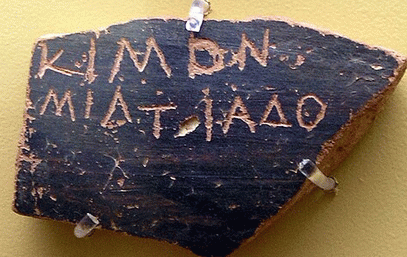
In one form of voting, Ancient Greece had a custom whereby a yearly vote was taken and whoever got the most votes, would be banished from the city for a period of time. How might that work today with the politics of today? Citizens would vote by inscribing the desired name on a piece of broken pottery. From this concept, we get the English word
"ostracize".
The modern Greek word
"οστρακίνοις" (o-stra-KEE-nees) ≈ "earthen vessels".
21. Voting analogies
Here are some voting analogies based on the Greek words.
The
"chosen" or
"elect" in a Greek
"election" had to do with removing and counting "
stones", or big pieces of
sand. In some cases, broken pieces of pottery were used with a connection to "
bones".
Might any of these analogies have to do with what Jesus says about the religious elite?
One "
counts" in order to "
measure" to determine who is "
great" and who is
not.
22. Revelation 13:18 Number of the beast
Revelation 13:18 Here is wisdom. Let him that hath understanding count the number of the beast: for it is the number of a man; and his number is Six hundred threescore and six. [kjv]
ωδε η σοφια εστιν ο εχων τον νουν ψηφισατω τον αριθμον του θηριου αριθμος γαρ ανθρωπου εστιν και ο αριθμος αυτου χξς εξακοσιοι εξηκονταεξ [gnt]
The verse after the "
mark" of the "
beast" contains the well-known "
number" of the "
beast". Many who have not read nor studied the Bible have heard of the number "
666" and the "
mark" of the "
beast".
"ψῆφος" ≈ "pebble, counter, vote" and many variations of meaning having to do with a "vote" where a "pebble" was used to "vote" by placing it in a container, sometimes an oil lamp (without the oil) on a "lamp stand"
"ψηφίζω" ≈ "calculations (abacus), cast one's vote" and many definition variations having to do with voting.
"ψηφοποιός" ≈ "rigging the vote" and, literally, "make a pebble".
23. Revelation 13:18 Number of the beast
Revelation 13:18 Here is wisdom. Let him that hath understanding count the number of the beast: for it is the number of a man; and his number is Six hundred threescore and six. [kjv]
ωδε η σοφια εστιν ο εχων τον νουν ψηφισατω τον αριθμον του θηριου αριθμος γαρ ανθρωπου εστιν και ο αριθμος αυτου χξς εξακοσιοι εξηκονταεξ [gnt]
The word used for
"count" often used for
"vote" using a
"pebble". It is not common and can be a play on words. The Greek word translated as
"number" is that of
"reckoning" as in
"accounting". Might the
666 be a distractor?
English: ... count the number ...
Greek: ... ψηφισατω τον αριθμον ...
Greek: ... ψηφι σατω τον αριθμον ... (play on words)
English: ... vote sato- tan ... (play on words)
English: ... vote Satan ... (play on words)
Jesus uses similar play on words with
Satan in other places.
24. Historical interpretation of church history
| Interpretations |
| ☐ Literal |
☐ Christian living |
| ☐ Figurative |
☐ Heresies over time |
| ☐ Historical |
☐ Prophetic details |
[spread spectrum communication] [self-similar like fractals] [linear combinations]
|
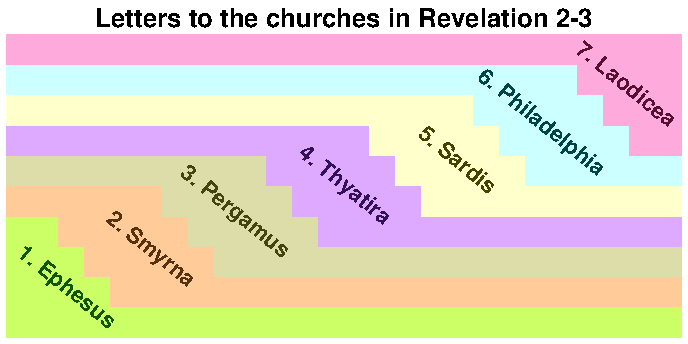
Note that the time of Roman persecutions was that of the universal church as a collection of small "mustard seeds" while the time of Roman acceptance was that of the universal church as "tree with birds making a home in the branches".
|
25. Build-up to the punch line play on words
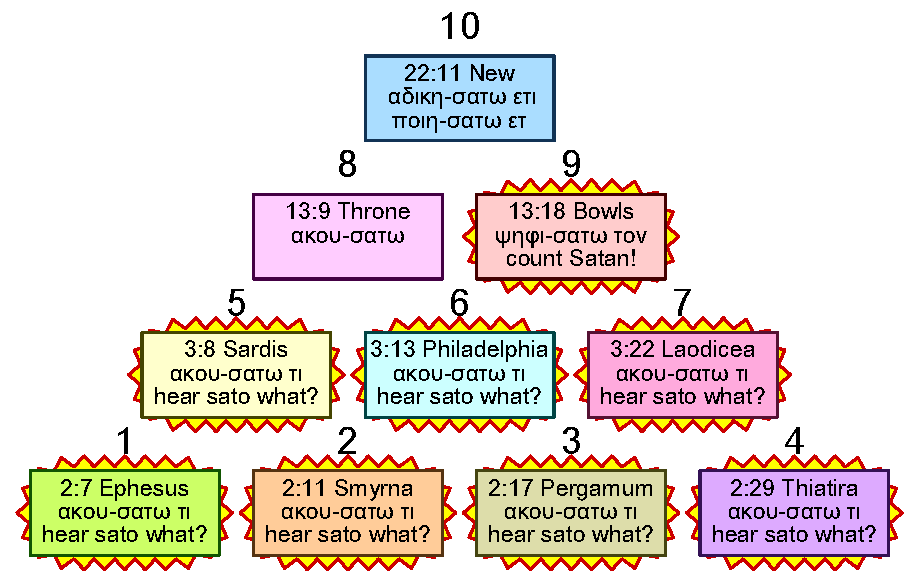 |
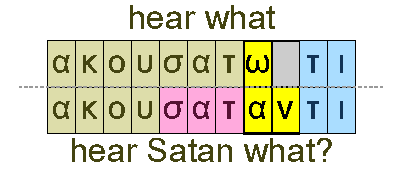
To each of the seven churches: "He that hath an ear, let him hear what the Spirit saith unto the churches ..."
|
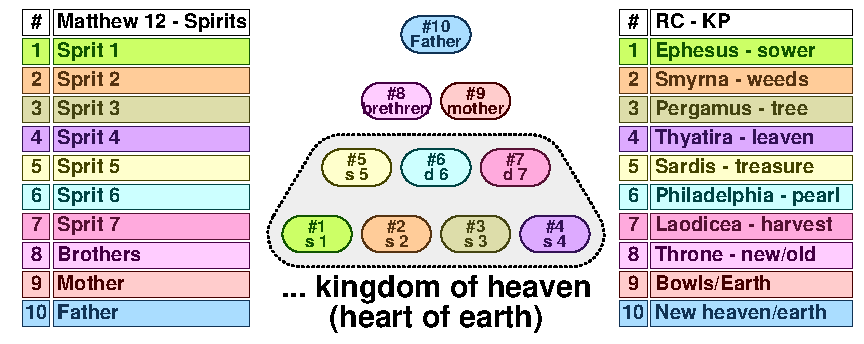
1-7: Churches: "hear" "sato" "what?" Might these be related to the seven evil spirits that return to the "house" in Matthew 12?
9: Bowls: "count" "Satan" (serpent, dragon).
26. TenPin model for seven spirits
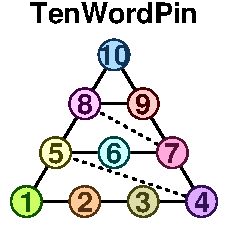
Might the "
seven" "
evil" "
spirits" be related to the "
seven" play on words of "
count sato what" as in "
count satan what" in Revelation?
How about the "
three" "
days" and "
three" "
nights" in the "
heart" of the "
earth" as compared to "
Jonah" being in the "
belly" of the "
whale"?
27. Matthew 22:14 The cold and frozen elect
Matthew 22:14 For many are called, but few are chosen. [kjv]
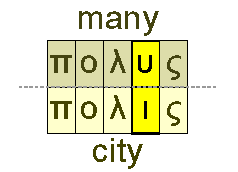
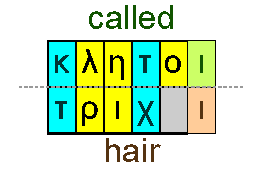
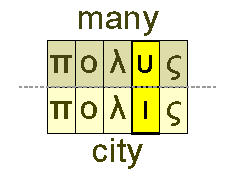
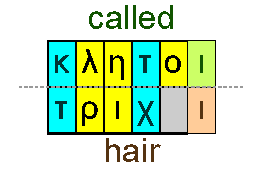
πολλοι γαρ εισιν κλητοι ολιγοι δε εκλεκτοι [gnt]
The Greek word translated as "called" is part of the Greek word for "church" as in those believers "called out".
The Greek word translated as "chosen" is that of "elected".
There is an old line, in or about
denominational churches (that have a
name), that goes as follows.
Instead of "many are called, but few are chosen",
the line is "many are cold, a few are frozen".
The line brings to mind the reference to
cold and
hot in the letter of Jesus to the Church of
Laodicea in Revelation.
28. Matthew 22:14 Callings
Matthew 22:14 For many are called, but few are chosen. [kjv]
πολλοι γαρ εισιν κλητοι ολιγοι δε εκλεκτοι [gnt]
While in church, you may hear God calling in many ways. However, God will not call you on your
cell phone. So you can turn that off while in church.
29. Matthew 16:18 Calling a masterful gathering of outgoing church believers
Matthew 16:18 And I say also unto thee, That thou art Peter, and upon this rock I will build my church; and the gates of hell shall not prevail against it. [kjv]
καγω δε σοι λεγω οτι συ ει πετρος και επι ταυτη τη πετρα οικοδομησω μου την εκκλησιαν και πυλαι αδου ου κατισχυσουσιν αυτης [gnt]
12:8 For the Son of man is Lord even of the sabbath day. [kjv]
κυριος γαρ εστιν και του σαββατου ο υιος του ανθρωπου [gnt]
Most people agree that the
"church" should represent the
"ἐκκλησία" ≈ "assembly, called-out, church" as in the
"gathering of believers" that are
"called (out) together". The word
"church" comes from
"κύριος" ≈ "lord or master". Discuss:
Is the "church" a "building"? Can the "leaders" of the "church" be considered the "elect"?
Is your "church" a "gathering of believers" or an entity that wants to be "Lord" or "Master" of those in the "church"?
30. Matthew 22:14 The chosen elect
31. Matthew 22:2-5 Parable of the wedding feast
Matthew 22:2 The kingdom of heaven is like unto a certain king, which made a marriage for his son, [kjv]
22:3 And sent forth his servants to call them that were bidden to the wedding: and they would not come. [kjv]
22:4 Again, he sent forth other servants, saying, Tell them which are bidden, Behold, I have prepared my dinner: my oxen and my fatlings are killed, and all things are ready: come unto the marriage. [kjv]
22:5 But they made light of it, and went their ways, one to his farm, another to his merchandise: [kjv]
32. Matthew 22:7-9 Parable of the wedding feast
Matthew 22:7 But when the king heard thereof, he was wroth: and he sent forth his armies, and destroyed those murderers, and burned up their city. [kjv]
22:8 Then saith he to his servants, The wedding is ready, but they which were bidden were not worthy. [kjv]
22:9 Go ye therefore into the highways, and as many as ye shall find, bid to the marriage. [kjv]
Here is the context right before the actual wedding feast.
22:7 The "murderers" are "destroyed", those "bidden", are "destroyed".
22:8 Those "asked" or otherwise "chosen" were not "ready" and were "destroyed". Those remaining are those in their own "field" and the "merchants".
22:9: Go "ask" all that can be "found" (those remaining) on the "path" of the "exit paths". There is no stated limit. The servants are assumed to be thorough.
33. Context review with Greek
Matthew 22:7 But when the king heard thereof, he was wroth: and he sent forth his armies, and destroyed those murderers, and burned up their city. [kjv]
ακουσας δε ο δε βασιλευς ωργισθη και πεμψας τα στρατευματα αυτου απωλεσεν τους φονεις εκεινους και την πολιν αυτων ενεπρησεν [gnt]
22:8 Then saith he to his servants, The wedding is ready, but they which were bidden were not worthy. [kjv]
τοτε λεγει τοις δουλοις αυτου ο μεν γαμος ετοιμος εστιν οι δε κεκλημενοι ουκ ησαν αξιοι [gnt]
22:9 Go ye therefore into the highways, and as many as ye shall find, bid to the marriage. [kjv]
πορευεσθε ουν επι τας διεξοδους των οδων και οσους αν εαν ευρητε καλεσατε εις τους γαμους [gnt]
34. Matthew 22:10-13 Parable of the wedding feast
Matthew 22:10 So those servants went out into the highways, and gathered together all as many as they found, both bad and good: and the wedding was furnished with guests. [kjv]
22:11 And when the king came in to see the guests, he saw there a man which had not on a wedding garment: [kjv]
22:12 And he saith unto him, Friend, how camest thou in hither not having a wedding garment? And he was speechless. [kjv]
22:13 Then said the king to the servants, Bind him hand and foot, and take him away, and cast him into outer darkness; there shall be weeping and gnashing of teeth. [kjv]
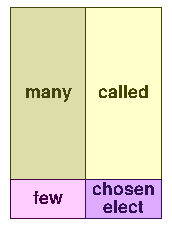
Who are the "many"? How were they "called"?
Who are the "few"? How many "few" are in these verses?
What happened to the "few" who were "chosen" or "elected"?
Why bind him "hand" and "foot"?
Who were those already "destroyed"?
[cherry picked verses]
35. Matthew 22:10-11 Many called and few chosen
Matthew 22:10 So those servants went out into the highways, and gathered together all as many as they found, both bad and good: and the wedding was furnished with guests. [kjv]
και εξελθοντες οι δουλοι εκεινοι εις τας οδους συνηγαγον παντας οσους ους ευρον πονηρους τε και αγαθους και επλησθη ο γαμος νυμφων ανακειμενων [gnt]
22:11 And when the king came in to see the guests, he saw there a man which had not on a wedding garment: [kjv]
εισελθων δε ο βασιλευς θεασασθαι τους ανακειμενους ειδεν εκει ανθρωπον ουκ ενδεδυμενον ενδυμα γαμου [gnt]
[compiler theory and practice]
36. Matthew 22:12-14 Many called and few chosen
Matthew 22:12 And he saith unto him, Friend, how camest thou in hither not having a wedding garment? And he was speechless. [kjv]
και λεγει αυτω εταιρε πως εισηλθες ωδε μη εχων ενδυμα γαμου ο δε εφιμωθη [gnt]
22:13 Then said the king to the servants, Bind him hand and foot, and take him away, and cast him into outer darkness; there shall be weeping and gnashing of teeth. [kjv]
τοτε ειπεν ο βασιλευς ειπεν τοις διακονοις δησαντες αυτου ποδας και χειρας αρατε αυτον και εκβαλετε αυτον εις το σκοτος το εξωτερον εκει εσται ο κλαυθμος και ο βρυγμος των οδοντων [gnt]
22:14 For many are called, but few are chosen. [kjv]
πολλοι γαρ εισιν κλητοι ολιγοι δε εκλεκτοι [gnt]
37. Matthew 22:13-14 Many called and few chosen
Matthew 22:13 Then said the king to the servants, Bind him hand and foot, and take him away, and cast him into outer darkness; there shall be weeping and gnashing of teeth. [kjv]
22:14 For many are called, but few are chosen. [kjv]
πολλοι γαρ εισιν κλητοι ολιγοι δε εκλεκτοι [gnt]
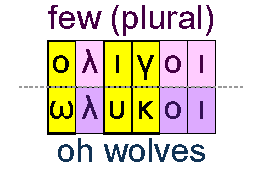
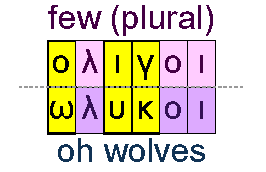
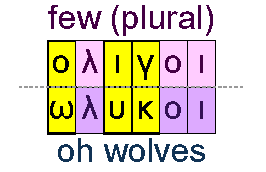
"ὀλίγοι" ≈ "little in size, value, duration, etc." (plural).
"ὦ" ≈ "oh (joy or pain)".
"λυκοί" ≈ "wolves" (could be a type of "bird").
What does Jesus mean when he says that
"few" are
"chosen" or
"elected"? This verse is the
only verse where Jesus makes this distinction of
"many",
"called",
"few" and
"chosen".
Should the Biblical context, as recorded by Matthew, be used in determining the meaning of these words? Here are examples of multiple lists?
Santa: "naughty" and "nice".
Dean: "Dean's List" and "Dean's Other List".
What list or lists (sometimes called a book) does God have?
38. Academic lists
Is it
good or
not good to be
"chosen"?
Most schools have what is known as a
"Dean's List" for the
"best" students.
West Point is a traditional
engineering school and the top of the class are called the
"engineers".
At
West Point, those cadets near the bottom of the class, the
"goats", often talked of being on the
"Dean's Other List".
It appears that, since the Naval Academy midshipman are known as "
goats", the idea was that the West Point cadets at the bottom of the class were on par with any of the Naval Academy midshipman. The reference to "
goat" does
not appear to be related to the parable of the "
sheep" and (young) "
goats". Nor does it refer to the "
goat" that "
escaped" or "
scapegoat".
39. TenWordPin summary
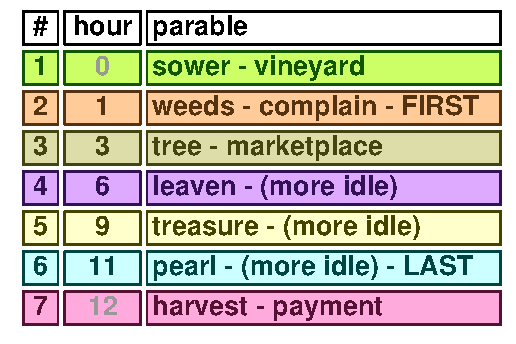
The parable of the vineyard workers can be compared with the kingdom parables in Matthew 13 using the TenWordPin model.
There are five hours, in a manner similar to five loaves (of bread).
There are the before and after, for two, in a manner similar to the two fish.
The word used for the one called "friend" (hour 1, complainer) is the same word as the one (few) without a wedding garment in the wedding feast two chapters later.
40. Before and after
The following verses are immediately before (end of previous chapter) and at the end of the parable of the vineyard workers.
Matthew 19:30 But many that are first shall be last; and the last shall be first. [kjv]
πολλοι δε εσονται πρωτοι εσχατοι και εσχατοι πρωτοι [gnt]
This parable is in verses 1 to 16.
20:16 So the last shall be first, and the first last: for many be called, but few chosen. [kjv]
ουτως εσονται οι εσχατοι πρωτοι και οι πρωτοι εσχατοι πολλοι γαρ εισιν κλητοι ολιγοι δε εκλεκτοι [gnt]
The end of the next chapter appears to be connected where Jesus uses the example of the
"first" as the religious establishment as
"birds" and the
"last" as the "
harlots" and "
tax collectors".
The
TR (Textus Receptus) adds "
many be called, but few chosen" in Matthew 20:16 which does not fit in this context and breaks the model.
41. Matthew 20:16 First and last
Matthew 20:16 So the last shall be first, and the first last: for many be called, but few chosen. [kjv]
ουτως εσονται οι εσχατοι πρωτοι και οι πρωτοι εσχατοι πολλοι γαρ εισιν κλητοι ολιγοι δε εκλεκτοι [gnt]
The ancient Greek word
"οὕτως" ≈ "thus" and indicates a conclusion from what has been said. One should look at what was said before this verse.
"πρῶτος" ≈ "first, earliest, most prominent, prime (number)" as in English words beginning with "proto".
"ἔσχατος" ≈ "farthest, most remote, last, final, extreme" and is the source of the English word "eschatology" as a "study of the end times".
Discuss:
Who are the "first"? Who are the "last"?
Who are those between the "first" and the "last"?
These questions appear to be answered, in part, at the end of the next chapter in the parable of the vineyard workers.
[job versus profession]
42. Matthew 24:22,24,31 Chosen elect
Matthew 24:22 And except those days should be shortened, there should no flesh be saved: but for the elect's sake those days shall be shortened. [kjv]
24:24 For there shall arise false Christs, and false prophets, and shall shew great signs and wonders; insomuch that, if it were possible, they shall deceive the very elect. [kjv]
24:31 And he shall send his angels with a great sound of a trumpet, and they shall gather together his elect from the four winds, from one end of heaven to the other. [kjv]
Jesus uses the noun for
"elect" or
"chosen" three times in Matthew 24 and
one other time, at the end of the Parable of the Wedding feast in Matthew 22. These nouns are either mistranslated in context or ambiguous in use (or both).
If one does not get the direct meaning from the verses, then the play on words are a hint as to the meaning of the verse (e.g., good, not good, etc.).
43. Matthew 22:14 Review
Matthew 22:14 For many are called, but few are chosen. [kjv]
πολλοι γαρ εισιν κλητοι ολιγοι δε εκλεκτοι [gnt]
Who are the "many"?
Who are the "called"?
Who are the "few"?
Who are the "chose" or "elect"?
In review, Jesus uses the word
"elect" in a
not good sense. Jesus uses this Greek word four times in Matthew. The
TR adds one more.
(*0) Matthew 20:16: End of the parable of the vineyard workers. Added by the TR and breaks the model.
(*1) Matthew 22:14: End of the parable of the wedding feast.
(*3) Matthew 24:22, 24, 31: Olivet Discourse on the End Times.
The translations that use this word in a
good sense appear to be mistranslated based on what is desired that the verses say and not what they actually say.
44. Election callings as used by others and not Jesus
Matthew 22:14 For many are called, but few are chosen. [kjv]
πολλοι γαρ εισιν κλητοι ολιγοι δε εκλεκτοι [gnt]
Jesus appears to use the Greek word for
"elect" in a
not good way. The corresponding "
verb" form is not a code word, but, in general, may be a play on words.
Early church fathers: Clement, Ignatius, Barnabas, etc.
Paul, Peter, etc.
How did each of these use the word for
"elect"?
45. Matthew 7:13-14 Strait talk about narrow and wide gates
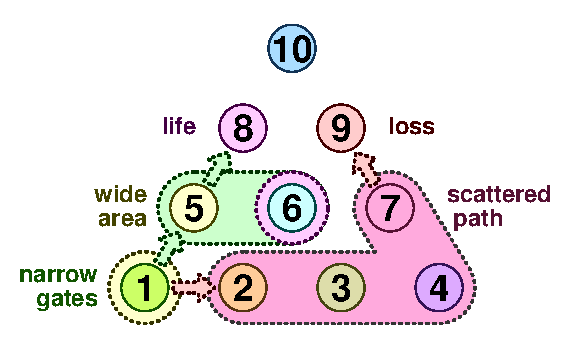
Matthew 7:13 Enter ye in at the strait gate: for wide is the gate, and broad is the way, that leadeth to destruction, and many there be which go in thereat: [kjv]
7:14 Because strait is the gate, and narrow is the way, which leadeth unto life, and few there be that find it. [kjv]
In Matthew 7, Jesus talks of the
"straight" "gate" and
"wide" "
area". The
TR adds the
"gate" to the
"wide" "
area". What exactly is a
"strait" "gate"? The ancient Greek word
"πλατύς" ≈ "wide, flat" and is related to the English word
"flat" and
"platypus" as, literally, "
flat feet".
How
"many" is
"many"? How
"few" is
"few"?
What does the word translated as "leadeth" mean?
What is the "life"? Is this eternal "life"?
What is the "loss" - translated as "destruction"? Is this eternal "destruction"?
[Psalm 23, He Leadeth Me (hymn)]
46. William Miller: Millerism
Matthew 24:41 Two women shall be grinding at the mill; the one shall be taken, and the other left. [kjv]
δυο αληθουσαι εν τω μυλωνι μυλω μια παραλαμβανεται και μια αφιεται [gnt]
Millerites were followers of
William Miller (1782-1849) in a movement called
Millerism. Miller was a Baptist lay preacher in northeast New York state. From his study of selected parts of English translations of the Bible, Miller predicted the Second Coming of Christ in the 1840's. Some followers of this movement became
Adventists such as the Seventh Day Adventists.
47. John Nelson Darby: Rapture
John Nelson Darby (1800-1882) as Anglo-American Bible teacher who developed a theory of the
rapture from cherry-picked English translations of the Bible. His ideas
enraptured many.
Latin: "rapture".
Greek: "snatching up" (harpooning).
Called the father of modern sensationalism. Darby had ideas that led to ideas of
inerrancy and
infallibly of the
scriptures. [DeMorgan, Boole, and modern logic]
[Darby Bibles - German (1871), French (1859), English (1870) - translated from the Hebrew and Greek (as understood from the Latin)]
48. Cyrus Scofield: Reference Bible
Cyrus Scofield (1843-1921) and his
Scofield Reference Bible (1909, 1917, etc.) with concordance, index, cross references, etc. (dispensations)
Prior to World War I, there was a cultural optimism as if the millennium of the Bible had already arrived.
Many ideas were cultivated as fulfilling prophecy. Part of this was a homeland for the return of Israel.
49. Hal Lindsey: Late Great Planet Earth
Hal Lindsey (1929-2024) was an American evangelical writer and television host. His 1970 book
The Late Great Planet Earth, based in ideas of the
rapture, sold (to date) almost 30 millions copies.
His TV series was called
The Hal Lindsey Report.
There were many follow-on books. The basic idea was that current events showed that the end time rapture was about to happen.
As with any such predictions, a house of cards in constructed by cherry-picking Bible verses, many using the English meaning of the translation. If any card turns out to not be what it was assumed to be. the entire house starts to fall. That fall could be great.
50. Tim LaHay: Left behind
The "
Left behind" series of books (1995-2007) by Tim LaHay (1926-2016) and Jerry B. Jenkins deals with the tribulation period in the Bible in general and the rapture in particular.
BIBLE (Basic Instructions Before Leaving Earth),
Much of the stories are based on the Bible but make certain assumptions that may or may not be true.
In particular, the idea that bodies will just disappear is assumed. It may happen that just the soul disappears and those that are left, after some major global catastrophe, do not realize that the rapture has happened.
51. Rapture and toilet paper
One idea many people have about the rapture, much of it from the Left Behind series of books, is that all believers will disappear.
This is similar to the shelves of toilet paper disappearing as a result of panic buying. This leads to the phrase, "
When the roll is called up yonder" from the hymn of the same name.
52. Brief history highlights
Jesus and cursed fig tree. Danger of moving mountains/definitions.
Jesus and the house, temple, end times.
Latin mistranslations to divert attention. Means, motive, opportunity.
English translation of Latin. Consequent English word meaning changes.
English cherry-picking of verses, inerrancy, whisper chain, etc., by Darby, Miller, Schofield, Hal Lindsey, La Haye, etc.
Adoption by conservative movements (some true, much not true)
Opposite reaction and adoption by liberal movements (some true, much not true).
53. End of page









 Jesus often uses code words so that sayings have more than one meaning. All the meanings can be true. The encoded (literal) form makes (some) sense (and some nonsense) while the decoded form makes sense. In general: