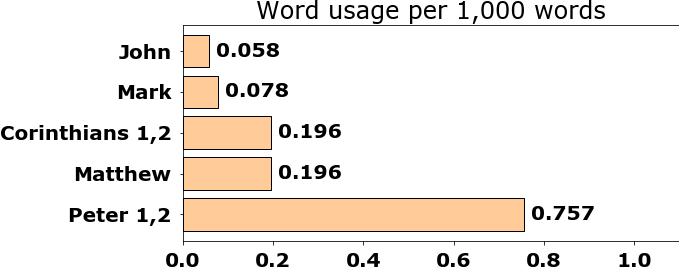
- *G5562 *8 χωρέω (kho-reh'-o) : from G5561; to be in (give) space, i.e. (intransitively) to pass, enter, or (transitively) to hold, admit (literally or figuratively):--come, contain, go, have place, (can, be room to) receive.
- χωρειν *2
- Matthew 19:12 ... sake. He that is able to receive it, let him receive it.
- Mark 2:2 ... were gathered together, insomuch that there was no room to receive them, no, not so much as about the door: ...
- χωρει
- Matthew 15:17 ... entereth in at the mouth goeth into the belly, and ...
- χωρουσιν
- Matthew 19:11 ... unto them, All men cannot receive this saying, save ...
- χωρειτω
- Matthew 19:12 ... sake. He that is able to receive it, let him receive it.
- χωρουσαι
- John 2:6 ... after the manner of the purifying of the Jews, containing two or three ...
- χωρησατε
- 2 Corinthians 7:2 Receive us; we have wronged no man, we have corrupted no man, ...
- χωρησαι
- 2 Peter 3:9 ... should perish, but that all should come to repentance.
13. Give way in John
John 2:6 And there were set there six waterpots of stone, after the manner of the purifying of the Jews, containing two or three firkins apiece. [kjv]
ησαν δε εκει υδριαι λιθιναι υδριαι εξ κειμεναι κατα τον καθαρισμον των ιουδαιων κειμεναι χωρουσαι ανα μετρητας δυο η τρεις [gnt]
21:25 And there are also many other things which Jesus did, the which, if they should be written every one, I suppose that even the world itself could not contain the books that should be written. Amen. [kjv]
εστιν δε και αλλα πολλα οσα α εποιησεν ο ιησους ατινα εαν γραφηται καθ εν ουδε ουδ αυτον οιμαι τον κοσμον χωρησαι χωρησειν τα γραφομενα βιβλια αμην [gnt]
Let us combine parts of both verses about the idea of
"give way" or
"make way".
John 2:6. Even if all the water of the world were poured in, the jars of stone (big pieces of sand) would not give way to more than they are prepared to hold.
John 21:25. Even if everything Jesus said and did were written, the (people in the) world (big pieces of sand) would not give way to more than they are prepared to hold.
John essentially says, "
what I wrote is sufficient for the (people in the) world to make a decision".
14. Speaking of books
Assume you talked at a rate of 1 word per second for 3 years non-stop (without sleeping, eating, etc.). A page of text with 80 lines of 25 words per line would have 2,000 words per page. A ream of paper of 500 pages, printed on one side only, could contain 1,000,000 words. A ream of paper is about 1.5 inches thick so there are 8 reams of paper per foot.
Words in 3 years = 24*365*60*60*3=94,608,000 or about 100,000,000 words.
A ream (500 pages) of paper could record 1,000,000 words (one side only).
These words could be recorded on 100 reams of paper.
This would require a stack of paper about 12.5 feet high.
Assume we could describe or summarize what Jesus did in the same space. Many consider the "
world" in this verse to be the universe. Could the universe contain a stack of books 25 feet high (printed on one side of each page)? How about 50 feet? How about 1,000 feet.
Perhaps this verse means something else. How hard would it be to create a more concise summary of what Jesus said and did?
15. Matthew 15:17 Give way to more food
Jesus makes a distinction between the "
belly" and the "
heart" using the Greek word for
"understand" that does
not have a
negative connotation.
Matthew 15:17 Do not ye yet understand, that whatsoever entereth in at the mouth goeth into the belly, and is cast out into the draught? [kjv]
ουπω ου νοειτε οτι παν το εισπορευομενον εις το στομα εις την κοιλιαν χωρει και εις αφεδρωνα εκβαλλεται [gnt]
The
ancient Greek word
"ἀφεδρών" ≈ "toilet" and comes from
"ἕδρα" ≈ "seat", as in "
cathedral", "
polyhedron", etc. What about
"συνέδριον" ≈ "council"?
The prefix
"ἀπο" ≈ "away from" which has an idea of a "
separating distance". The English word
"draught" is an older and obsolete word for
"outhouse" as a
"toilet".
The ancient Greek word
"χωρέω" ≈ "give way, make way". That is, what goes in pushes out what is there such that what is in
"gives way" or
"makes way" to what is coming in.
16. Matthew 19:6 Joining and separating
Matthew 19:6 Wherefore they are no more twain, but one flesh. What therefore God hath joined together, let not man put asunder. [kjv]
ωστε ουκετι εισιν δυο αλλα σαρξ μια ο ουν ο θεος συνεζευξεν ανθρωπος μη χωριζετω [gnt]
Discuss:
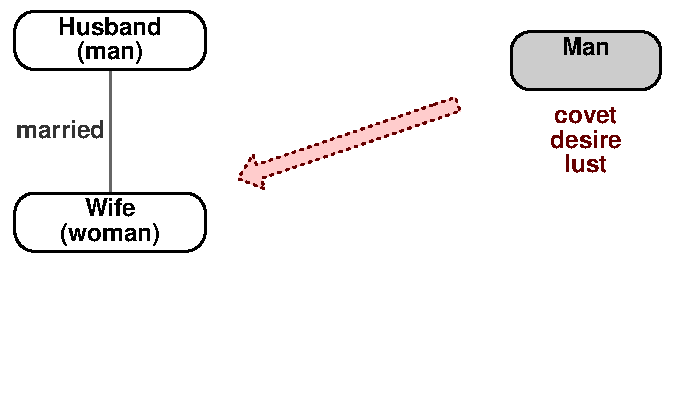
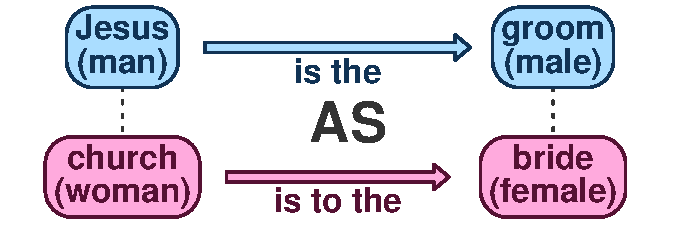
What "man" or "bird" would try to "separate" a "woman" or "wife" from her "man" or "husband"?
What "man" or "bird" would try to "separate" the "bride" or "church" from her "groom" or "Jesus"?
What might be the connection between these two ideas? That was the subject of the previous discourse in Matthew 18.
The Greek word for
"asunder" is from and has the
Greek word for
"mountain" in it. The example used in the previous chapter was of a "
sheep" going "
on" the "
mountain" or
"definition" to be
"great".
17. Matthew 19:11 Give way
Matthew 19:11 But he said unto them, All men cannot receive this saying, save they to whom it is given. [kjv]
ο δε ειπεν αυτοις ου παντες χωρουσιν τον λογον τουτον αλλ οις δεδοται [gnt]
The ancient Greek word
"χωρέω" ≈ "give ground, give way".
☐
All cannot give ground to this saying.
☐
All cannot give way to this saying.
Since the translators (and later commentators, pastors, etc.) could not
"give way" to this saying (separate literal from intended meaning), they came up with the word
"receive" or "
accept" to fit their literal interpretation. This then goes into the Bible dictionaries as the actual meaning intended by Jesus.
A play on words may be with the ancient Greek word
"χωρίζω" ≈ "separate, divide, distinguish" and is the source of the English word
"horizen". This word was used in Matthew 19:6 (5 verses earlier).
☐
All cannot separate this saying (literal from intended meaning). (Who might this be?)
18. Matthew 19:12 Make room
Matthew 19:12 For there are some eunuchs, which were so born from their mother's womb: and there are some eunuchs, which were made eunuchs of men: and there be eunuchs, which have made themselves eunuchs for the kingdom of heaven's sake. He that is able to receive it, let him receive it. [kjv]
εισιν γαρ ευνουχοι οιτινες εκ κοιλιας μητρος εγεννηθησαν ουτως και εισιν ευνουχοι οιτινες ευνουχισθησαν υπο των ανθρωπων και εισιν ευνουχοι οιτινες ευνουχισαν εαυτους δια την βασιλειαν των ουρανων ο δυναμενος χωρειν χωρειτω [gnt]
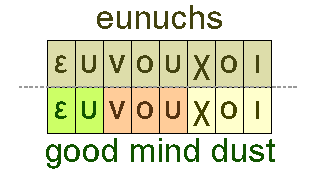
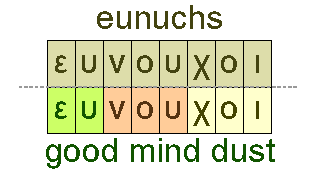
Whatever is meant by the words translated as
"eunuchs", anyone that has the
"potential" to
"make room" or
"understand" should
"make room" and
"understand". That is, rightly
"divide" multiple meanings.
The Greek word translated as
"of" "
men" is that of
"under" "
men". The Greek word translated as
"for" "
heaven" is that of
"through" or
"by" "
heaven" where the "
kingdom" of "
heaven" has (at least) two senses - one good and one not good..
19. Matthew 19:12
Matthew 19:12 For there are some eunuchs, which were so born from their mother's womb: and there are some eunuchs, which were made eunuchs of men: and there be eunuchs, which have made themselves eunuchs for the kingdom of heaven's sake. He that is able to receive it, let him receive it. [kjv]
εισιν γαρ ευνουχοι οιτινες εκ κοιλιας μητρος εγεννηθησαν ουτως και εισιν ευνουχοι οιτινες ευνουχισθησαν υπο των ανθρωπων και εισιν ευνουχοι οιτινες ευνουχισαν εαυτους δια την βασιλειαν των ουρανων ο δυναμενος χωρειν χωρειτω [gnt]
Whatever is meant by the words translated as
"eunuchs", there appear to be three sources.
nature ("out of" the "mother") [wolves three-ness - harlot]
nurture ("under" "men")
other (from "self" "through" the "kingdom" of "heaven")
20. Jeremiah 13:23 Nature and nurture and leopard spots
Jeremiah 13:23 Can the Ethiopian change his skin, or the leopard his spots? then may ye also do good, that are accustomed to do evil. [kjv]
ει αλλαξεται αιθιοψ το δερμα αυτου και παρδαλις τα ποικιλματα αυτης και υμεις δυνησεσθε ευ ποιησαι μεμαθηκοτες τα κακα [lxx]
Is it
nature (e.g., genetics) or
nurture (e.g., environment)? Is it a combination of these?
Jeremiah uses that analogy to tell the people that they have learned to do some of the bad things that they do and they need not be bad in that way.
21. Matthew 19:12 Eunuchs
Matthew 19:12 For there are some eunuchs, which were so born from their mother's womb: and there are some eunuchs, which were made eunuchs of men: and there be eunuchs, which have made themselves eunuchs for the kingdom of heaven's sake. He that is able to receive it, let him receive it. [kjv]
εισιν γαρ ευνουχοι οιτινες εκ κοιλιας μητρος εγεννηθησαν ουτως και εισιν ευνουχοι οιτινες ευνουχισθησαν υπο των ανθρωπων και εισιν ευνουχοι οιτινες ευνουχισαν εαυτους δια την βασιλειαν των ουρανων ο δυναμενος χωρειν χωρειτω [gnt]
If Jesus had meant physical and literal
eunuchs, then, in the limit of everyone following that advice, the entire world would cease to exist in 120 years.
Note: UNIX is an operation system on which the play on words with
eunuchs is often made. Linus Torvalds rewrote the UNIX kernel and that Open Source rewrite became known as Linux.
22. Matthew 19:12 Eunuchs
Matthew 19:12 For there are some eunuchs, which were so born from their mother's womb: and there are some eunuchs, which were made eunuchs of men: and there be eunuchs, which have made themselves eunuchs for the kingdom of heaven's sake. He that is able to receive it, let him receive it. [kjv]
εισιν γαρ ευνουχοι οιτινες εκ κοιλιας μητρος εγεννηθησαν ουτως και εισιν ευνουχοι οιτινες ευνουχισθησαν υπο των ανθρωπων και εισιν ευνουχοι οιτινες ευνουχισαν εαυτους δια την βασιλειαν των ουρανων ο δυναμενος χωρειν χωρειτω [gnt]
The
ancient Greek word
"εὐνοῦχος" ≈ "overseer of a harem, eunuch" and, in Christian theology, a person who abstains from sexual relations.
Except for the story in Acts 8 of the Ethiopian eunuch, this is the only place where this word is used in the
GNT (Greek New Testament). Perhaps Jesus was using this word as a code word with an additional meaning using a play on words.
Using the deeper meaning of what Jesus means, this may refer to a person who abstains from deceptions, seductions, etc., of the believers (sheep) of the body of Christ.
23. Strongs - eunuchs
*G2134 *2 εὐνουχίζω (yoo-noo-khid'-zo) : from G2135 εὐνοῦχος; to castrate (figuratively, live unmarried):--make...eunuch.
*G2135 *8 εὐνοῦχος (yoo-noo'-khos) : from eune (a bed) and G2192; a castrated person (such being employed in Oriental bed-chambers); by extension an impotent or unmarried man; by implication, a chamberlain (state-officer):--eunuch.
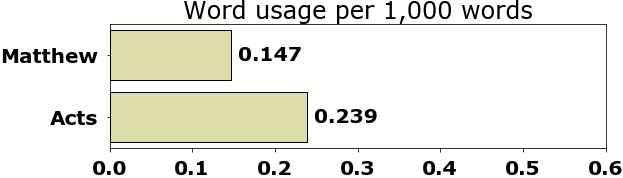 |
Words: ευνουχισαν=1 ευνουχισθησαν=1 ευνουχοι=3 ευνουχος=5
|
| Eunuch words in the GNT |
| 5 |
Matthew 19:12 |
| 5 |
Acts 8:27‑39 |
Aside from the story of the Ethiopian
eunuch in Acts 8 (five words). The other five words are used only by Jesus and all in Matthew 19:12.
The
ancient Greek word
"εὐνοῦχος" ≈ "overseer of a harem, eunuch" and, in Christian theology, a person who abstains from sexual relations.
24. Usage - eunuchs
- *G2134 *2 εὐνουχίζω (yoo-noo-khid'-zo) : from G2135 εὐνοῦχος; to castrate (figuratively, live unmarried):--make...eunuch.
ευνουχισθησαν
Matthew 19:12 ... eunuchs, which were made eunuchs of men: and there be eunuchs, which have made themselves eunuchs ...
ευνουχισαν
Matthew 19:12 ... eunuchs, which were made eunuchs of men: and there be eunuchs, which have made themselves eunuchs ...
- *G2135 *8 εὐνοῦχος (yoo-noo'-khos) : from eune (a bed) and G2192; a castrated person (such being employed in Oriental bed-chambers); by extension an impotent or unmarried man; by implication, a chamberlain (state-officer):--eunuch.
ευνουχος *5
Acts 8:27 ... behold, a man of Ethiopia, an eunuch of great authority under Candace queen ...
Acts 8:34 And the eunuch answered Philip, and said, I pray ...
Acts 8:36 ... a certain water: and the eunuch said, See, here is water; ...
Acts 8:38 ... both Philip and the eunuch; and he baptized him.
Acts 8:39 ... caught away Philip, that the eunuch saw him no more: ...
ευνουχοι *3
Matthew 19:12 For there are some eunuchs, which were so born from their mother's womb: and there are some eunuchs, which were made eunuchs ...
25. Matthew 19:12
Matthew 19:12 For there are some eunuchs, which were so born from their mother's womb: and there are some eunuchs, which were made eunuchs of men: and there be eunuchs, which have made themselves eunuchs for the kingdom of heaven's sake. He that is able to receive it, let him receive it. [kjv]
εισιν γαρ ευνουχοι οιτινες εκ κοιλιας μητρος εγεννηθησαν ουτως και εισιν ευνουχοι οιτινες ευνουχισθησαν υπο των ανθρωπων και εισιν ευνουχοι οιτινες ευνουχισαν εαυτους δια την βασιλειαν των ουρανων ο δυναμενος χωρειν χωρειτω [gnt]
The English word
"for" provides the idea of
"because". The Greek word
"through" provides the idea of
"provided by". Is there a difference?
.... eunuchized themselves for (because of) the kingdom of the heavens ...
.... eunuchized themselves through (provided by) the kingdom of the heavens ...
26. Matthew 19:12 Good mind
27. Matthew 19:12 Paraphrase using play on words
Matthew 19:12 For there are some eunuchs, which were so born from their mother's womb: and there are some eunuchs, which were made eunuchs of men: and there be eunuchs, which have made themselves eunuchs for the kingdom of heaven's sake. He that is able to receive it, let him receive it. [kjv]
Paraphrase:
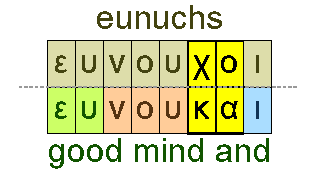
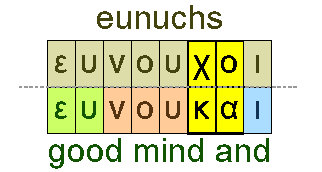
For there are eunuchs [good minds and (also)] that out of the womb [wolf] of the mother [three-ness] are born (come into being) which and (also) are eunuchs [good minds and (also)] that are made eunuchs [good minds divided like] under of men and there are eunuchs [good minds and (also)] through the kingdom of the heavens. Those who can /potentially make room for it, let them make room for it.
Some of the play on words (e.g., Spoonerisms) appear to refer to the not good part of what can happen.
28. Matthew 19:12
KJV: For there are some eunuchs, which were so born from their mother's womb: and there are some eunuchs, which were made eunuchs of men: and there be eunuchs, which have made themselves eunuchs for the kingdom of heaven's sake. He that is able to receive it, let him receive it.
Greek: εισιν γαρ ευνουχοι οιτινες εκ κοιλιας μητρος εγεννηθησαν ουτως και εισιν ευνουχοι οιτινες ευνουχισθησαν υπο των ανθρωπων και εισιν ευνουχοι οιτινες ευνουχισαν εαυτους δια την βασιλειαν των ουρανων ο δυναμενος χωρειν χωρειτω
29. Matthew 19:13 Children
30. Strongs - show honor to
*G2008 *29 ἐπιτιμάω (ep-ee-tee-mah'-o) : from G1909 and G5091; to tax upon, i.e. censure or admonish; by implication, forbid:--(straitly) charge, rebuke.
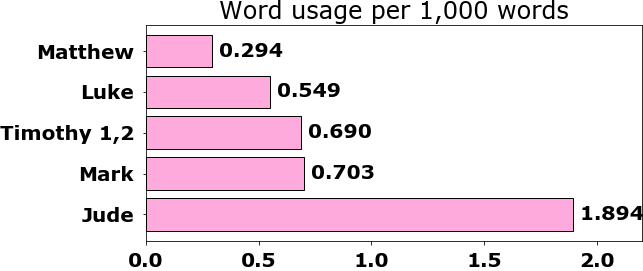 |
Words: επετιμα επετιμησαν επετιμησεν=14 επετιμων=4 επιτιμαν=2 επιτιμησαι επιτιμησας επιτιμησον=3 επιτιμων=2
|
The ancient Greek word
"ἐπιτιμάω" ≈ "show honor to, raise in price, object to one (as blamable)". In the
GNT, this word is usually translated as
"rebuke" unless Jesus in talking in which case it is often translated as
"charge" is an
"warn".
It is not clear how the meaning in the
GNT was decided as decisions appear to conflict with the meanings of the Greek word.
31. 2 Timothy 4:2 Reproof
The word
"reproof" is not the same as
"rebuke".
2 Timothy 4:2 Preach the word; be instant in season, out of season; reprove, rebuke, exhort with all longsuffering and doctrine. [kjv]
κηρυξον τον λογον επιστηθι ευκαιρως ακαιρως ελεγξον επιτιμησον παρακαλεσον εν παση μακροθυμια και διδαχη [gnt]
The word
"rebuke" has more of an official censure from a superior-subordinate relationship.
The word
"reproof" has more of an intellectual logical reasoning interchange. The
ancient Greek word
"ἔλεγχος" ≈ "argument of disproof, reproach". The
"reproach" appears to have been influenced and by subsequent theologians and translations of this word from the
GNT.
32. A reproof on the word rebuke
The word "
rebuke" is not the same as "
reproof".
The ancient Greek word
"ἐπιτιμάω" ≈ "honor, censure" so that the word can be good or not good depending on the context. In the
GNT and
LXX (Septuagint) it is in the "
censure" sense.
The ancient Greek prefix "επι" ≈ "on".
The ancient Greek word "τιμή" ≈ "honor, value, worth" as in the name "Timothy" which means "honoring God".
An important idea of a "
rebuke" is that the person doing the "
rebuke" is assuming a superior relationship to the one being rebuked who is therefore in a subordinate relationship.
33. Matthew 18:15 Refutations
Matthew 18:15 Moreover if thy brother shall trespass against thee, go and tell him his fault between thee and him alone: if he shall hear thee, thou hast gained thy brother. [kjv]
εαν δε αμαρτηση εις σε ο αδελφος σου υπαγε και ελεγξον αυτον μεταξυ σου και αυτου μονου εαν σου ακουση εκερδησας τον αδελφον σου [gnt]
The
"refutation" in the work "
Sophistic Refutations" by Aristotle uses this word for
"logical reasoning". The ancient Greek title
"Σοφιστικοί έλεγχοι" ≈ "Sophistic Refutations".
Aristotle is concerned with using "
good logical reasoning" to
"refute" "
bad logical reasoning" as in "
deception", (deliberate or otherwise).
34. Matthew 19:13 Rebuke
Matthew 19:13 Then were there brought unto him little children, that he should put his hands on them, and pray: and the disciples rebuked them. [kjv]
τοτε προσηνεχθη προσηνεχθησαν αυτω παιδια ινα τας χειρας επιθη αυτοις και προσευξηται οι δε μαθηται επετιμησαν αυτοις [gnt]
The
"rebuke" is an
observation by Matthew and not what Jesus says.
35. Matthew 19:13
KJV: Then were there brought unto him little children, that he should put his hands on them, and pray: and the disciples rebuked them.
Greek: τοτε προσηνεχθη προσηνεχθησαν αυτω παιδια ινα τας χειρας επιθη αυτοις και προσευξηται οι δε μαθηται επετιμησαν αυτοις
Latin: tunc oblati sunt ei parvuli ut manus eis inponeret et oraret discipuli autem increpabant eis
36. Matthew 19:14 Suffrage
Matthew 19:14 But Jesus said, Suffer little children, and forbid them not, to come unto me: for of such is the kingdom of heaven. [kjv]
ο δε ιησους ειπεν αφετε τα παιδια και μη κωλυετε αυτα ελθειν προς με των γαρ τοιουτων εστιν η βασιλεια των ουρανων [gnt]
The English word
"suffer" means to
"allow". The woman's suffrage movement was to
"allow" women to vote, etc. This is one of the themes in the Disney movie Mary Poppins, released in August 1964 and set in 1910 England.
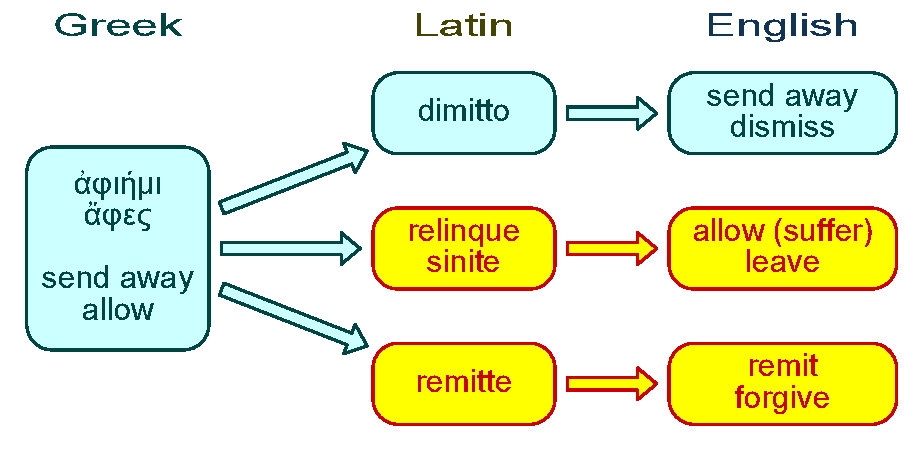
The Latin word
"sino" ≈ "let, permit, allow". The Greek for
"suffer" has to do with
"letting go" as in
"forgiving".
37. Matthew 19:14 Suffer the children
Matthew 19:14 But Jesus said, Suffer little children, and forbid them not, to come unto me: for of such is the kingdom of heaven. [kjv]
ο δε ιησους ειπεν αφετε τα παιδια και μη κωλυετε αυτα ελθειν προς με των γαρ τοιουτων εστιν η βασιλεια των ουρανων [gnt]
The ancient Greek word
"ἀφίημι" ≈ "send forth, send away" and is the word often used by the
KJV for "
suffer". The word is often used for "
forgive" as in "
release from" and comes from two Greek words.
"απο" ≈ "from" as in a separating distance.
"ἵημι" ≈ "release, let go".
Is the "
kingdom of heaven" used here best described as the "
realm" of an "
idea", a "
way", an "
area" or "
people" (or something else)?
38. Forgive the word slide
39. Strongs - prevent
*G2967 *23 κωλύω (ko-loo'-o) : from the base of G2849; to estop, i.e. prevent (by word or act):--forbid, hinder, keep from, let, not suffer, withstand.
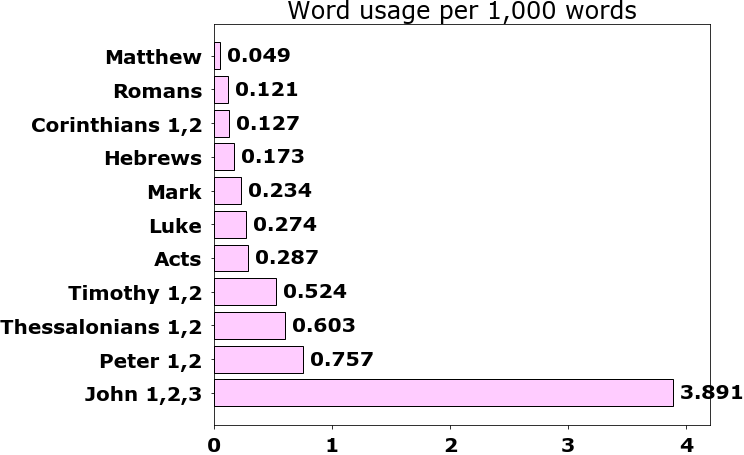 |
Words: εκωλυθην εκωλυομεν εκωλυσαμεν εκωλυσατε εκωλυσεν=2 κωλυει=2 κωλυειν κωλυεσθαι κωλυετε=6 κωλυθεντες κωλυοντα κωλυοντων=2 κωλυσαι=2 κωλυσης
|
The ancient Greek word
"κωλύω" ≈ "hinder, prevent" and appears to be pre-Greek in origin.
Other verbs of preventing usually take μή before the infinitive, but this is not the case with κωλύω.
40. Usage - prevent
- *G2967 *23 κωλύω (ko-loo'-o) : from the base of G2849; to estop, i.e. prevent (by word or act):--forbid, hinder, keep from, let, not suffer, withstand.
κωλυετε *6 of 23
Matthew 19:14 ... Suffer little children, and forbid them not, to come ...
Mark 9:39 But Jesus said, Forbid him not: for ...
Mark 10:14 ... unto me, and forbid them not: for ...
Luke 9:50 ... said unto him, Forbid him not: for he ...
Luke 18:16 ... unto me, and forbid them not: for ...
1 Corinthians 14:39 ... covet to prophesy, and forbid not to speak with tongues.
41. Matthew 19:14 Forbid the prevent
Matthew 19:14 But Jesus said, Suffer little children, and forbid them not, to come unto me: for of such is the kingdom of heaven. [kjv]
ο δε ιησους ειπεν αφετε τα παιδια και μη κωλυετε αυτα ελθειν προς με των γαρ τοιουτων εστιν η βασιλεια των ουρανων [gnt]
The ancient Greek word
"κωλύω" ≈ "hinder, prevent" and appears to be pre-Greek in origin.
Would the religious elite ever try to "keep" "children", as in "believers", from going/coming to (their vision of) Jesus? Explain.
Would the religious elite ever try to "force" or "lead" "children", as in "believers", into going/coming to (their vision of) Jesus? Explain.
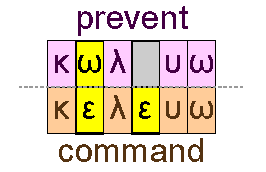
"κελεύω" ≈ "urge, command". Does a "leader" ever do this?
"κωλύω" ≈ "hinder, prevent". Does a "leader" ever do this?
Might there be e play on words here?
42. Words: Follow as not commanding
Matthew 10:38 And he that taketh not his cross, and followeth after me, is not worthy of me. [kjv]
και ος ου λαμβανει τον σταυρον αυτου και ακολουθει οπισω μου ουκ εστιν μου αξιος [gnt]
10:39 He that findeth his life shall lose it: and he that loseth his life for my sake shall find it. [kjv]
ο ευρων την ψυχην αυτου απολεσει αυτην και ο απολεσας την ψυχην αυτου ενεκεν εμου ευρησει αυτην [gnt]
The English word
"acolyte" comes from the late Latin word
"acolythus" ≈ "acolyte" which comes from the ancient Greek word
"ἀκόλουθος" ≈ "following, attending". That word comes from
"κέλευθος" ≈ "road, way, path" which is from
"κελεύω" ≈ "urge, command" which appears in the
KJV and the
LXX.
The idea appears to be that if one is not commanding or leading than one is following or attending. We are told to be "
followers" and not "
leaders" in the human sense of the word. An interesting use of the word for
"command" appears in a verse for the "
rapture" and often translated as
"shout".
43. Matthew 19:14
KJV: But Jesus said, Suffer little children, and forbid them not, to come unto me: for of such is the kingdom of heaven.
Greek: ο δε ιησους ειπεν αφετε τα παιδια και μη κωλυετε αυτα ελθειν προς με των γαρ τοιουτων εστιν η βασιλεια των ουρανων
Latin: Iesus vero ait eis sinite parvulos et nolite eos prohibere ad me venire talium est enim regnum caelorum
Wessex: Ða cwaeð se haelend. laeteð þa litlingas. & nelle ge hyo for-beodan cuman to me. swilcre ys heofena rice.
Wycliffe: And the disciplis blamyden hem. But Jhesus seide to hem, Suffre ye that litle children come to me, and nyle ye forbede hem; for of siche is the kyngdom of heuenes.
Tyndale: But Iesus sayde: suffre the chyldren and forbid them not to come to me: for of suche is the kyngdome of heven.
Luther: Aber Jesus sprach: Lasset die Kindlein und wehret ihnen nicht, zu mir zu kommen; denn solcher ist das Himmelreich.
Spanish: Pero Jesús dijo: Dejad a los niños venir a mí, y no se los impidáis, porque de los tales es el reino de los cielos.
44. Matthew 19:15
Matthew 19:15 And he laid his hands on them, and departed thence. [kjv]
και επιθεις αυτοις τας χειρας αυτοις επορευθη εκειθεν [gnt]
This is commentary by Matthew.
This ends this short session. The next is about to start.
45. Matthew 19:15
KJV: And he laid his hands on them, and departed thence.
Greek: και επιθεις αυτοις τας χειρας αυτοις επορευθη εκειθεν
46. Matthew 19:16-20 Context
Matthew 19:16 And, behold, one came and said unto him, Good Master, what good thing shall I do, that I may have eternal life? [kjv]
19:17 And he said unto him, Why callest thou me good? there is none good but one, that is, God: but if thou wilt enter into life, keep the commandments. [kjv]
19:18 He saith unto him, Which? Jesus said, Thou shalt do no murder, Thou shalt not commit adultery, Thou shalt not steal, Thou shalt not bear false witness, [kjv]
19:19 Honour thy father and thy mother: and, Thou shalt love thy neighbour as thyself. [kjv]
19:20 The young man saith unto him, All these things have I kept from my youth up: what lack I yet? [kjv]
Why the
order of commandments? What is "
lacking" in the young man?
47. Matthew 19:20-21 Verses
Matthew 19:20 The young man saith unto him, All these things have I kept from my youth up: what lack I yet? [kjv]
19:21 Jesus said unto him, If thou wilt be perfect, go and sell that thou hast, and give to the poor, and thou shalt have treasure in heaven: and come and follow me. [kjv]
Can you be "perfect"? The Greek meaning is different.
What is it that one "hast" and who has it? (mistranslation and changed word order). This is a key word in the verse.
Who are the "poor"? How might giving all the possessions that one has to the "poor" help them spiritually?
What exactly is "treasure" in "heaven"? Do you have that "treasure" before you "follow" Jesus?
48. End of page