Send
Close Add comments:
(status displays here)
Got it! This site "creationpie.org" uses cookies. You consent to this by clicking on "Got it!" or by continuing to use this website. Note: This appears on each machine/browser from which this site is accessed.
Luke 11:5-8: Parable of the friend at midnight
1. Matthew 6:7-8 Vain repetitions of vain repetitions
Matthew 6:7 But when ye pray, use not vain repetitions, as the heathen do: for they think that they shall be heard for their much speaking. [kjv]
προσευχομενοι δε μη βαττολογησητε βατταλογησητε ωσπερ οι εθνικοι δοκουσιν γαρ οτι εν τη πολυλογια αυτων εισακουσθησονται [gnt]
orantes autem nolite multum loqui sicut ethnici putant enim quia in multiloquio suo exaudiantur [v]

In Matthew 6:7, as part of the "
Sermon on the Mount", Jesus says not to pray using
"vain repetitions" as the "
heathen" do.
This is a specific instance of the idea that "
if some is good then more is better". Some pastors (and others) boast that as a child (or even now) they repeat the Lord's Prayer every night.
A few verses later is the "
Lord's Prayer" which, as an example, does not have repetitions within itself, but could be repeated at different times.
Some pastors appear to think that they get "
paid by the word" according to quantity and not quality. At times producing meaningless or even deceptive content, they may lecture their congregations about trying to keep the pastor to any time schedule.
2. Matthew 6:9-13 Lord's Prayer in Matthew
The Lord's prayer is in Matthew 6:9-13. The immediate context includes Matthew 6:7-15.
As with any verses, the
context of the Lord's Prayer is important. The general context is in the middle of the Sermon on the Mount.
Our Father which art in heaven, Hallowed be thy name.
Thy kingdom come. Thy will be done in earth, as it is in heaven.
Give us this day our daily bread.
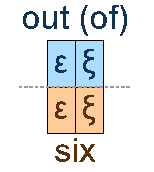
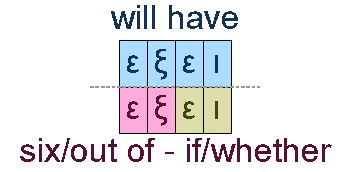
And forgive us our debts, as we forgive our debtors.
And lead us not into temptation, but deliver us from evil:
For thine is the kingdom, and the power, and the glory, for ever.
Amen.
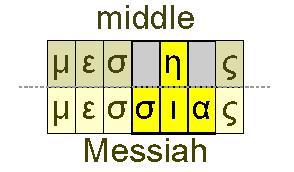
|
3. An even better interpretation
Matthew 6:14 For if ye forgive men their trespasses, your heavenly Father will also forgive you: [kjv]
εαν γαρ αφητε τοις ανθρωποις τα παραπτωματα αυτων αφησει και υμιν ο πατηρ υμων ο ουρανιος [gnt]
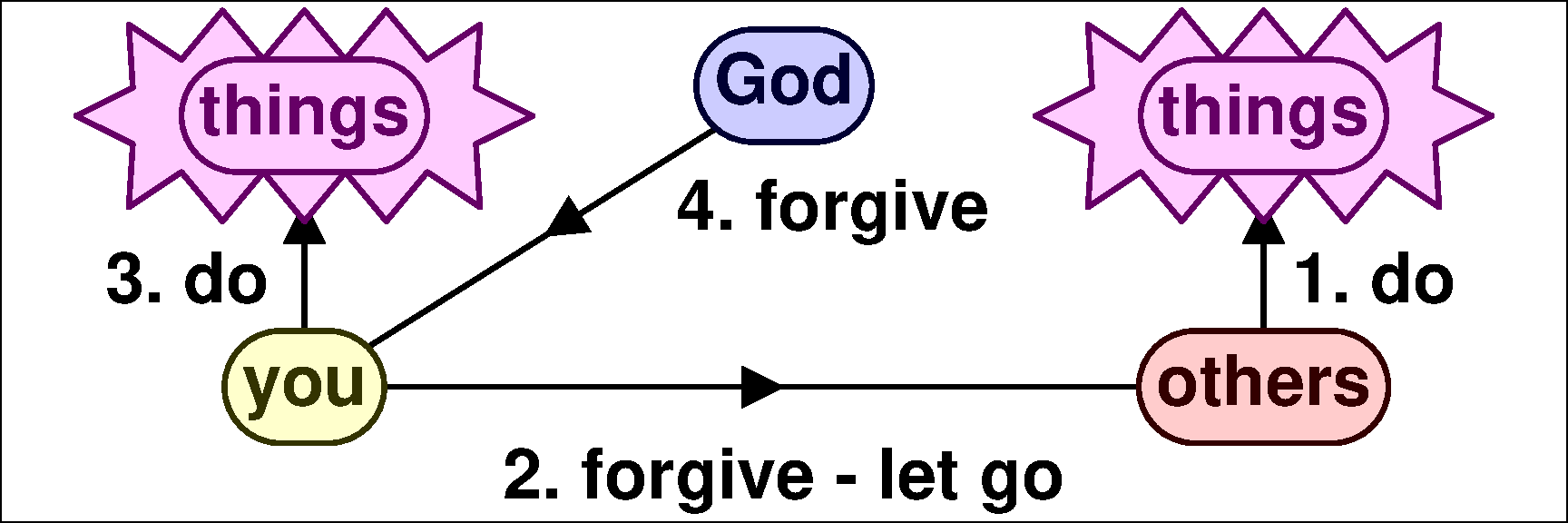
The "
things" can be thought of as "
stupid things" as a simplification of the ancient Greek word (used here)
"παράπτωσις" ≈ "impetuous pursuit, going astray". The parts of the word mean, literally, going "
beyond falling".
4. Luke 11:1-4: Lord's Prayer in Luke
Luke 11:1 And it came to pass, that, as he was praying in a certain place, when he ceased, one of his disciples said unto him, Lord, teach us to pray, as John also taught his disciples. [kjv]
11:2 And he said unto them, When ye pray, say, Our Father which art in heaven, Hallowed be thy name. Thy kingdom come. Thy will be done, as in heaven, so in earth. [kjv]
11:3 Give us day by day our daily bread. [kjv]
11:4 And forgive us our sins; for we also forgive every one that is indebted to us. And lead us not into temptation; but deliver us from evil. [kjv]
Luke appears to have arranged what people remembered and told him into a reasonable order. The Lord's Prayer in Luke is followed by the parable of the friend at midnight, which has to do with
"bread".
5. Parable of the friend at midnight
|
|
Luke 11:5 And he said unto them, Which of you shall have a friend, and shall go unto him at midnight, and say unto him, Friend, lend me three loaves; [kjv]
11:6 For a friend of mine in his journey is come to me, and I have nothing to set before him? [kjv]
11:7 And he from within shall answer and say, Trouble me not: the door is now shut, and my children are with me in bed; I can not rise and give thee. [kjv]
11:8 I say unto you, Though he will not rise and give him, because he is his friend, yet because of his importunity he will rise and give him as many as he needeth. [kjv]
|
Who are the "friends"? Who is a "friend" of whom?
What is "importunity"? Who in the story has "importunity"?
6. Microsoft Co-Pilot AI
Question: What is the meaning of the parable of the friend at midnight in Luke 11:5-8? Some answers:
Core meaning: Persistence in prayer – The parable’s main point is that believers should keep asking, keep seeking, and keep knocking (Luke 11:9–10). Just as the neighbor’s persistence compelled the friend to act, so too should prayers persist in asking God for what is in His will.
Application: For Christians, the parable is a call to pray with persistence, confidence, and faith, trusting that God will grant what aligns with His will. It also warns against asking with wrong motives (James 4:3) and emphasizes that God’s response is rooted in His love and mercy, not our “shameless” tactics.
In short, Jesus uses the parable to show that God, unlike a reluctant neighbor, is eager to meet our needs when we persist in prayer with faith and confidence
Microsoft Co-Pilot AI. (as of 2026-11-10)
7. Attractive refrigerator magnet sermons
A "
refrigerator magnet sermon" is a sermon that is quite "
attractive" but contains
little meaningful content - from what the Bible says (after adjusting for translation issues, etc.). Such sermons can be preached in
any church. A euphemism for a "
refrigerator magnet sermon" is
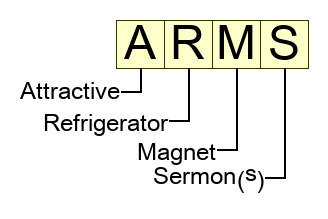
ARMS (Attractive Refrigerator Magnet Sermons).
When someone asks you what you thought of the church or sermon, you can say:
☐ "
Your church has real open ARMS."
☐ "
I felt welcomed with open ARMS"
☐ "
That preaching was an great example of open ARMS."
Note: A "
refrigerator magnet sermon" not of the polarity of the congregation is "
repulsive"
unlike actual magnets where opposite poles attract.
8. Luke 11:5-8: Parable of the friend at midnight
Luke 11:5 And he said unto them, Which of you shall have a friend, and shall go unto him at midnight, and say unto him, Friend, lend me three loaves; [kjv]
και ειπεν προς αυτους τις εξ υμων εξει φιλον και πορευσεται προς αυτον μεσονυκτιου και ειπη αυτω φιλε χρησον μοι τρεις αρτους [gnt]
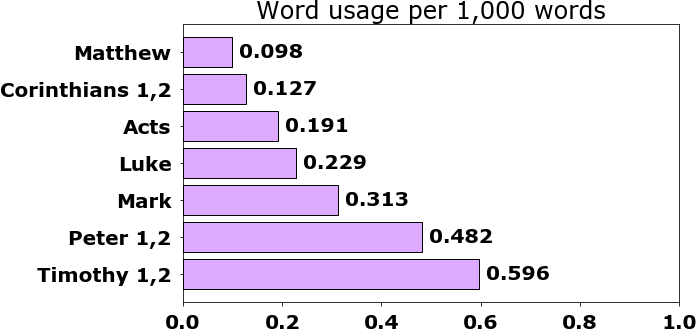
The parable by Jesus of the friend at midnight is in Luke 11:5-8. One take-away is that one should not be afraid to ask repeatably for literal daily bread. A comparison is often made to the parable of the unjust judge in Luke 18.
In Greek, the
"three" (as usual) precedes the
"loaves". Jesus tends not to use the word
"three" in a good sense.
Is this really what the parable of the friend at midnight means? Let us first look at a more traditional literal view of the verses and then analyze them in more detail (translation issues, ambiguous pronouns, play on words, etc.).
Some older content, not yet integrated, is at
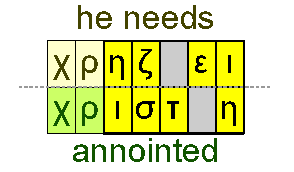
Luke 11:5-8: Parable of the friend at midnight - extra.
9. Luke 11:5
Luke 11:5 And he said unto them, Which of you shall have a friend, and shall go unto him at midnight, and say unto him, Friend, lend me three loaves; [kjv]
και ειπεν προς αυτους τις εξ υμων εξει φιλον και πορευσεται προς αυτον μεσονυκτιου και ειπη αυτω φιλε χρησον μοι τρεις αρτους [gnt]
The
ancient Greek word
"πορεύω" ≈ "go, carry, convey".
The Greek for
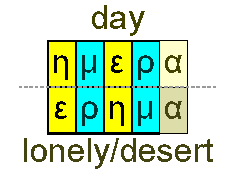
"midnight" is, literally, the "
middle of the night". There are three
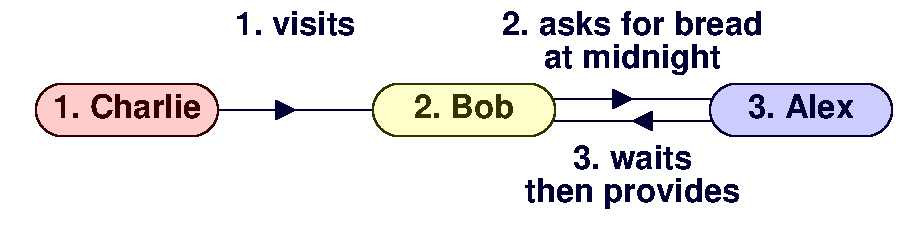
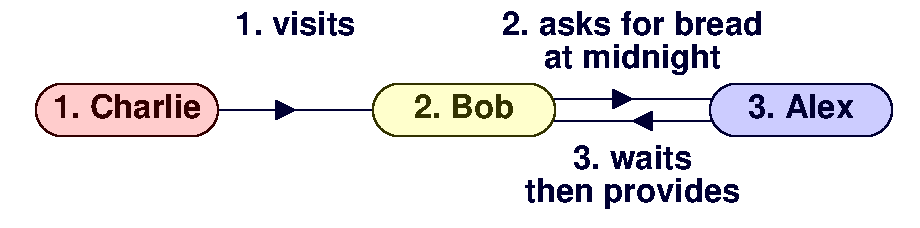
"friends" in the story. We will identify them as follows.
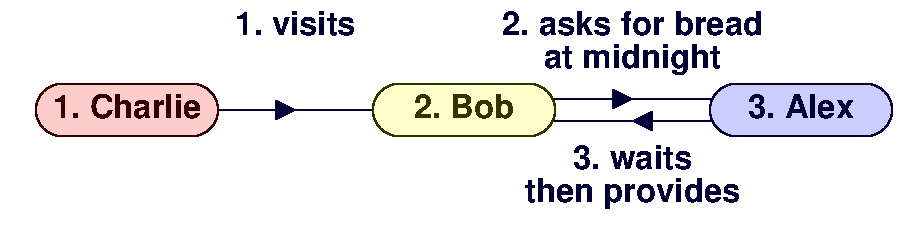
Friend#1 Charlie came to Friend#2 Bob as (an invited) guest.
Friend#2 Bob goes to Friend#3 Alex at midnight for bread.
Friend#3 Alex is sleeping with his family at midnight.
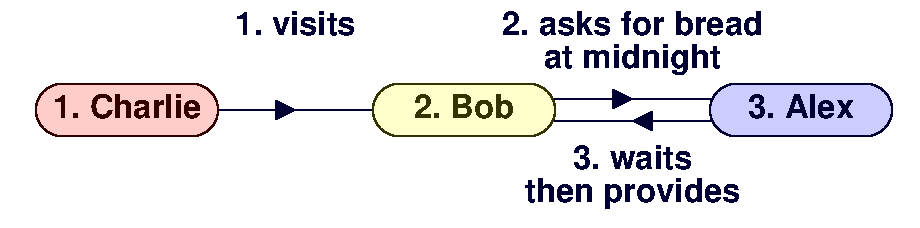
Who is
Friend#1 Charlie?
10. Midnight
Proverbs 27:14 He that blesseth his friend with a loud voice, rising early in the morning, it shall be counted a curse to him. [kjv]
ος αν ευλογη φιλον το πρωι μεγαλη τη φωνη καταρωμενου ουδεν διαφερειν δοξει [lxx]
Whosoever shall bless a friend in the morning with a loud voice, shall seem to differ nothing from one who curses him. [bs3]
Being woken up at midnight or early in the morning is not appreciated.
The early worm gets eaten by the bird.
Are you more of a
morning person or
evening person?
Early morning noises: breathing, lip-flapping, snoring, log-sawing.
[functional equivalence, black boxes, wife waking up grumpy]
11. Early bird and the worm
Have you heard that "
the early bird gets the worm"? From the other side, it might be said that "
the early worm gets eaten by the bird".
The full saying is "
The early bird gets the worm, but the second mouse gets the cheese!".
That is, the first mouse gets eaten by the cat. A Biblical parody of this (source unknown) is "
Blessed is the second mouse for he shall inherit the cheese."
Matthew 5:5 Blessed are the meek: for they shall inherit the earth. [kjv]
12. Luke 11:5 Both ways
Jesus is speaking.
Luke 11:5 And he said unto them, Which of you shall have a friend, and shall go unto him at midnight, and say unto him, Friend, lend me three loaves; [kjv]
Three
"loaves" of what? Yes sir, yes sir,
"three" bags full.
Can we look at it both ways?
You are Friend#2 Bob and you go to Friend#3 Alex.
You are Friend#3 Alex and Friend#2 Bob comes to you.
Who is Friend#1 Charlie?
Is there another way? Are these relationships at the peer level? The parable of the unjust judge involves a subordinate and superior. So does the woman begging scraps from the master's table.
13. 2 Kings 10:18
2 Kings 10:18 And Jehu gathered all the people together, and said unto them, Ahab served Baal a little; but Jehu shall serve him much. [kjv]
και συνηθροισεν ιου παντα τον λαον και ειπεν προς αυτους αχααβ εδουλευσεν τω βααλ ολιγα και γε ιου δουλευσει αυτω πολλα [lxx]
The "
leader" will always want you to say "
aye aye" and agree with them.
Yes sir, yes sir, three bags full. (from the children's poem
Baa baa black sheep, have you any wool.)
14. Luke 11:6
Luke 11:6 For a friend of mine in his journey is come to me, and I have nothing to set before him? [kjv]
Hospitality at that time was important. The literal view only needs to make plausible sense - if one does not look too deeply at the details. Some make a great effort to rationalize the literal view.
The Greek for "
journey" is the same word the early Christians used for the "
way", the word in "
exodus" as the "
way out".
Discuss: Why might Friend#2 Bob not have been prepared?
Discuss: What might the "bread" represent?
What type of friend is Friend#1 Charlie?
We are talking about a
"friend" of a
"friend". This is a "
meta friend".
15. Luke 11:7
Luke 11:7 And he from within shall answer and say, Trouble me not: the door is now shut, and my children are with me in bed; I can not rise and give thee. [kjv]
Friend#3 Alex at first makes excuses, providing reasons why he cannot help.
Jesus tells a parable about two people being asked to do something.
One says he will not do it, then does it.
One says he will do it, then does not.
Jesus asks which did the will of the father/Father.
16. Luke 11:8
Luke 11:8 I say unto you, Though he will not rise and give him, because he is his friend, yet because of his importunity he will rise and give him as many as he needeth. [kjv]
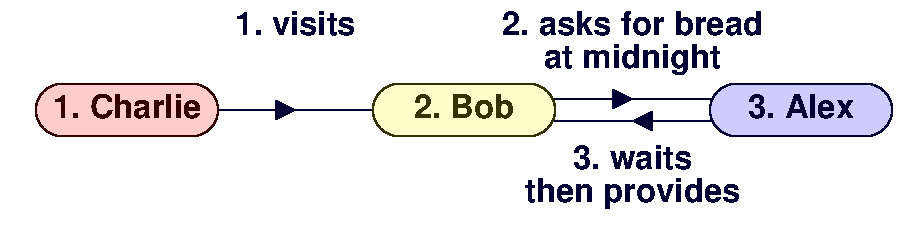 Friend#3 Alex
gave
Friend#2 Bob what he "
needs" and, perhaps, not what he "
wants". What is the difference?
One view: The Friend#2 Bob is "impudent". That is, he has gone "beyond" and has "fallen" in his desired obligation to Friend#1 Charlie and wants Friend#3 Alex rectify the situation, at midnight - not a convenient time.
Another view: Friend#3 Alex is "impudent" because hospitality is due, regardless of the time of day.
Which is correct? Can they both be correct?
17. Transitive relation
Most theological thought is that the friend being asked is Jesus.
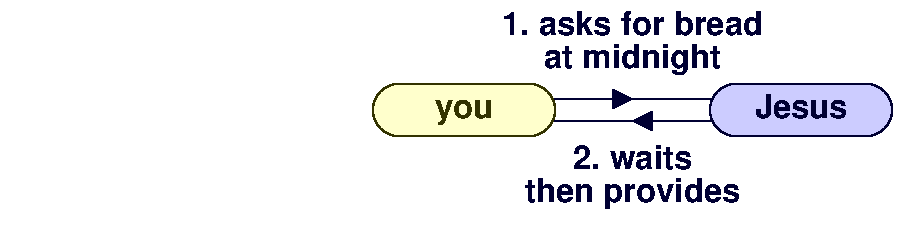 |
Are you the one asking Jesus?
|
 |
Are you the one getting asked by others?
|
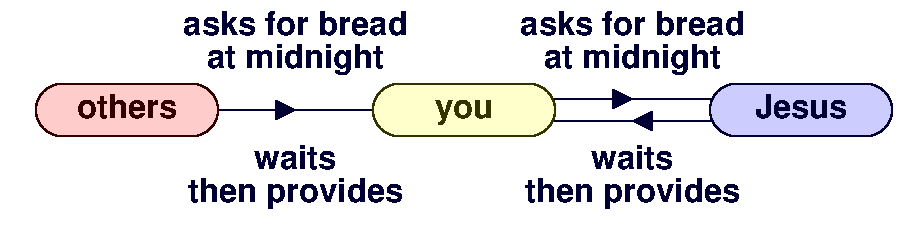 |
We can combine both to get a transitive relationship.
|
Paraphrase:
You should do unto others (within the limits of God's laws) what you would want Jesus to do unto you.
18. Luke 11:9
The verse right after the parable of the friend at midnight is the following.
Luke 11:9 And I say unto you, Ask, and it shall be given you; seek, and ye shall find; knock, and it shall be opened unto you. [kjv]
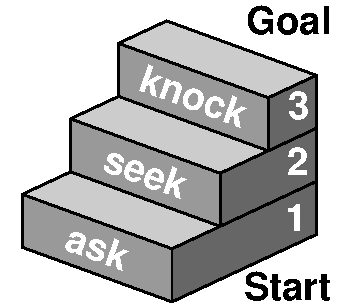
Jesus continues with the "
ask", "
seek" and "
knock" sequence. Discuss the following.
Is the "
ask" meant to mean to not prepare and "
seek" your friend at midnight and "
knock" to make requests?
19. Context
Note that Luke puts the "
parable of the friend at midnight" right after the Lord's Prayer. The verses right after the Lord's Prayer in Matthew appear to fit well with the "
parable of the friend at midnight". What might be the significance of this?
Discuss: What are the similarities and differences between the "
parable of the unjust judge" and the "
parable of the friend at midnight"?
20. Parable of the ten virgins
In the "
parable of the ten virgins", half are prudent and half are not.
The half that are not prudent did not get ready for the bridegroom (Jesus coming). The half that were wise did get ready. They do not accede to the request by the half who did not get ready to give them some of their oil to light the lamps.
Discuss: What are the similarities and differences between the "
parable of the ten virgins" and the "
parable of the friend at midnight"?
When Jesus washes the feet of the disciples, Peter asks for his head also. Jesus puts limits on what is needed.
Discuss: What limits should be put on requests made by friends?
21. Luke 11:8 Pronouns
Luke 11:8 I say unto you, Though he will not rise and give him, because he is his friend, yet because of his importunity he will rise and give him as many as he needeth. [kjv]
λεγω υμιν ει και ου δωσει αυτω αναστας δια το ειναι αυτου φιλον αυτου δια γε την αναιδειαν αυτου εγερθεις δωσει αυτω οσων χρηζει [gnt]
|
1. "he" (give verb implied).
2. "to him" (dative pronoun).
3. "he" (is verb implied).
4. "of him" (genitive pronoun).
5. "of him" (genitive pronoun).
6. "he" (rise verb implied).
7. "he" (give verb implied).
8. "to him" (dative pronoun).
9. "he" (need verb implied).
|
There appear to be
three persons in the (short) parable. To whom do each of the pronouns in this ending verse refer? For each, it could be "
it".
Note that
39 =
19683 ways to assign
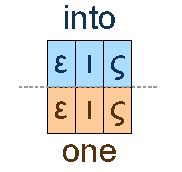
three people to pronouns. Not all make sense. Which mapping was chosen as the approved solution? What others might make sense? Would any missing non-verbal communication (hand movements, eye movements, head position, facial expressions, etc.) help? Jesus uses these in the Sermon on the Mount (and elsewhere).
Luke puts these verses between two groups of verses that correspond to the Sermon on the Mount.
22. Strongs - lend
- *G5531 *1 χράω (khrah'-o) : probably the same as the base of G5530; to loan:--lend.
23. Luke 11:5 Useful
Luke 11:5 And he said unto them, Which of you shall have a friend, and shall go unto him at midnight, and say unto him, Friend, lend me three loaves; [kjv]
και ειπεν προς αυτους τις εξ υμων εξει φιλον και πορευσεται προς αυτον μεσονυκτιου και ειπη αυτω φιλε χρησον μοι τρεις αρτους [gnt]
… vestrum … amicum … media nocte … amice commoda … tres panes [v]
The
ancient Greek word
"χρῆσις" ≈ "use, utility, intimacy" and comes from
"χρἄω" ≈ "use, lend, declare". The
Latin word
"commodus" ≈ "suitable, useful" or
"commodus" ≈ "fit, suitable, opportune".
Friend:
☐
Make use/useful to me
three loaves!
☐
Lend to me
three loaves! Do I need to give them back later?
☐
Declare to me
three loaves!
What have these
loaves been doing?
Loafing? Do you have a
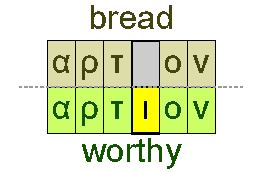
breader answer? How about a
butter answer? A
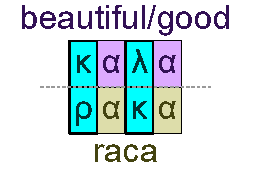
marginal one might do. Why
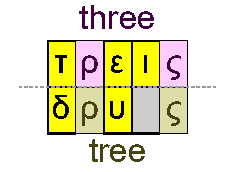
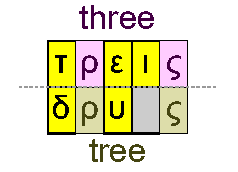
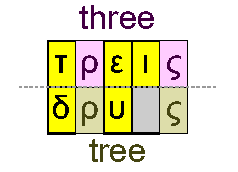
three? Maybe it's a special deal - a
tree for all!
24. Strongs - gain possession
*G2192 *701 ἔχω (ekh'-o) : scheo skheh'-o; (used in certain tenses only) a primary verb; to hold (used in very various applications, literally or figuratively, direct or remote; such as possession; ability, contiuity, relation, or condition):--be (able, X hold, possessed with), accompany, + begin to amend, can(+ -not), X conceive, count, diseased, do + eat, + enjoy, + fear, following, have, hold, keep, + lack, + go to law, lie, + must needs, + of necessity, + need, next, + recover, + reign, + rest, + return, X sick, take for, + tremble, + uncircumcised, use.
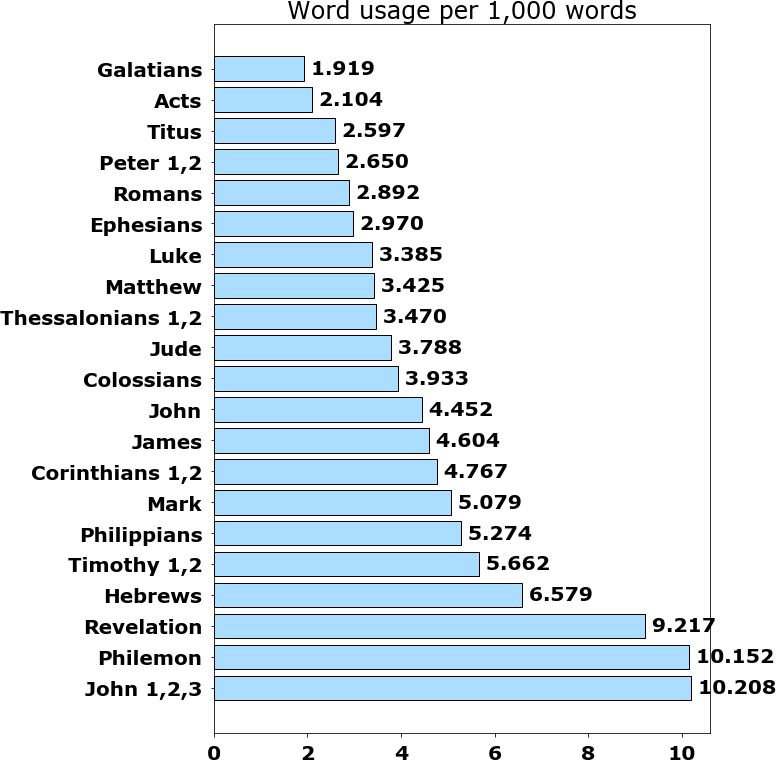 |
Words: ειχαν=2 ειχε ειχεν=24 ειχετε=3 ειχομεν ειχον=18 ειχοσαν=2 εξει=6 εξεις=4 εξετε εξουσιν=2 εσχεν=5 εσχες εσχηκα εσχηκαμεν=2 εσχηκεν εσχηκοτα εσχομεν εσχον=5 εχε=4 εχει=102 εχειν=30 εχεις=27 εχετε=50 εχετω=3 εχη=11 εχητε=11 εχοι=2 εχοιεν εχομεν=41 εχομενα εχομενας εχομενη=3 εχον=4 εχοντα=29 εχοντας=16 εχοντες=46 εχοντι=10 εχοντος=5 εχοντων=9 εχουσα=15 εχουσαι=3 εχουσαις=3 εχουσαν=6 εχουση εχουσης=2 εχουσι=2 εχουσιν=32 εχω=46 εχωμεν=6 εχων=85 εχωσι εχωσιν=5 σχητε σχω=5 σχωμεν=2
|
25. Usage - gain possession
26. Luke 11:5 Will have
Luke 11:5 And he said unto them, Which of you shall have a friend, and shall go unto him at midnight, and say unto him, Friend, lend me three loaves; [kjv]
και ειπεν προς αυτους τις εξ υμων εξει φιλον και πορευσεται προς αυτον μεσονυκτιου και ειπη αυτω φιλε χρησον μοι τρεις αρτους [gnt]
The
ancient Greek word
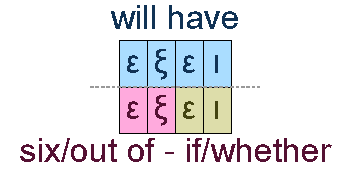
"εξει" ≈ "will have" (used one time by Jesus in Matthew and one time in Luke) from
"ἔχω" ≈ "have".
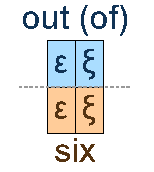
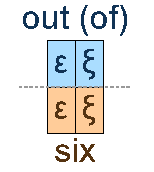
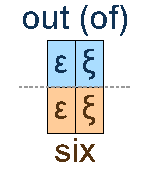
Does it appear that, for some reason, Jesus is bringing out the idea of the number "
six"? The
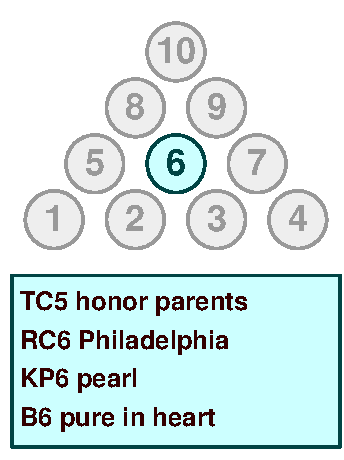
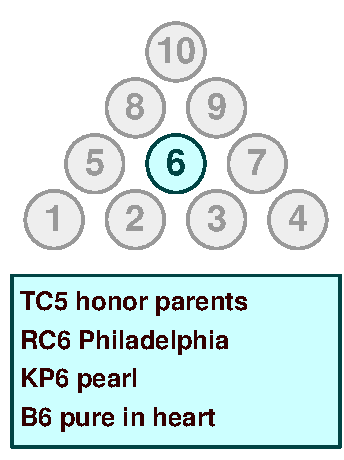
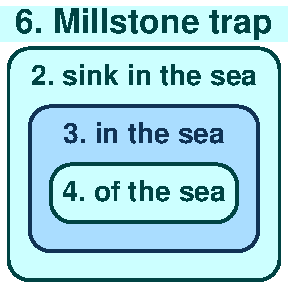
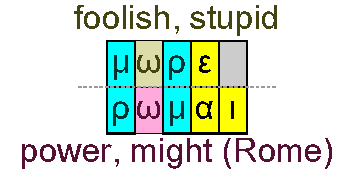
node 6 of the Ten Pin model has to do with tradition, the millstone deception, etc.
27. Luke 11:5,8 Friend
Luke 11:5 And he said unto them, Which of you shall have a friend, and shall go unto him at midnight, and say unto him, Friend, lend me three loaves; [kjv]
και ειπεν προς αυτους τις εξ υμων εξει φιλον και πορευσεται προς αυτον μεσονυκτιου και ειπη αυτω φιλε χρησον μοι τρεις αρτους [gnt]
11:8 I say unto you, Though he will not rise and give him, because he is his friend, yet because of his importunity he will rise and give him as many as he needeth. [kjv]
λεγω υμιν ει και ου δωσει αυτω αναστας δια το ειναι αυτου φιλον αυτου δια γε την αναιδειαν αυτου εγερθεις δωσει αυτω οσων χρηζει [gnt]
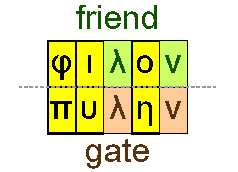
"φίλον" ≈ "friend" (accusative masculine singular) from "φίλος" ≈ "that which is loved or important, friend"
"πῠ́λην" ≈ "wing of gates, door, entrance" (accusative feminine singular) from "πύλη" ≈ "wing of gates, door, entrance"
What does Jesus mean when he says he is your
"friend"? Might he be your
"gateway"? What if you choose another
"gateway"? All three uses of
"friend" in these verses refer to the
same person (the one being asked, not the one offering).
28. Strongs - midnight
- *G3317 *4 μεσονύκτιον (mes-on-ook'-tee-on) : neuter of compound of G3319 and G3571; midnight (especially as a watch):--midnight.
μεσονυκτιον *2
Mark 13:35 ... cometh, at even, or at midnight, or at the cockcrowing, or in the morning:
Acts 16:25 And at midnight Paul and Silas ...
μεσονυκτιου *2
Luke 11:5 ... shall go unto him at midnight, and say unto him, ...
Acts 20:7 ... continued his speech until midnight.
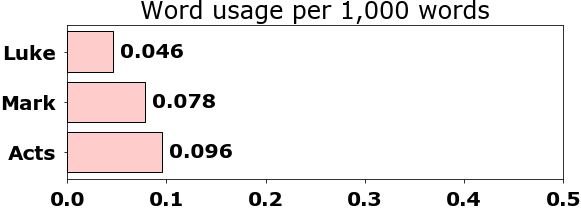 |
Words: μεσονυκτιον=2 μεσονυκτιου=2
|
29. Luke 11:5 Midnight
30. Matthew 25:6 Messiah in the middle
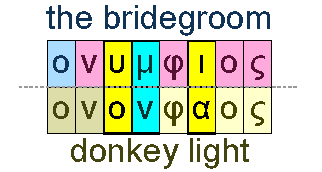
Matthew 25:6 And at mid night there was a cry made, Behold, the bridegroom cometh; go ye out to meet him. [kjv]
μεσης δε νυκτος κραυγη γεγονεν ιδου ο νυμφιος ερχεται εξερχεσθε εις απαντησιν αυτου [gnt]
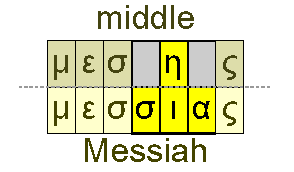
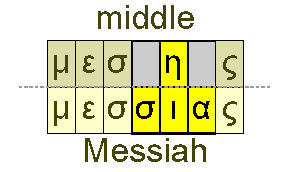
"μέσης" ≈ "middle".
"Μεσσίας" ≈ "Messiah".
In John 3, Nicodemus meets Jesus in the
"middle" of the
"night". The Greek word for
"middle", as used, can be a play on words with the Greek word for
"Messiah" which comes from the Hebrew.
"μέσος" ≈ "middle, between, half" and, as used, "μέσης" ≈ "middle".
"Μεσσίας" ≈ "Messiah" and comes from the Hebrew word "משיח" (me-SHEE-ach) ≈ "Messiah". The Greek word for "Messiah" does not appear in the LXX (Septuagint) or GNT (Greek New Testament), except as a play on words.
31. Luke 11:5 Messiah of the night
Luke 11:5 And he said unto them, Which of you shall have a friend, and shall go unto him at midnight, and say unto him, Friend, lend me three loaves; [kjv]
και ειπεν προς αυτους τις εξ υμων εξει φιλον και πορευσεται προς αυτον μεσονυκτιου και ειπη αυτω φιλε χρησον μοι τρεις αρτους [gnt]
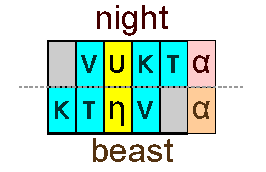
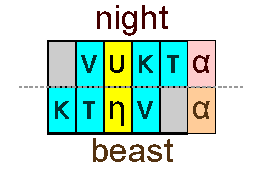
Can this
"friend" provide the
"Messiah", being in the
"middle" of the
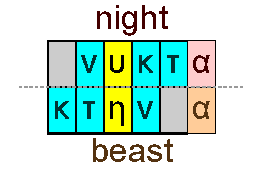
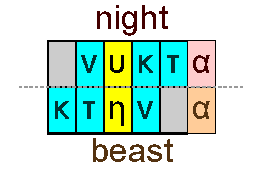
"beasts", and the
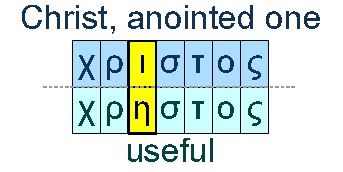
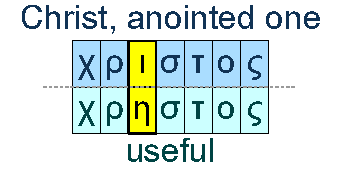
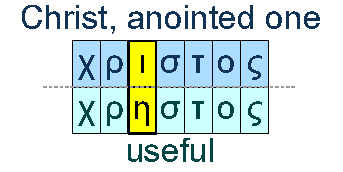
"useful" "Christ"? Without the
"T" or
"tau" of the
"cross" it would be just
"useful" and not
"Christ". In the last verse, the
"T" or
"tau" or
"cross" is present in the verb used. Might that indicate a
change in the person to whom the verb applies?
32. Matthew 12:40 Days and nights
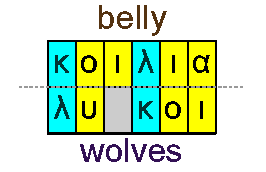
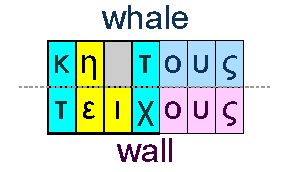
Matthew 12:40 For as Jonas was three days and three nights in the whale's belly; so shall the Son of man be three days and three nights in the heart of the earth. [kjv]
ωσπερ γαρ ην ιωνας εν τη κοιλια του κητους τρεις ημερας και τρεις νυκτας ουτως εσται ο υιος του ανθρωπου εν τη καρδια της γης τρεις ημερας και τρεις νυκτας [gnt]
What does Jesus say about the
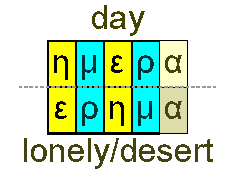
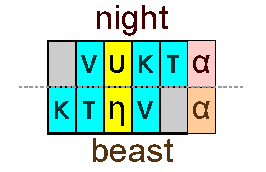
"three" "days" and
"three" "nights"? What do people assume that Jesus says? Why might this be so? Is this reasonable?
What Jesus says
3*day+3*night |
day
1 |
day
2 |
day
3 |
night
1 |
night
2 |
night
3 |
What people assume
3*(day+night) |
day
1 |
night
1 |
day
2 |
night
2 |
day
3 |
night
3 |
How do our implicit assumptions effect the way we think?
33. Matthew 12:40 Days and nights
Matthew 12:40 For as Jonas was three days and three nights in the whale's belly; so shall the Son of man be three days and three nights in the heart of the earth. [kjv]
ωσπερ γαρ ην ιωνας εν τη κοιλια του κητους τρεις ημερας και τρεις νυκτας ουτως εσται ο υιος του ανθρωπου εν τη καρδια της γης τρεις ημερας και τρεις νυκτας [gnt]
Greek:
three days and three nights.
Play:
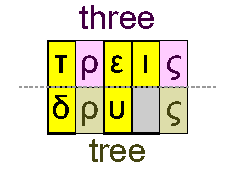
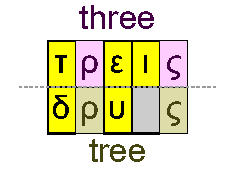
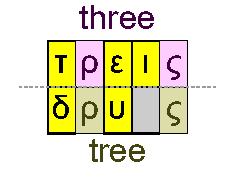
tree wilderness and tree beast .
Gathering of believers of Jesus: ... freely you have received, freely give ...
Church as master organization: ... treely you have received, treely give ...
[Three Dog Night]
34. Days and nights into the ages
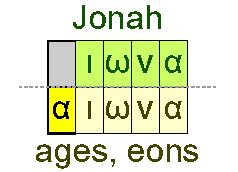
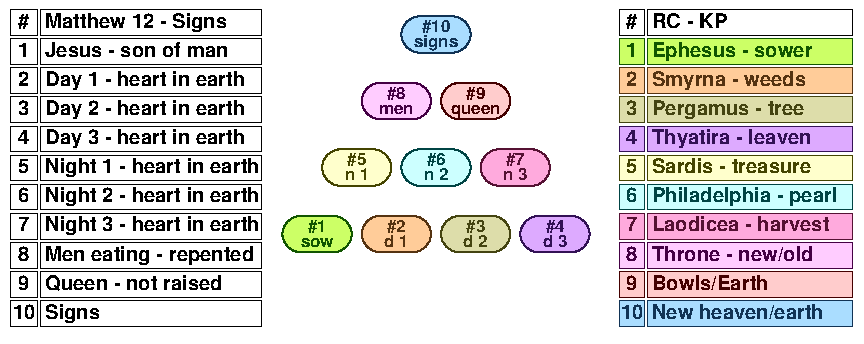
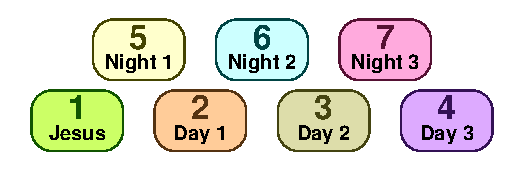
Jesus, the Son, is #1 (sower) whose "holy" "spirit" then goes into the "ages" in the "heart" of the "little ones" (believers).
Let the "three" "days" be #2 (weeds), #3 (tree), #4 (leaven). These are associated with the "catholic" "church", later the Catholic Church.
Let the "three" "nights" be #5 (treasure), #6 (pearl), #7 (harvest). These are associated with the Protestant Church and after.
It is not clear how the
Eastern or
Orthodox Church fits the patterns.
35. Matthew 12:40 Paraphrase
36. Luke 11:5 Three worthy
Luke 11:5 And he said unto them, Which of you shall have a friend, and shall go unto him at midnight, and say unto him, Friend, lend me three loaves; [kjv]
και ειπεν προς αυτους τις εξ υμων εξει φιλον και πορευσεται προς αυτον μεσονυκτιου και ειπη αυτω φιλε χρησον μοι τρεις αρτους [gnt]
Is there such a thing as a
"worthy" "tree"?
The
"middle" of the
"nights" would be
node 6. Might this
"friend" be involved in the "
millstone" "
deception" or "
entrapment"?
Might the
"three" types of
"worthy" ones be those deceived and entrapped in the
"tree" of
node 3? That is: "
bird" in
node 2, "
fish" in
node 3, "
pig" in
node 4. These would be collected together in
node 3. Can a "
bird" or "
pig" or "
fish" escape or otherwise get out?
37. Proverbs 27:14
KJV: He that blesseth his friend with a loud voice, rising early in the morning, it shall be counted a curse to him.
Hebrew: מברך רעהו בקול גדול בבקר השכים קללה תחשב לו׃
Greek: ος αν ευλογη φιλον το πρωι μεγαλη τη φωνη καταρωμενου ουδεν διαφερειν δοξει
Brenton: Whosoever shall bless a friend in the morning with a loud voice, shall seem to differ nothing from one who curses him.
38. Luke 11:5
KJV: And he said unto them, Which of you shall have a friend, and shall go unto him at midnight, and say unto him, Friend, lend me three loaves;
Greek: και ειπεν προς αυτους τις εξ υμων εξει φιλον και πορευσεται προς αυτον μεσονυκτιου και ειπη αυτω φιλε χρησον μοι τρεις αρτους
Latin: et ait ad illos quis vestrum habebit amicum et ibit ad illum media nocte et dicit illi amice commoda mihi tres panes
39. Luke 11:6 Since after
Luke 11:6 For a friend of mine in his journey is come to me, and I have nothing to set before him? [kjv]
επειδη φιλος μου παρεγενετο εξ οδου προς με και ουκ εχω ο παραθησω αυτω [gnt]
The
ancient Greek word
"ἐπειδή" ≈ "after, since". The
modern Greek word
"επειδή" (eh-pee-THEE) ≈ "for, because".
It appears that "
ever since" this
"friend" arrived I have a "
need" that I did not know about before. I am glad as I have been a "
beggar" for that Good News.
The
"friend" came to me rather than me going to him. What can this
"friend" do for me?
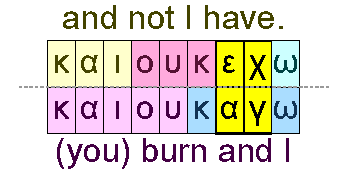
Was this a
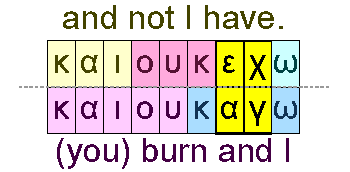
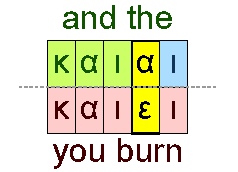
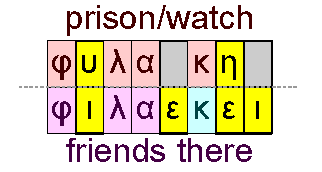
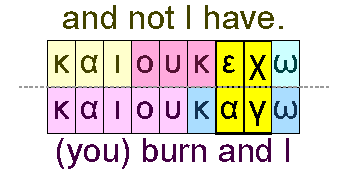
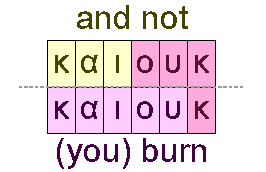
"burning" desire? Who is it that might be
"burning" or might
"burn"?
40. United Methodist Apostles Creed
I believe in Jesus Christ, his only Son, our Lord,
who was conceived by the Holy Spirit,
born of the Virgin Mary,
suffered under Pontius Pilate,
was crucified, died, and was buried;
he descended to the dead.
On the third day he
rose again;
he ascended into heaven,
is seated at the right hand of the Father,
and will come again to judge the living and the dead.
The line "
he descended to the dead" is in the Ecumenical version but not the Traditional version.
41. Ephesians 4:9 Descended to the dead
Ephesians 4:9 Now that he ascended, what is it but that he also descended first into the lower parts of the earth? [kjv]
το δε ανεβη τι εστιν ει μη οτι και κατεβη πρωτον εις τα κατωτερα μερη της γης [gnt]
UM Apostle's Creed: I believe in God the Father Almighty, maker of heaven and earth; ... and was buried;
he descended to the dead. On the third day ... to judge the living and the dead. I believe in the Holy Spirit,
the holy catholic church, the communion of saints, ... the resurrection of the body and the life everlasting. Amen.
Note that the "
he descended to the dead" is often omitted in UM church services when repeating the Apostle's Creed. Why might that be?
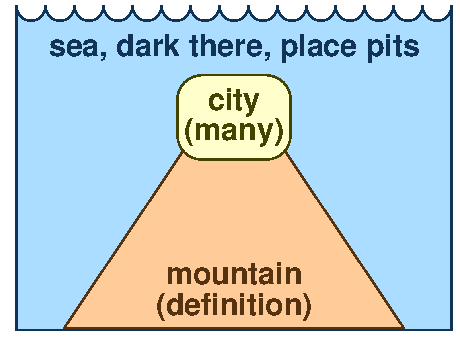
What is in the center of the earth? That would be the "
pit" with
no "
bottom".
42. Under the earth
What is "
under the earth"?
Matthew 27:52 And the graves were opened; and many bodies of the saints which slept arose, [kjv]
και τα μνημεια ανεωχθησαν και πολλα σωματα των κεκοιμημενων αγιων ηγερθη ηγερθησαν [gnt]
… sanctorum … [v]
… weihaize … [got]
… Heiligen… [lu]
Note that these "
saints" would have been from the time of the
OT (Old Testament).
The
Gothic "
weihaize" as "
holy" (ones) is the source of the first part of the German word
"Weihnachten" ≈ "Christmas" as, literally "
Holy" and "
night".
43. Luke 11:6 Visitor from hell
Luke 11:6 For a friend of mine in his journey is come to me, and I have nothing to set before him? [kjv]
επειδη φιλος μου παρεγενετο εξ οδου προς με και ουκ εχω ο παραθησω αυτω [gnt]
Might this be
"hell" on "
earth"?
Might it be related to
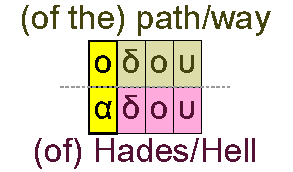
node 6?
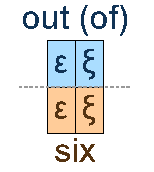
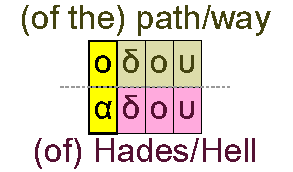
The Greek word translated as "in" is that of "out of".
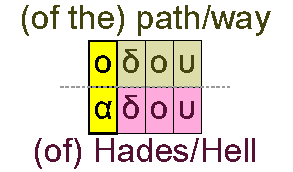
The Greek word translated as "journey" is that of "path" or "way".
44. Luke 11:6 Burning desire
45. Strongs - set before
- *G3908 *19 παρατίθημι (par-at-ith'-ay-mee) : from G3844 and G5087; to place alongside, i.e. present (food, truth); by implication, to deposit (as a trust or for protection):--allege, commend, commit (the keeping of), put forth, set before.
46. 1 Samuel 28:22 Bread to go
Saul has just seen the witch of Endor. It is night. A servant tries to comfort him with
"bread" "set before". He will die the next day against the Philistines.
1 Samuel 28:22 Now therefore, I pray thee, hearken thou also unto the voice of thine handmaid, and let me set a morsel of bread before thee; and eat, that thou mayest have strength, when thou goest on thy way. [kjv]
και νυν ακουσον δη φωνης της δουλης σου και παραθησω ενωπιον σου ψωμον αρτου και φαγε και εσται εν σοι ισχυς οτι πορευση εν οδω [lxx]
The
ancient Greek word
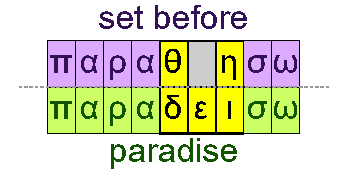
"παρατίθημι" ≈ "place or set before, serve (food/drink)".
"τίθημι" ≈ "put, place, set".
"παρά" ≈ "beyond"
The
ancient Greek word
"πορεύω" ≈ "go, carry, convey". This is the same verb (different inflection) that Jesus uses is the Great Commission.
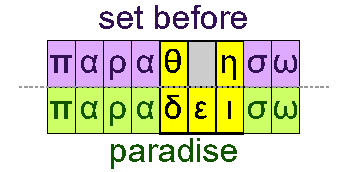
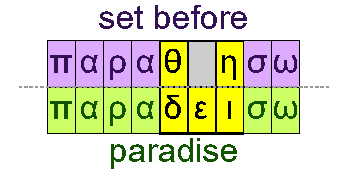
47. Luke 11:6 Set before a paradise
48. Luke 11:6 Word play
Luke 11:6 For a friend of mine in his journey is come to me, and I have nothing to set before him? [kjv]
επειδη φιλος μου παρεγενετο εξ οδου προς με και ουκ εχω ο παραθησω αυτω [gnt]
Greek:
For a friend (Jesus points to himself) of me (Jesus points to the others) is (comes into being) out of [six] (a) path (point down) [hades] to me (point to the others) and not[you burn] I have [and I also] that to set before [paradise] (with respect to) him/it (Jesus points to himself) .
The friend (Jesus) is visiting you (one of the listeners). He has gone through hell to get here.
You go to the other friend (the religious establishment). They will burn.
The listener, you, has a paradise in him, the visiting friend (Jesus).
How will the religious establishment respond to the request?
49. Luke 11:6
KJV: For a friend of mine in his journey is come to me, and I have nothing to set before him?
Greek: επειδη φιλος μου παρεγενετο εξ οδου προς με και ουκ εχω ο παραθησω αυτω
50. Preparation
Luke 11:3 Give us day by day our daily bread. [kjv]
τον αρτον ημων τον επιουσιον διδου ημιν το καθ ημεραν [gnt]
The Lord's Prayer in Luke is right
before the parable of the friend at midnight in Luke.
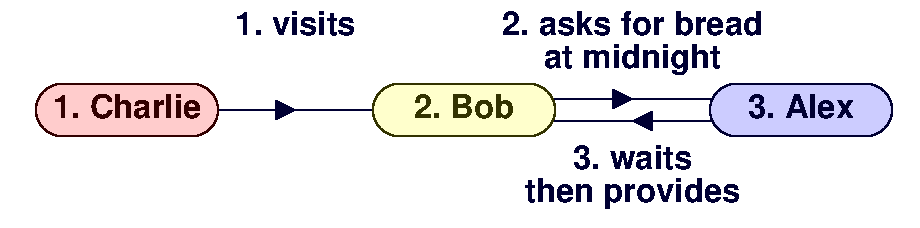
In the parable of the friend at midnight, the one "
friend" was not prepared for the other "
friend".
51. Matthew 5:23 And there
52. Gift at the alter
|
|
There are two main events or competitions.
Great Commission (what Jesus wants you to do).
Gifts on the altar (what birds want you to do)
Which is the most important event or competition?
Which is just a shadow of an event or competition?
|
What happens if there are a
"hundred" "sheep" at the
"alter" and
"one" "wanders" to find out what the "
shepherd" wants and then goes and does that without returning to the
"alter"?
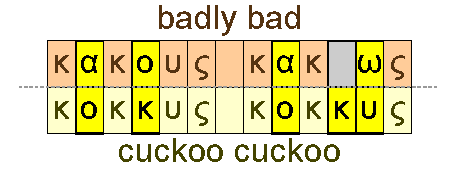
53. Matthew 6:34 Bird calls
Matthew 6:34 Take therefore no thought for the morrow: for the morrow shall take thought for the things of itself. Sufficient unto the day is the evil thereof. [kjv]
μη ουν μεριμνησητε εις την αυριον η γαρ αυριον μεριμνησει τα εαυτης αυτης αρκετον τη ημερα η κακια αυτης [gnt]
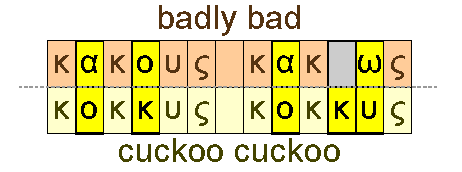
54. Luke 11:7 Bad bird calls
55. Luke 11:7
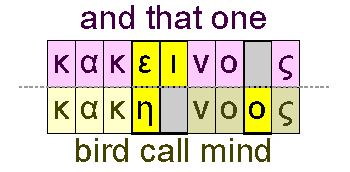
Luke 11:7 And he from within shall answer and say, Trouble me not: the door is now shut, and my children are with me in bed; I can not rise and give thee. [kjv]
κακεινος εσωθεν αποκριθεις ειπη μη μοι κοπους παρεχε ηδη η θυρα κεκλεισται και τα παιδια μου μετ εμου εις την κοιτην εισιν ου δυναμαι αναστας δουναι σοι [gnt]
"ἔσωθεν" ≈ "from inside, inwardly".
"ἔξωθεν" ≈ "from outside, outwardly".
"νόσε" ≈ "be sick, be distressed, etc." (vocative singular) from "νόσος" ≈ "sickness, disease, illness, plague, misery, suffering, distress"
"σῴζω" ≈ "heal, observe, rescue" and, from the GNT, "save".
[illness, save]
56. Matthew 23:25-26 Cleaning the cup and bowl
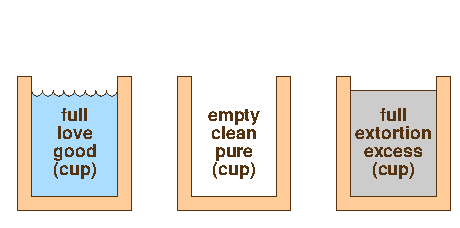
Matthew 23:25 Woe unto you, scribes and Pharisees, hypocrites ! for ye make clean the outside of the cup and of the platter, but within they are full of extortion and excess. [kjv]
23:26 Thou blind Pharisee, cleanse first that which is within the cup and platter, that the outside of them may be clean also. [kjv]
They are "empty" on the "outside".
They are "full" of "extortion" and "excess".
If they "clean" the "inside" they will then be "empty" on both "inside" and "outside".
What then do they need to do to be "
good" and have "
love"?
The
ancient Greek word
"καθαρός" ≈ "clean, clear, pure" which is negated with an alpha prefix as
"ἀκάθαρτος" ≈ "unclean, impure". The Greek word
"clean" is often given a positive connotation. What happens when a "
bird"
"cleans" out your blueberry bush of every piece of "
fruit" on the bush? The bush is
"clean". Is that
good or
not good?
57. Isaiah 10:20
Isaiah 10:20 And it shall come to pass in that day, that the remnant of Israel, and such as are escaped of the house of Jacob, shall no more again stay upon him that smote them; but shall stay upon the LORD, the Holy One of Israel, in truth. [kjv]
και εσται εν τη ημερα εκεινη ουκετι προστεθησεται το καταλειφθεν ισραηλ και οι σωθεντες του ιακωβ ουκετι μη πεποιθοτες ωσιν επι τους αδικησαντας αυτους αλλα εσονται πεποιθοτες επι τον θεον τον αγιον του ισραηλ τη αληθεια [lxx]
"ἔσωθεν" ≈ "from inside, inwardly".
"ἔξωθεν" ≈ "from outside, outwardly".
58. Isaiah 10:20
KJV: And it shall come to pass in that day, that the remnant of Israel, and such as are escaped of the house of Jacob, shall no more again stay upon him that smote them; but shall stay upon the LORD, the Holy One of Israel, in truth.
Hebrew: והיה ביום ההוא לא יוסיף עוד שאר ישראל ופליטת בית יעקב להשען על מכהו ונשען על יהוה קדוש ישראל באמת׃
Greek: και εσται εν τη ημερα εκεινη ουκετι προστεθησεται το καταλειφθεν ισραηλ και οι σωθεντες του ιακωβ ουκετι μη πεποιθοτες ωσιν επι τους αδικησαντας αυτους αλλα εσονται πεποιθοτες επι τον θεον τον αγιον του ισραηλ τη αληθεια
59. Luke 11:7 Measured feet
60. Luke 11:7 Closed door
Luke 11:7 And he from within shall answer and say, Trouble me not: the door is now shut, and my children are with me in bed; I can not rise and give thee. [kjv]
κακεινος εσωθεν αποκριθεις ειπη μη μοι κοπους παρεχε ηδη η θυρα κεκλεισται και τα παιδια μου μετ εμου εις την κοιτην εισιν ου δυναμαι αναστας δουναι σοι [gnt]
Does Jesus ever talk of a "
closed" "
door"? How about in regards to the religious establishment?
[RC6 RC7]
[mimic]
61. Matthew 23:13-23 Woe to the hypocrites
Matthew 23:13 But woe unto you, scribes and Pharisees, hypocrites ! for ye shut up the kingdom of heaven against men: for ye neither go in yourselves, neither suffer ye them that are entering to go in. [kjv]
ουαι δε υμιν γραμματεις και φαρισαιοι υποκριται οτι κλειετε την βασιλειαν των ουρανων εμπροσθεν των ανθρωπων υμεις γαρ ουκ εισερχεσθε ουδε τους εισερχομενους αφιετε εισελθειν [gnt]
23:15 Woe unto you, scribes and Pharisees, hypocrites ! for ye compass sea and land to make one proselyte, and when he is made, ye make him twofold more the child of hell than yourselves. [kjv]
ουαι υμιν γραμματεις και φαρισαιοι υποκριται οτι περιαγετε την θαλασσαν και την ξηραν ποιησαι ενα προσηλυτον και οταν γενηται ποιειτε αυτον υιον γεεννης διπλοτερον υμων [gnt]
62. Matthew 25:10 Shut door
Matthew 25:10 And while they went to buy, the bridegroom came; and they that were ready went in with him to the marriage: and the door was shut. [kjv]
απερχομενων δε αυτων αγορασαι ηλθεν ο νυμφιος και αι ετοιμοι εισηλθον μετ αυτου εις τους γαμους και εκλεισθη η θυρα [gnt]
The "
five" "
foolish" "
virgins" go to "
buy".
Who do they "buy" from?
Were they sold a bill of goods, perhaps a bad "pearl" by a wolf dog, "merchant" (great one of the earth), etc.?
To not be thrown out of the "
marriage" "
feast", one needs the proper "
garments" of "
righteousness". These are provided by the "
bridegroom".
How does the "
shut" "
door" compare to closing the door of the ark of Noah? This was in the previous chapter as part of the (same) Olivet Discourse.
[marriage feast in Matthew, Peter and shut door]
63. Door and hunted beast
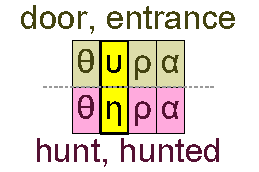
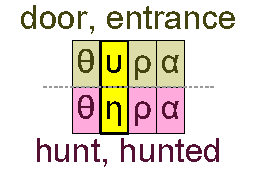
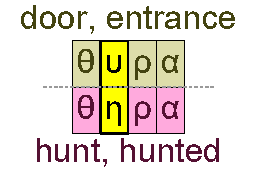
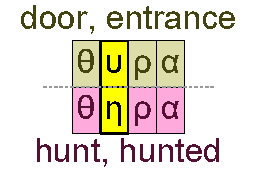
The Greek word for
"door", appearing
3 times in Revelation, can be a play on words with the Greek word for
"beast" which appears over
30 times in Revelation.
The ancient Greek word "θύρα" ≈ "door, entrance".
The ancient Greek word "θήρα" ≈ "hunt, hunted".
The modern Greek word "θύρα" (THEE-ra) ≈ "door, gate".
The modern Greek word "θήρα" (THEE-ra) ≈ "hunt, hunted".
Today, these words are pronounced in modern Greek such that they sound the same. However, in ancient Greece, there must have been some distinction in the way the vowels "
η" and "
υ" were pronounced.
64. Matthew 25:10-11 Shut door panic
Matthew 25:10 And while they went to buy, the bridegroom came; and they that were ready went in with him to the marriage: and the door was shut. [kjv]
… kaufen… Bräutigam… bereit … gingen … Hochzeit… Tür … verschlossen. [lu]
25:11 Afterward came also the other virgins, saying, Lord, Lord, open to us. [kjv]
The German word "die Tür" ≈ "the door".
The Gothic word "daur" ≈ "door".
The German word for "
mid-life crisis" is "
Torschlusspanik" which is literally "
shut door panic", the fear of getting caught on the wrong side of a closing door (or gate). It can also mean "
last-minute panic". The German word
"schließen" ≈ "shut".
65. Matthew 21:34 Servants as bait
66. Strongs - children
*G3813 *52 παιδίον (pahee-dee'-on) : neuter diminutive of G3816; a childling (of either sex), i.e. (properly), an infant, or (by extension) a half-grown boy or girl; figuratively, an immature Christian:--(little, young) child, damsel.
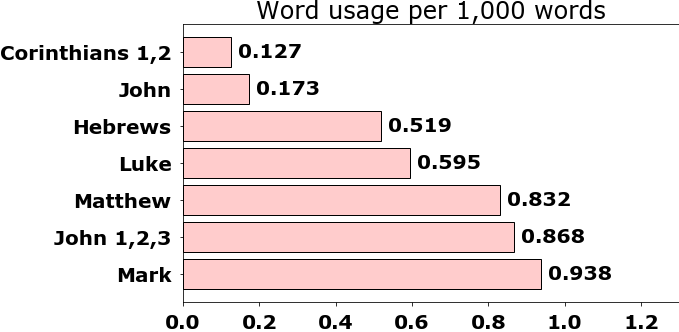 |
Words: παιδια=13 παιδιοις=2 παιδιον=26 παιδιου=7 παιδιων=4
|
The
ancient Greek word
"παιδεία" ≈ "child-rearing, education" and, in context, could be
"servants".
67. Luke 11:7 Servants
Luke 11:7 And he from within shall answer and say, Trouble me not: the door is now shut, and my children are with me in bed; I can not rise and give thee. [kjv]
κακεινος εσωθεν αποκριθεις ειπη μη μοι κοπους παρεχε ηδη η θυρα κεκλεισται και τα παιδια μου μετ εμου εις την κοιτην εισιν ου δυναμαι αναστας δουναι σοι [gnt]
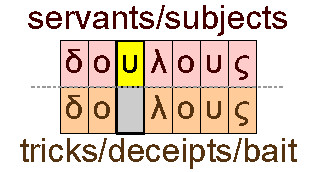
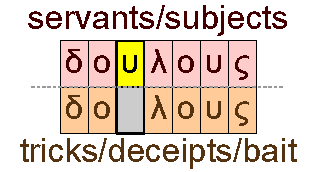
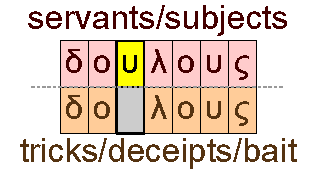
"δουλους" ≈ "servile, subject" (accusative plural) of "δοῦλος" ≈ "servile, subject".
"δόλους" ≈ "trick, deceit, bait (for fish)" (accusative plural) of "δόλος" ≈ "trick, deceit, bait (for fish)".
The
ancient Greek word
"παιδεία" ≈ "child-rearing, education" and, in context, could be
"servants".
68. Matthew 22:7 And beds of the many
Matthew 22:7 But when the king heard thereof, he was wroth: and he sent forth his armies, and destroyed those murderers, and burned up their city. [kjv]
ακουσας δε ο δε βασιλευς ωργισθη και πεμψας τα στρατευματα αυτου απωλεσεν τους φονεις εκεινους και την πολιν αυτων ενεπρησεν [gnt]
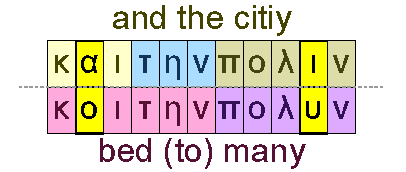
"και" ≈ "and" and "την" ≈ "the" and "πολιν" ≈ "cities" (accusative singular)
"κοίτην" ≈ "bed, lair, nest" (accusative singular) and "πολύν" ≈ "many" (accusative singular).
69. Strongs - homosexual
- *G733 *2 ἀρσενοκοίτης (ar-sen-ok-oy'-tace) : from G730 and G2845; a sodomite:--abuser of (that defile) self with mankind.
- αρσενοκοιται
- 1 Corinthians 6:9 ... nor effeminate, nor abusers of themselves with mankind,
- αρσενοκοιταις
- 1 Timothy 1:10 For whoremongers, for them that defile themselves with mankind, for menstealers, for liars, for perjured persons, and ...
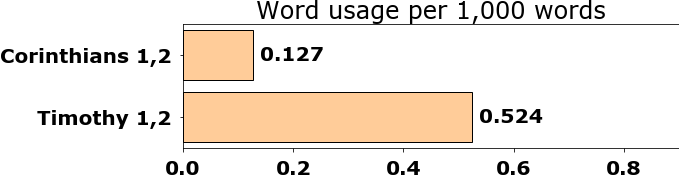 |
Words: αρσενοκοιται αρσενοκοιταις
|
70. Strongs - bed
*G2845 *4 κοίτη (koy'-tay) : from G2749; a couch; by extension, cohabitation; by implication, the male sperm:--bed, chambering, X conceive.
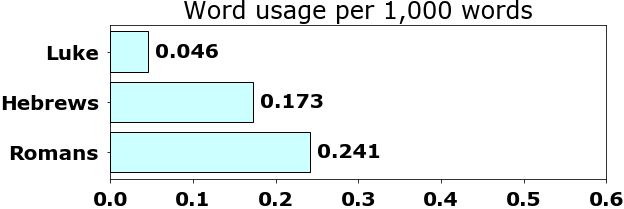 |
Words: κοιταις κοιτη κοιτην=2
|
The
ancient Greek word
"κοίτη" ≈ "bed, resting place, lair" and can refer to sexual activity.
The
ancient Greek word
"κοίτη" ≈ "river bed".
71. Strongs - bed
- *G2845 *4 κοίτη (koy'-tay) : from G2749; a couch; by extension, cohabitation; by implication, the male sperm:--bed, chambering, X conceive.
- κοιτην *2
- Luke 11:7 ... with me in bed; I can not rise ...
- Romans 9:10 ... Rebecca also had conceived by one, even by ...
- κοιταις
- Romans 13:13 ... and drunkenness, not in chambering and wantonness, not ...
- κοιτη
- Hebrews 13:4 ... in all, and the bed undefiled: but whoremongers ...
72. Luke 11:7 Beds
Luke 11:7 And he from within shall answer and say, Trouble me not: the door is now shut, and my children are with me in bed; I can not rise and give thee. [kjv]
κακεινος εσωθεν αποκριθεις ειπη μη μοι κοπους παρεχε ηδη η θυρα κεκλεισται και τα παιδια μου μετ εμου εις την κοιτην εισιν ου δυναμαι αναστας δουναι σοι [gnt]
The Greek word translated as "
in" is that of "
into" which, in context, can mean "
against".
"κοίτην" ≈ "bed, lair, nest"
73. The actual potency and inner workings of energy
Galatians 3:5 He therefore that ministereth to you the Spirit, and worketh miracles among you, doeth he it by the works of the law, or by the hearing of faith? [kjv]
ο ουν επιχορηγων υμιν το πνευμα και ενεργων δυναμεις εν υμιν εξ εργων νομου η εξ ακοης πιστεως [gnt]
Energy is a word and concept that has ancient roots but had a
different meaning in ancient times. Aristotle first used the ancient Greek word
"ενέργεια" ≈ "actuality" for
"actuality", literally,
"in working".
The
ancient Greek word
"δύναμις" ≈ "power, might, strength, potentiality" and is used by Aristotle for something that has
"potential".
KJV (King James Version) : ... worketh miracles among you ...
Paraphrase: ... actualizes the potential in you ...
The root word is
"work" and is used many times in the
LXX and
GNT.
74. Luke 11:7 Potentiality
Luke 11:7 And he from within shall answer and say, Trouble me not: the door is now shut, and my children are with me in bed; I can not rise and give thee. [kjv]
κακεινος εσωθεν αποκριθεις ειπη μη μοι κοπους παρεχε ηδη η θυρα κεκλεισται και τα παιδια μου μετ εμου εις την κοιτην εισιν ου δυναμαι αναστας δουναι σοι [gnt]
The
ancient Greek word
"δύναμαι" ≈ "able, capable, strong enough". Aristotle uses this word for
"potentiality" as contrasted with "
actuality".
Of what is there no
potentiality?
75. Strongs - rise up
*G450 *107 ἀνίστημι (an-is'-tay-mee) : from G303 and G2476; to stand up (literal or figurative, transitive or intransitive):--arise, lift up, raise up (again), rise (again), stand up(-right).
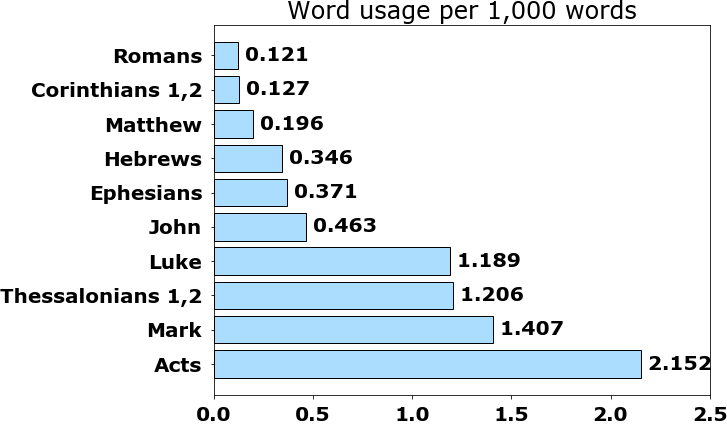 |
Words: αναπηδησας αναστα=2 ανασταν ανασταντες=6 αναστας=35 αναστασα=2 αναστη=2 αναστηθι=7 αναστηναι=7 αναστησας=3 αναστησει=3 αναστησεται=5 αναστησονται=4 αναστησω=4 αναστωσιν=2 ανεστη=15 ανεστησαν=2 ανεστησεν=4 ανισταμενος ανιστασθαι ανισταται
|
The
ancient Greek word
"ἀνίστημι" ≈ "make to stand up, raise up" and, in context
"raise from the dead".
76. Usage - rise up
- *G450 *107 ἀνίστημι (an-is'-tay-mee) : from G303 and G2476; to stand up (literal or figurative, transitive or intransitive):--arise, lift up, raise up (again), rise (again), stand up(-right).
αναστηναι *7 of 107
Mark 8:31 ... after three days rise again.
Mark 9:10 ... themselves, questioning one with another what the rising from the dead should mean.
Luke 24:7 ... and the third day rise again.
Luke 24:46 ... Christ to suffer, and to rise from the dead the third day:
John 20:9 ... that he must rise again from the dead.
Acts 10:41 ... him after he rose from the dead.
Acts 17:3 ... must needs have suffered, and risen again from the dead; and ...
77. Luke 11:7
Luke 11:7 And he from within shall answer and say, Trouble me not: the door is now shut, and my children are with me in bed; I can not rise and give thee. [kjv]
κακεινος εσωθεν αποκριθεις ειπη μη μοι κοπους παρεχε ηδη η θυρα κεκλεισται και τα παιδια μου μετ εμου εις την κοιτην εισιν ου δυναμαι αναστας δουναι σοι [gnt]
Is it
possible for the
religious establishment to
"raise up" from the
dead?
"οὐ" ≈ "not" (concrete).
The
ancient Greek word
"ἀνίστημι" ≈ "make to stand up, raise up" and, in context
"raise from the dead".
The
ancient Greek word
"ἀνάστασις" ≈ "standing up, making someone move, resurrection" and is the source of the English name
"Anastasia" with the shorter form
"Stacy".
78. Luke 11:7
KJV: And he from within shall answer and say, Trouble me not: the door is now shut, and my children are with me in bed; I can not rise and give thee.
Greek: κακεινος εσωθεν αποκριθεις ειπη μη μοι κοπους παρεχε ηδη η θυρα κεκλεισται και τα παιδια μου μετ εμου εις την κοιτην εισιν ου δυναμαι αναστας δουναι σοι
79. Matthew 25:7 Arise and wake up
Matthew 25:7 Then all those virgins arose, and trimmed their lamps. [kjv]
τοτε ηγερθησαν πασαι αι παρθενοι εκειναι και εκοσμησαν τας λαμπαδας αυτων εαυτων [gnt]
The
ancient Greek word
"ἐγείρω" ≈ "awaken, raise up, erect a building"`. Jesus often uses the word for "
sleep" as "
dead". He thus,
"awakens" the "
dead" such as Lazarus. The same word is used for a "
lame" person who is
"raised up" to walk.
All "
ten"
"arose" or were
"woken up".
The "quick" or "living" might have been "sleeping".
The "dead" might have been "woken up" or "resurrected".
They were
sleeping two verses earlier.
80. Luke 11:8 Rise up
Luke 11:8 I say unto you, Though he will not rise and give him, because he is his friend, yet because of his importunity he will rise and give him as many as he needeth. [kjv]
λεγω υμιν ει και ου δωσει αυτω αναστας δια το ειναι αυτου φιλον αυτου δια γε την αναιδειαν αυτου εγερθεις δωσει αυτω οσων χρηζει [gnt]
… dabit … surgens … amicus … propter inprobitatem … surget … necessarios [v]
There are two different Greek words used in this verse. Both can have the meaning of
"resurrection" as in
"raise up".
Who is the "
he" that will
"actually" "raise up from the dead" to give "
him" what he "
needs"? What is it that he "
needs"?
"ἀνίστημι" ≈ "make to stand up, raise up" and, in context, "raise from the dead".
"ἐγείρω" ≈ "awaken, raise up, erect a building". Jesus often uses the word for "sleep" as "dead". He thus, "awakens" the "dead" such as Lazarus.
The
KJV translates both words as "
rise", probably because the Latin uses the same word for the two different Greek words. The
Latin word
"surgo" ≈ "rise, arise, lift up, straighten" and the source of the English word
"surge".
81. Matthew 7:13 Through the diet
Matthew 7:13 Enter ye in at the strait gate: for wide is the gate, and broad is the way, that leadeth to destruction, and many there be which go in thereat: [kjv]
εισελθετε εισελθατε δια της στενης πυλης οτι πλατεια η πυλη και ευρυχωρος η οδος η απαγουσα εις την απωλειαν και πολλοι εισιν οι εισερχομενοι δι αυτης [gnt]
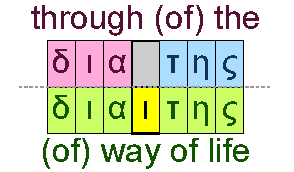
"διά" ≈ "through" (preposition)
"της" ≈ "(of) the" (genitive feminine singular)
"δῐαίτης" ≈ "(of) way of life" (genitive feminine singular)
The Greek words for
"through" "(of) the" can be a play on words with
"(of) way of life". The English word
"diet" comes, through French, from the Latin word
"diaeta" ≈ "diet, regimen" (Medieval "
assembly") and which comes from the ancient Greek word
"δίαιτα" ≈ "way of living, residence, health regimen" and related meanings.
82. Luke 11:8 Diet
Luke 11:8 I say unto you, Though he will not rise and give him, because he is his friend, yet because of his importunity he will rise and give him as many as he needeth. [kjv]
λεγω υμιν ει και ου δωσει αυτω αναστας δια το ειναι αυτου φιλον αυτου δια γε την αναιδειαν αυτου εγερθεις δωσει αυτω οσων χρηζει [gnt]
… dabit … surgens … amicus … propter inprobitatem … surget … necessarios [v]
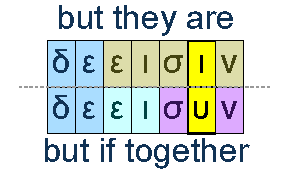
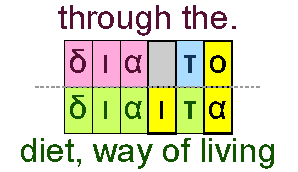
"διά" ≈ "through" (preposition) and "το" ≈ "the" (neuter definite article).
"δίαιτα" ≈ "way of living, accommodation, sustenance" from "διαιτάω" ≈ "treat, handle, arbitrate".
The Greek word translated as
"because" is that of
"through".
The
ancient Greek word
"πῠ́λην" ≈ "wing of gates, gate, door" (accusative singular) from
"πυλη" ≈ "wing of gates, gate, door". A synonym is
"θύρα" ≈ "gate, door".
83. Strongs - lack of respect
84. Usage - persistence
*G335 *1 ἀναίδεια (an-ah'-ee-die-ah') : from a compound of G1 (as a negative particle (compare G427)) and G127; impudence, i.e. (by implication) importunity:--importunity.
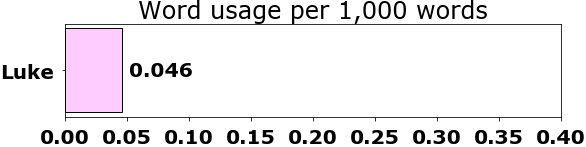 |
Words: αναιδιαν=1
|
Whenever a word is used once in the
GNT, that word and usage needs to be carefully researched to determine if any double meanings or play on words are being used.
Luke: The
ancient Greek word
"ἀναιδής" ≈ "shameless, ruthless".
Matthew: The
ancient Greek word
"παράπτωσις" ≈ "impetuous pursuit, going astray". The parts of the word mean, literally, going "
beyond falling".
85. Importunity
Luke 11:8 I say unto you, Though he will not rise and give him, because he is his friend, yet because of his importunity he will rise and give him as many as he needeth. [kjv]
λεγω υμιν ει και ου δωσει αυτω αναστας δια το ειναι αυτου φιλον αυτου δια γε την αναιδειαν αυτου εγερθεις δωσει αυτω οσων χρηζει [gnt]
… dabit … surgens … amicus … propter inprobitatem … surget … necessarios [v]
The
English word
"importunity" means a constant and insistent demanding and comes from the Latin word
"importunitas" ≈ "incivility".
The
Latin word, used here, is
"improbitas" ≈ "wickedness, dishonesty, improbity, depravity".
The
ancient Greek word
"ἀναιδής" ≈ "shameless, ruthless". The
modern Greek word
"αναίδεια" (a-NEH-thee-a) ≈ "lack of modesty and respect, impudence".
86. Luke 11:8
Luke 11:8 I say unto you, Though he will not rise and give him, because he is his friend, yet because of his importunity he will rise and give him as many as he needeth. [kjv]
λεγω υμιν ει και ου δωσει αυτω αναστας δια το ειναι αυτου φιλον αυτου δια γε την αναιδειαν αυτου εγερθεις δωσει αυτω οσων χρηζει [gnt]
"ἀναίδειαν" ≈ "shameless, ruthless" (as used) from "ἀναιδής" ≈ "shameless, ruthless".
"Αἵδης" ≈ "Hades, grave, hell", alternative spelling of "ᾍδης" ≈ "Hades, grave, hell".
"ἀϊδής" ≈ "invisible".
[if hell if]
87. Strongs - need
*G5535 *5 χρῄζω (khrade'-zo) : from G5532; to make (i.e. have) necessity, i.e. be in want of:--(have) need.
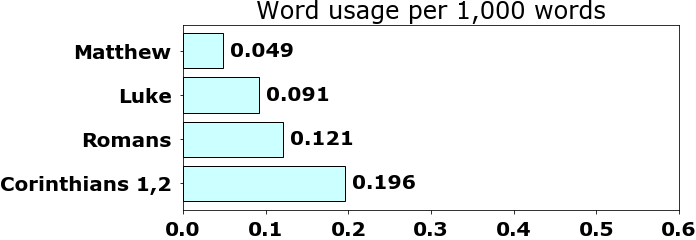 |
Words: χρηζει χρηζετε=2 χρηζη χρηζομεν
|
The
ancient Greek word
"χρῄζω" ≈ "need, lack, desire, prophesy, foretell". What is the difference between a
"need" and a
"want" and a
"desire"?
The
ancient Greek word
"χρεία" ≈ "need, purpose, use" from
"χρή" ≈ "have to, ought, should". One derived word is the
ancient Greek word
"χρήματα" ≈ "money" from
"χρῆμα" ≈ "need, goods, affair". In Romans, Paul makes a pun out of another derived word meaning
"useful" in relation to
"Christ".
88. Usage - need
- *G5535 *5 χρῄζω (khrade'-zo) : from G5532; to make (i.e. have) necessity, i.e. be in want of:--(have) need.
χρηζετε *2
Matthew 6:32 ... Father knoweth that ye have need of all these things.
Luke 12:30 ... Father knoweth that ye have need of these things.
χρηζει
χρηζη
χρηζομεν
2 Corinthians 3:1 ... to commend ourselves? or need we, as some others, epistles ...
89. Clothes of righteousness
Galatians 3:27 For as many of you as have been baptized into Christ have put on Christ. [kjv]
οσοι γαρ εις χριστον εβαπτισθητε χριστον ενεδυσασθε [gnt]
Ephesians 4:24 And that ye put on the new man, which after God is created in righteousness and true holiness. [kjv]
και ενδυσασθαι τον καινον ανθρωπον τον κατα θεον κτισθεντα εν δικαιοσυνη και οσιοτητι της αληθειας [gnt]
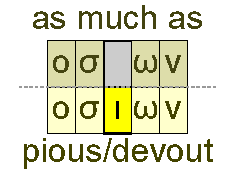
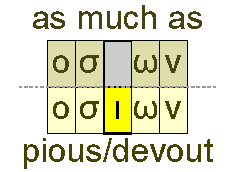
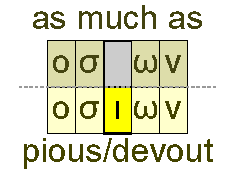
"ὅσοι" ≈ "as much as, how much" as in inflection of "ὅσος" ≈ "as much as, how much".
"ὅσιοι" ≈ "pious, devout" (plural) from "ὅσιος" ≈ "pious, devout"
The Greek word for
"clothes" means, literally, to
"put on". What is to be
"put on"? How about Jesus and righteousness.
The
ancient Greek word
"ὅσιος" ≈ "pious, devout" (of gods) as apposed to
"δίκαιος" ≈ "sanctified" by human law. In general, it was for things allowed by gods but not sacred. Paul appears to use a play on words in Galatians 3:37.
90. Matthew 24:5 Definition
Matthew 24:5 For many shall come in my name, saying, I am Christ; and shall deceive many. [kjv]
πολλοι γαρ ελευσονται επι τω ονοματι μου λεγοντες εγω ειμι ο χριστος και πολλους πλανησουσιν [gnt]
The
ancient Greek word
"χριστός" ≈ "anointed one, Christ". The meaning of
"Christ" in Greek is "
anointed one" and is used to translate the Hebrew word for "
Messiah".
What exactly are the requirements to say "I am the Christ"?
How is this different from someone saying "I am not the Christ"?
What exactly are the requirements to say "I am anointed" (by myself)?
It appears that "
false Christs" or "
fake Christs" or those who feign to be
"Christ" may be self-anointed as a "
knock-off" of the real
"Christ".
[self-anointed, self-esteem]
[sharing glory, sharing opinion]
91. Luke 11:8 Much useful
Luke 11:8 I say unto you, Though he will not rise and give him, because he is his friend, yet because of his importunity he will rise and give him as many as he needeth. [kjv]
λεγω υμιν ει και ου δωσει αυτω αναστας δια το ειναι αυτου φιλον αυτου δια γε την αναιδειαν αυτου εγερθεις δωσει αυτω οσων χρηζει [gnt]
"ὅσων" ≈ "as much as, how much" (genitive plural) from "ὅσος" ≈ "as much as, how much"
"ὁσῐ́ων" ≈ "pious, devout" (genitive plural) from "ὅσιος" ≈ "pious, devout"
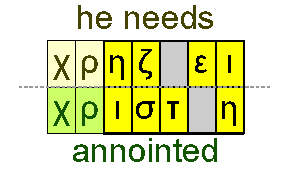
"χρῄζει" ≈ "he needs" (as used).
"χρῑστή" ≈ "rubbed, smeared, anointed" (feminine adjective) and "χριστός" ≈ "anointed one, Christ".
The "
z" as "
tz" sounds somewhat similar to the "
st" sound.
92. Luke 11:8
KJV: I say unto you, Though he will not rise and give him, because he is his friend, yet because of his importunity he will rise and give him as many as he needeth.
Greek: λεγω υμιν ει και ου δωσει αυτω αναστας δια το ειναι αυτου φιλον αυτου δια γε την αναιδειαν αυτου εγερθεις δωσει αυτω οσων χρηζει
93. Matthew 6:7-8 Vain repetitions of vain repetitions
Matthew 6:7 But when ye pray, use not vain repetitions, as the heathen do: for they think that they shall be heard for their much speaking. [kjv]
προσευχομενοι δε μη βαττολογησητε βατταλογησητε ωσπερ οι εθνικοι δοκουσιν γαρ οτι εν τη πολυλογια αυτων εισακουσθησονται [gnt]
orantes autem nolite multum loqui sicut ethnici putant enim quia in multiloquio suo exaudiantur [v]

In Matthew 6:7, as part of the "
Sermon on the Mount", Jesus says not to pray using
"vain repetitions" as the "
heathen" do.
This is a specific instance of the idea that "
if some is good then more is better". Some pastors (and others) boast that as a child (or even now) they repeat the Lord's Prayer every night.
A few verses later is the "
Lord's Prayer" which, as an example, does not have repetitions within itself, but could be repeated at different times.
Some pastors appear to think that they get "
paid by the word" according to quantity and not quality. At times producing meaningless or even deceptive content, they may lecture their congregations about trying to keep the pastor to any time schedule.
94. Luke 11:7
Luke 11:7 And he from within shall answer and say, Trouble me not: the door is now shut, and my children are with me in bed; I can not rise and give thee. [kjv]
κακεινος εσωθεν αποκριθεις ειπη μη μοι κοπους παρεχε ηδη η θυρα κεκλεισται και τα παιδια μου μετ εμου εις την κοιτην εισιν ου δυναμαι αναστας δουναι σοι [gnt]
[vane repetitions]
95. Paraphrase
The verses will now be paraphrased.
Luke put these verses after the Lord's Prayer and before the seek and you will find. In the Sermon on the Mount, these sections, before and after, involve a lot of non-verbal communication.
Image Jesus using the hand movements, facial expressions, etc. where one side is the not good religious establishment, the other side are the disciples who want to do the right thing, and he will sometimes point to himself (place his hand on his breast).
96. Luke 11:5 Paraphrase
Luke 11:5 And he said unto them, Which of you shall have a friend, and shall go unto him at midnight, and say unto him, Friend, lend me three loaves; [kjv]
και ειπεν προς αυτους τις εξ υμων εξει φιλον και πορευσεται προς αυτον μεσονυκτιου και ειπη αυτω φιλε χρησον μοι τρεις αρτους [gnt]
Paraphrase:
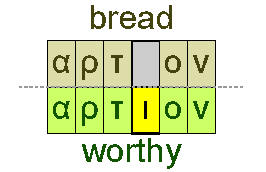
Which out of [six] you having [six] (a) friend and traveling to him middle [Messiah] of the night [beast] and say to it/him friend (be) useful [Christ] to me three [tree] loaves [worthy].
97. Luke 11:6 Paraphrase
Luke 11:6 For a friend of mine in his journey is come to me, and I have nothing to set before him? [kjv]
επειδη φιλος μου παρεγενετο εξ οδου προς με και ουκ εχω ο παραθησω αυτω [gnt]
Greek:
For a friend (Jesus points to himself) of me (Jesus points to the others) is (comes into being) out of [six] (a) path (point down) [hades] to me (point to the others) and not[you burn] I have [and I also] that to set before [paradise] (with respect to) him/it (Jesus points to himself) .
The friend (Jesus) is visiting you (one of the listeners). He has gone through hell to get here.
You go to the other friend (the religious establishment). They will burn.
The listener, you, has a paradise in him, the visiting friend (Jesus).
How will the religious establishment respond to the request?
98. Luke 11:7 Paraphrase
Luke 11:7 And he from within shall answer and say, Trouble me not: the door is now shut, and my children are with me in bed; I can not rise and give thee. [kjv]
κακεινος εσωθεν αποκριθεις ειπη μη μοι κοπους παρεχε ηδη η θυρα κεκλεισται και τα παιδια μου μετ εμου εις την κοιτην εισιν ου δυναμαι αναστας δουναι σοι [gnt]
Paraphrase:
And he [bird calls] inside (unclean) answers saying not (to) me [measure] toil [foot] already door [beast] closed and the children/servants of mine with me into the bed (fornication) are not possible rise (resurrect) and give [yes] you.
99. Luke 11:8 Pronouns
Luke 11:8 I say unto you, Though he will not rise and give him, because he is his friend, yet because of his importunity he will rise and give him as many as he needeth. [kjv]
λεγω υμιν ει και ου δωσει αυτω αναστας δια το ειναι αυτου φιλον αυτου δια γε την αναιδειαν αυτου εγερθεις δωσει αυτω οσων χρηζει [gnt]
|
1. "he" (give verb implied).
2. "to him" (dative pronoun).
3. "he" (is verb implied).
4. "of him" (genitive pronoun).
5. "of him" (genitive pronoun).
6. "he" (rise verb implied).
7. "he" (give verb implied).
8. "to him" (dative pronoun).
9. "he" (need verb implied).
|
There appear to be
three persons in the (short) parable. To whom do each of the pronouns in this ending verse refer? For each, it could be "
it".
100. Luke 11:8
Luke 11:8 I say unto you, Though he will not rise and give him, because he is his friend, yet because of his importunity he will rise and give him as many as he needeth. [kjv]
λεγω υμιν ει και ου δωσει αυτω αναστας δια το ειναι αυτου φιλον αυτου δια γε την αναιδειαν αυτου εγερθεις δωσει αυτω οσων χρηζει [gnt]
Paraphrase:
I say unto you if and not give you rise (resurrect) through it [diet] is friend of you through yet the shameless/ruthless of him (religious elite) he (friend, Jesus) will rise (resurrect) to give of him (Jesus) as you need [Christ].
101. Luke 11:9
KJV: And I say unto you, Ask, and it shall be given you; seek, and ye shall find; knock, and it shall be opened unto you.
Greek: καγω υμιν λεγω αιτειτε και δοθησεται υμιν ζητειτε και ευρησετε κρουετε και ανοιγησεται υμιν
102. End of page