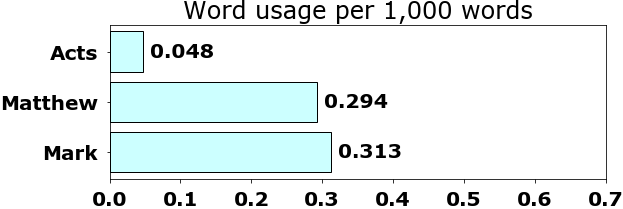
- *G3725 *12 ὅριον (hor'-ee-on) : neuter of a derivative of an apparently primary horos (a bound or limit); a boundary-line, i.e. (by implication) a frontier (region):--border, coast.
- οριων *6
- Matthew 8:34 ... he would depart out of their coasts.
- Matthew 15:22 ... came out of the same coasts, and cried unto him, ...
- Mark 5:17 ... to depart out of their coasts.
- Mark 7:31 ... departing from the coasts of Tyre and Sidon, he came unto the sea of Galilee, through the midst of the coasts of Decapolis.
- Acts 13:50 ... them out of their coasts.
- ορια *4
- Matthew 15:39 ... and came into the coasts of Magdala.
- Matthew 19:1 ... and came into the coasts of Judaea beyond Jordan;
- Mark 7:24 And from thence he arose, and went into the borders ...
- Mark 10:1 ... from thence, and cometh into the coasts of Judæa by the farther side ...
- οριοις *2
- Matthew 2:16 ... and in all the coasts thereof, from two years old ...
- Matthew 4:13 ... which is upon the sea coast, in the borders of Zabulon and Nephthalim:
7. Matthew 24:15-20 Delimiting the boundary of the region of a mountain
How can one
"define" a
"mountain"?
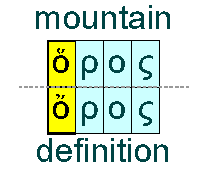
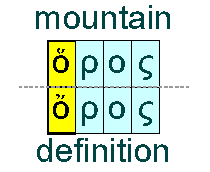
The ancient Greek word (smooth breathing) "ὄρος" ≈ "mountain".
The ancient Greek word (rough breathing) "ὅρος" ≈ "boundary, definition".
The ancient Greek words (and sounds) merged in modern Greek as
"όρος" (O-ros) ≈ "mountain, definition, boundary".
In ancient Greek, there was (in Attic Greek) a rough or smooth breathing difference that disappeared by the time of the
GNT (Greek New Testament). These distinctions have been continued by scholars and sometimes the importance of the differences appears to be exaggerated.
Let us look at the two meanings of the same word and then investigate the times that Jesus uses the word to see if anything interesting is discovered.
8. Defining a definition
The ancient Greek word (
rough breathing)
"ὅρος" ≈ "boundary, definition" and is the source of the English word
"horizon".
Aristotle often emphasizes the importance of
"definitions" in identifying bad logic. Of course, Aristotle then defines what he means by a
"definition".
English: A definition is a phrase indicating the essence of something. (Loeb#391, p. 281)
Greek: Ἔστι δ´ ὅρος μὲν λόγος ὁ τὸ τί ἦν εἶναι σημαίνων, [Topica, 101b-102a]
"λόγος" ≈ "rational explanation, word".
"σημαίνω" ≈ "to indicate" and is the source, through French, of the English word "semantics". The noun form is "sign" and is sometimes translated as "miracle".
The aspirated rough breathing comes through in Latin and into English in the sound of the letter "
h". Aristotle used this word for "
definition" many times. This was only used for a while in the first century BC and discontinued but persists in ancient Greek notations to this day.
9. Mountains of Oreo cookies
The ancient Greek word (
smooth breathing)
"ὄρος" ≈ "mountain".
Ancient Greek appears to have had no word for hill. They lived in a very mountainous area. Note that the English often uses
"hills" where the Greek uses
"mountains". The English state named
"Montana" is from the Spanish word
"montaña" ≈ "mountain" which is from the Latin word
"montanus" ≈ "mountain".
The origin of the name "
Oreo" in "
Oreo cookie" is unknown.
One idea (there are others) is that it came from the Greek word for
"mountain".
Aristotle uses the word for
"mountain" often in his work on
Meteorology.
English: From Pyrene (this is a mountain range towards the equinoctial sunset in Celtice) there flow the Istrus and the Tartessus (Loeb#397, p. 97)
Greek: ἐκ δὲ τῆς Πυρήνης (τοῦτο δ' ἐστὶν ὄρος πρὸς δυσμὴν ἰσημερινὴν ἐν τῇ Κελτικῇ) ῥέουσιν ὅ τε Ἴστρος καὶ ὁ Ταρτησσός. [350b]
Aristotle mentions the
Pyrenees mountains and the
Celts as a general Greek name for what is today Spain and France. The Latin name for the Celts was the Gauls.
10. Play on words
11. New Testament Greek: B. G. McClean
In his book,
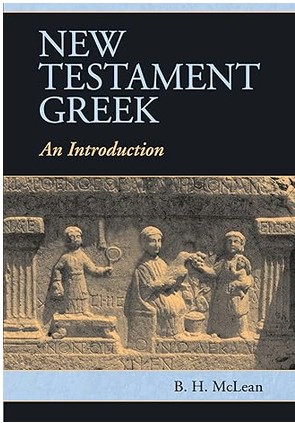
New Testament Greek: An Introduction (2011, Cambridge University Press), (then) Professor of New Testament Language and Literature at Knox College, University of Toronto, B. H. McLean explains some of the rough and smooth breathing issues in the
GNT.
The system of pronunciation developed by Erasmus is known as the Erasmian pronunciation system. It gives the same values to Greek letters as their corresponding Latin equivalents. It is also based on the non-linguistic principle that each letter should be pronounced differently. (p. 3)
According to the Erasmian system of pronunciation, a rough breathing mark adds an "h" sound (i.e., aspiration) to the pronunciation. (p. 17)
Using the Latin-based Erasmian system of pronunciation makes it hard to "
hear" play on words in the Greek.
12. Matthew 17:1 Disambiguation
Matthew 17:1 And after six days Jesus taketh Peter, James, and John his brother, and bringeth them up into an high mountain apart, [kjv]
και μεθ ημερας εξ παραλαμβανει ο ιησους τον πετρον και ιακωβον και ιωαννην τον αδελφον αυτου και αναφερει αυτους εις ορος υψηλον κατ ιδιαν [gnt]
If the context cannot by itself be used to determine whether the word refers to a
"mountain" or a (flat)
"region" or
"coast", some context needs to be added to make the passage clear. Consider the following.
... brought them to a region by themselves.
... brought them to a mountain by themselves.
Which meaning is to be used? Now add a disambiguating word.
... brought them to a high region by themselves.
... brought them to a high mountain by themselves.
Which one of the meanings now fit? Which does not fit? What implications does this have for those who make a theological distinction about the
"mountain" being "
high"?
The
KJV (King James Version) translates as "
apart" the Greek word that means "
by themselves".
13. Matthew 17:1
KJV: And after six days Jesus taketh Peter, James, and John his brother, and bringeth them up into an high mountain apart,
Greek: και μεθ ημερας εξ παραλαμβανει ο ιησους τον πετρον και ιακωβον και ιωαννην τον αδελφον αυτου και αναφερει αυτους εις ορος υψηλον κατ ιδιαν
14. Usage - mountain
*G3735 *64 ὄρος (or'-os) : probably from an obsolete oro (to rise or "rear"; perhaps akin to G142; compare G3733); a mountain (as lifting itself above the plain): -hill, mount(-ain).
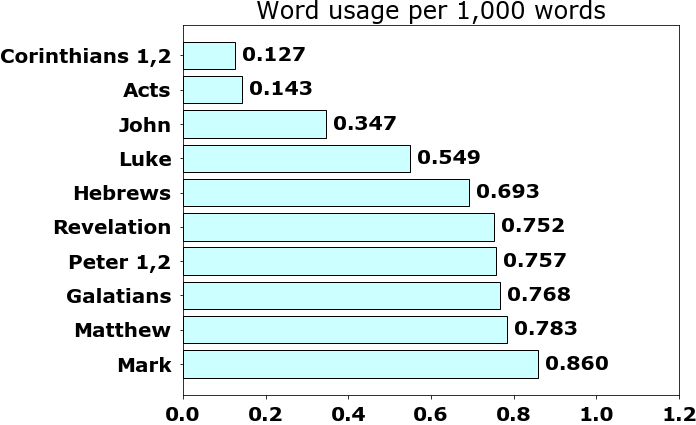 |
Words: ορει=11 ορεσιν=4 ορεων ορη=7 ορος=29 ορους=12
|
(smooth breathing) "ὄρος" ≈ "mountain".
(rough breathing) "ὅρος" ≈ "boundary, definition".
15. Jesus speaks
Let us investigate the use of the word for
"mountain" or
"definition" in the
GNT in Matthew as spoken by Jesus and not, for example, as used in the connecting commentary by Matthew.
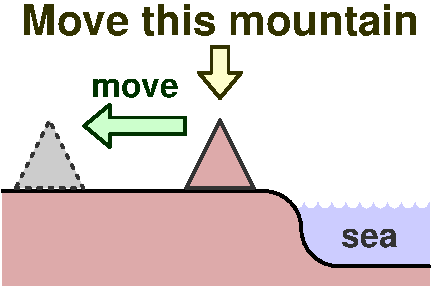
The verses about "
moving"
this "mountain" and "
moving"
this "mountain" into the "
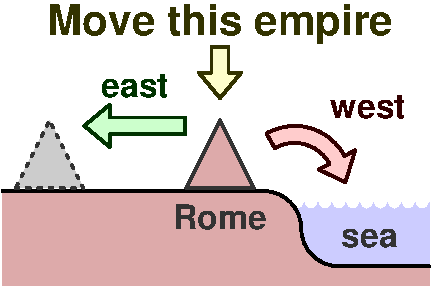
sea" appear to refer to Rome and Constantine in the fourth century (empires as
"mountains") and, perhaps, Jerome late in the fourth century (words and doctrine as
"definitions").
16. Matthew Move a mountain
Matthew 17:20 And Jesus said unto them, Because of your unbelief: for verily I say unto you, If ye have faith as a grain of mustard seed, ye shall say unto this mountain, Remove hence to yonder place; and it shall remove; and nothing shall be impossible unto you. [kjv]
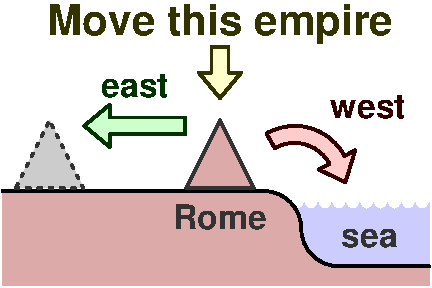
If Rome is considered a
"mountain", as in an "
empire", then
Constantine, through
"faith", did "
move" the
"mountain" of
Rome to
Constantinople.
Less than 200 years later, Western Roman Empire (Rome) fell into the sea.
In 1452, the Eastern Roman Empire (Constantinople) was conquered.
17. Matthew 17:20 Latin Vulgate conjecture
Matthew 17:20 And Jesus said unto them, Because of your unbelief: for verily I say unto you, If ye have faith as a grain of mustard seed, ye shall say unto this mountain, Remove hence to yonder place; and it shall remove; and nothing shall be impossible unto you. [kjv]
Consider the play on words between
"mountain" and
"definition" in Greek.
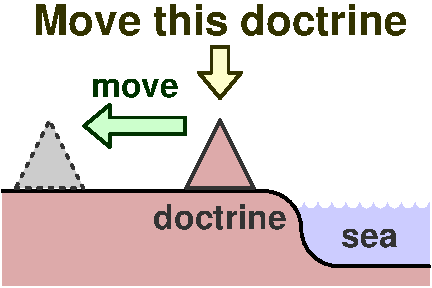
Late in the fourth century,
Jerome translated what was to be called the
Latin Vulgate. The
definitions of many words of the "
doctrine" or "
teaching" were "
moved" to be something other than what appears to have been meant in the Greek. The woman "
encrypted" or "
baked" false doctrine (leaven) with true doctrine (wheat flour) until it was
all mixed together but appeared as true doctrine.
The moving of this mountain (i.e., many definitions) did put that present and future church in a position to do what might have been considered "
impossible" before that time.
18. Matthew 21:21 Mountain into the sea
Matthew 21:21 Jesus answered and said unto them, Verily I say unto you, If ye have faith, and doubt not, ye shall not only do this which is done to the fig tree, but also if ye shall say unto this mountain, Be thou removed, and be thou cast into the sea; it shall be done. [kjv]
αποκριθεις δε ο ιησους ειπεν αυτοις αμην λεγω υμιν εαν εχητε πιστιν και μη διακριθητε ου μονον το της συκης ποιησετε αλλα καν τω ορει τουτω ειπητε αρθητι και βληθητι εις την θαλασσαν γενησεται [gnt]
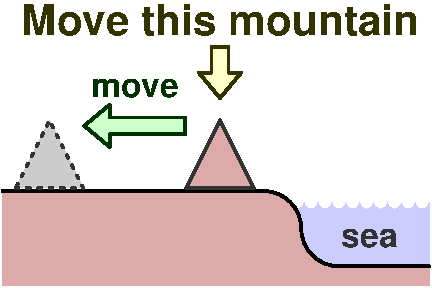
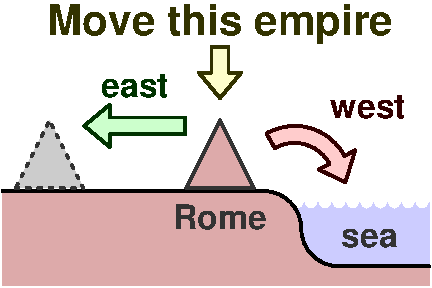
If
Constantine (and Rome) did not divide, as
"through division" or
"discernment", translated
"doubt" in the
KJV, into east and west, that entire
"mountain" could have been moved into the
"sea".
19. Matthew 24:15
Jesus uses the word
"mountains" in the Olivet Discourse where Jesus talks about "
all of it" and the "
end of times". Here is the verse before.
Matthew 24:15 When ye therefore shall see the abomination of desolation, spoken of by Daniel the prophet, stand in the holy place, (whoso readeth, let him understand:) [kjv]
οταν ουν ιδητε το βδελυγμα της ερημωσεως το ρηθεν δια δανιηλ του προφητου εστος εν τοπω αγιω ο αναγινωσκων νοειτω [gnt]
It does appear that those who want to understand this need to "
read". It appears that this "
understanding" is for practical purpose and not for the purpose, say, of "
salvation".
The Greek for "
see" is that of "
seeing" with "
understanding". Both Jesus (after) and Daniel (before) both talk about something that happened during the "
silent years".
The next verse contains the word
"mountain".
20. Matthew 24:16-17 Mountains
Matthew 24:16 Then let them which be in Judaea flee into the mountains: [kjv]
τοτε οι εν τη ιουδαια φευγετωσαν επι εις τα ορη [gnt]
24:17 Let him which is on the housetop not come down to take any thing out of his house: [kjv]
ο επι του δωματος μη καταβαινετω καταβατω αραι τι τα εκ της οικιας αυτου [gnt]
This verse sequence is part of the Olivet Discourse where Jesus talks about "
all of it" and the "
end of times" and appears to refer to an actual
"mountain". It is not clear how one would flee to a
"definition".
The ancient Greek word "εις" ≈ "into" (more active and dynamic).
The ancient Greek word "επί" ≈ "on" (more passive and static)
It is unclear how one would flee "
into" the "
mountains" rather than "
on" the "
mountains" (some Greek manuscripts)
What is often attributed to Koine Greek idioms appears to be a bias as to what the translators (and Greek scholars) want the text to say - often made worse by changes in the English language over time.
21. Matthew 24:16
KJV: Then let them which be in Judaea flee into the mountains:
Greek: τοτε οι εν τη ιουδαια φευγετωσαν επι εις τα ορη
22. Matthew 24:17
KJV: Let him which is on the housetop not come down to take any thing out of his house:
Greek: ο επι του δωματος μη καταβαινετω καταβατω αραι τι τα εκ της οικιας αυτου
23. Matthew 24:18
Matthew 24:18 Neither let him which is in the field return back to take his clothes. [kjv]
και ο εν τω αγρω μη επιστρεψατω οπισω αραι τα ιματια το ιματιον αυτου [gnt]
24. Matthew 24:18
KJV: Neither let him which is in the field return back to take his clothes.
Greek: και ο εν τω αγρω μη επιστρεψατω οπισω αραι τα ιματια το ιματιον αυτου
25. Matthew 24:19
Matthew 24:19 And woe unto them that are with child, and to them that give suck in those days ! [kjv]
ουαι δε ταις εν γαστρι εχουσαις και ταις θηλαζουσαις εν εκειναις ταις ημεραις [gnt]
26. Matthew 24:19
KJV: And woe unto them that are with child, and to them that give suck in those days !
Greek: ουαι δε ταις εν γαστρι εχουσαις και ταις θηλαζουσαις εν εκειναις ταις ημεραις
27. Matthew 24:20
Matthew 24:20 But pray ye that your flight be not in the winter, neither on the sabbath day: [kjv]
προσευχεσθε δε ινα μη γενηται η φυγη υμων χειμωνος μηδε εν σαββατω [gnt]
28. Matthew 24:20
KJV: But pray ye that your flight be not in the winter, neither on the sabbath day:
Greek: προσευχεσθε δε ινα μη γενηται η φυγη υμων χειμωνος μηδε εν σαββατω
29. Salt of the earth verses
In this context, we are only interested only in the
"mountain". The English uses
"hill".
sheep
 |
Matthew 5:16 Let your light so shine before men, that they may see your good works, and glorify your Father which is in heaven. [kjv]
|
birds
 |
5:15 Neither do men light a candle, and put it under a bushel, but on a candlestick; and it giveth light unto all that are in the house. [kjv]
|
fish
 |
5:14 Ye are the light of the world. A city that is set on an hill cannot be hid. [kjv]
|
pigs
 |
5:13 Ye are the salt of the earth: but if the salt have lost his savour, wherewith shall it be salted? it is thenceforth good for nothing, but to be cast out, and to be trodden under foot of men. [kjv]
|

These ideas will be in the summary of the houses built on rock and sand at the end of the Sermon on the Mount.
Words in these verses may be
code words, have
double meanings, be
play on words, etc. The Greek words may have been changed (mistranslated), omitted, etc. [top-down view]
30. Sheep as walking before
The ancient Greek word
"πρόβατα" ≈ "sheep" and comes from the literal words "
before" and "
walk". Sheep have a tendency to "
walk before" or "
wander away". Sheep are supposed to "
walk" "
before" in "
righteousness".
The Greek word for
"sheep" comes from two parts;
The ancient Greek word "πρός" ≈ "to, towards"and is the related to English words that start with "pro".
The ancient Greek word"βαίνω" ≈ "walk"and is the source of English words such as "acrobat" (one who walks end to end).
What musical instrument is played by two sheep?
A two-baa. That was woolly bad. Ewe heard it here first.
31. Planets as wandering stars
Matthew 24:5 For many shall come in my name, saying, I am Christ; and shall deceive many. [kjv]
πολλοι γαρ ελευσονται επι τω ονοματι μου λεγοντες εγω ειμι ο χριστος και πολλους πλανησουσιν [gnt]
How does a "
sheep" know if it has gone or is going
"astray"? How
"many" is
"many"?
The ancient Greek word
"πλάνη" ≈ "wandering, roaming" and, figuratively,
"going astray" or
"in error". as in wandering off-target. The English word
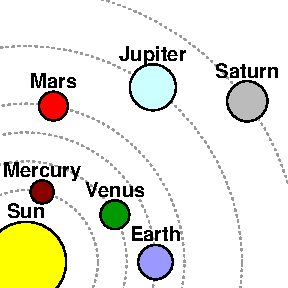
"planet" comes from this Greek word as a shortened form of
"wandering star" since planets were considered wandering stars. The modern Greek word
"πλανήτης" (pla-NEE-tees) ≈ "planet".
Discuss: Consider the billions of people throughout the ages. Are the
"many" a few insurrectionists from the first century or so who led a few thousand followers?
32. Matthew 18:12 Sheep and mountains
Matthew 18:12 How think ye? if a man have an hundred sheep, and one of them be gone astray, doth he not leave the ninety and nine, and goeth into the mountains, and seeketh that which is gone astray? [kjv]
τι υμιν δοκει εαν γενηται τινι ανθρωπω εκατον προβατα και πλανηθη εν εξ αυτων ουχι αφεις αφησει τα εννενηκονταεννεα ενενηκοντα εννεα επι τα ορη και πορευθεις ζητει το πλανωμενον [gnt]

100=99+1
|
The Greek says "
man" and not "
shepherd". In the parables, Jesus uses (and then explains) the code word "
man" to refer to "
Jesus as God".
Why is the
"hundred" important? Are the
99 "
on" the
"mountains" in danger when the "
man" "
leaves"? The only direction from "
on" the
"mountains" is
down,
down,
down, eventually to the "
sea".
How does Jesus reinforces the "
ninety and nine" to
avoid the "
one cookie rule"?
33. Matthew 18:6 Offending little ones
Matthew 18:6 But whoso shall offend one of these little ones which believe in me, it were better for him that a millstone were hanged about his neck, and that he were drowned in the depth of the sea. [kjv]
ος δ αν σκανδαλιση ενα των μικρων τουτων των πιστευοντων εις εμε συμφερει αυτω ινα κρεμασθη μυλος ονικος επι περι τον τραχηλον αυτου και καταποντισθη εν τω πελαγει της θαλασσης [gnt]
Which meaning fits the best?
offend, offended (attacks or annoys or bothers)
stumbling block (someone else set it up, tripped up)
ensnare, entrap (verbal or physical, get caught in it)
misinterpret, misunderstand (verbal, self-deception), misrepresent
Many today associate this verse with "
child abuse". However, the word for "
little ones" can have a double meaning of new believers in Christ. Does this increase the responsibility of pastors, teachers, etc.? In what way?
Note that the "
depth of the sea" is, in Greek, the "
sea of the sea".
34. Matthew 10:42 Drink a cup
Matthew 10:42 And whosoever shall give to drink unto one of these little ones a cup of cold water only in the name of a disciple, verily I say unto you, he shall in no wise lose his reward. [kjv]
και ος εαν αν ποτιση ενα των μικρων τουτων ποτηριον ψυχρου μονον εις ονομα μαθητου αμην λεγω υμιν ου μη απολεση τον μισθον αυτου [gnt]
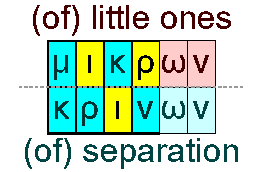
"ψυχροῦ" ≈ "(of) cold" (genitive).
Jesus uses the idea of
"little ones" to refer to believers of all ages. The play on words is a believer who has been
"separated".
The
"water" is inferred in the Greek as
"cold" "
water" from
"cold" and the word "
drink".
What exactly does this verse mean?
What does a "cup" of "cold", perhaps water, mean?
Is giving a "little one" a "cup" of "cold", perhaps water, good or not good?
35. Matthew 24:15-16
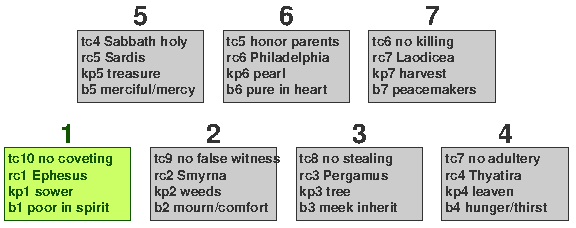
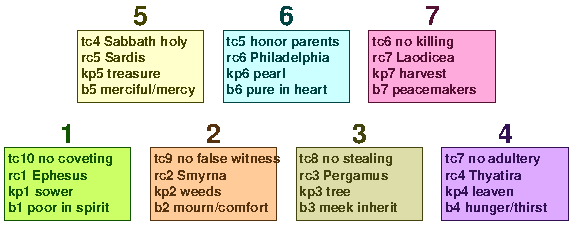
This verse appears to be a TenWordPin sequence of just the first seven pins.
Flee into the "
definitions"! Do not "
flee" to be with the "
many" on a "
mountain"!
Matthew 24:15 When ye therefore shall see the abomination of desolation, spoken of by Daniel the prophet, stand in the holy place, (whoso readeth, let him understand:) [kjv]
οταν ουν ιδητε το βδελυγμα της ερημωσεως το ρηθεν δια δανιηλ του προφητου εστος εν τοπω αγιω ο αναγινωσκων νοειτω [gnt]
24:16 Then let them which be in Judaea flee into the mountains: [kjv]
τοτε οι εν τη ιουδαια φευγετωσαν επι εις τα ορη [gnt]
36. Matthew 24:17
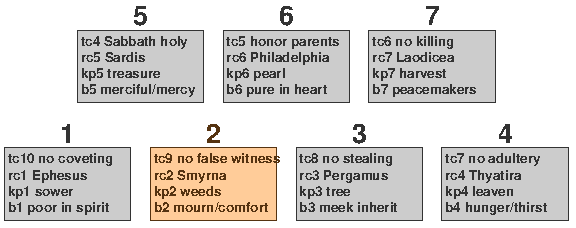
The "
bird" has help up an "
opinion", not put under a "
measure", to give false "
light" to all in the "
house". Do not return!
Matthew 24:17 Let him which is on the housetop not come down to take any thing out of his house: [kjv]
ο επι του δωματος μη καταβαινετω καταβατω αραι τι τα εκ της οικιας αυτου [gnt]
37. Matthew 24:18
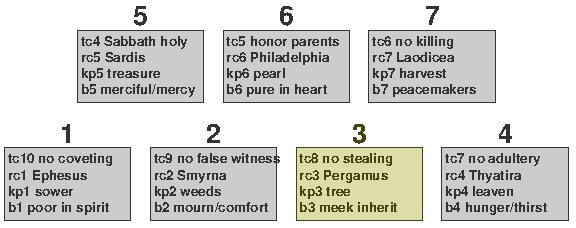
The "
field" is the "
world" of the "
many" on a "
mountain". If they took the "
cloak", then "
forgive" or "
leave" also the "
garment" [I am what being?].
Matthew 24:18 Neither let him which is in the field return back to take his clothes. [kjv]
και ο εν τω αγρω μη επιστρεψατω οπισω αραι τα ιματια το ιματιον αυτου [gnt]
38. Matthew 24:19
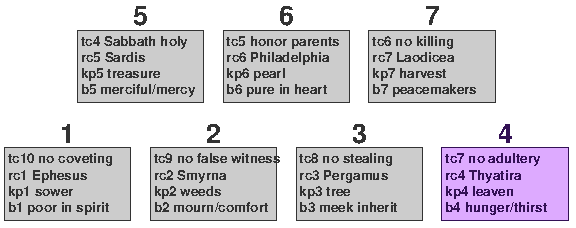
The "
woe" is the sound of a "
bird" of prey (or pray). The "
with child" word is a play on words with "
stars" (creation day 4). The "
give suck" is a play on words with "
live" "
friends".
Matthew 24:19 And woe unto them that are with child, and to them that give suck in those days ! [kjv]
ουαι δε ταις εν γαστρι εχουσαις και ταις θηλαζουσαις εν εκειναις ταις ημεραις [gnt]
39. Matthew 24:20
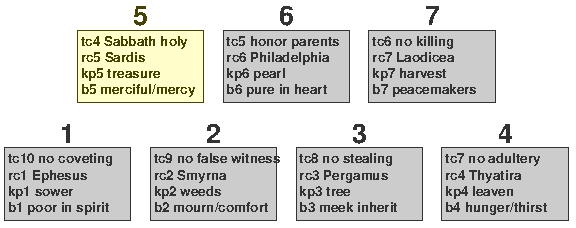
Keep the "
Sabbath" holy.
Matthew 24:20 But pray ye that your flight be not in the winter, neither on the sabbath day: [kjv]
προσευχεσθε δε ινα μη γενηται η φυγη υμων χειμωνος μηδε εν σαββατω [gnt]
40. Matthew 24:20
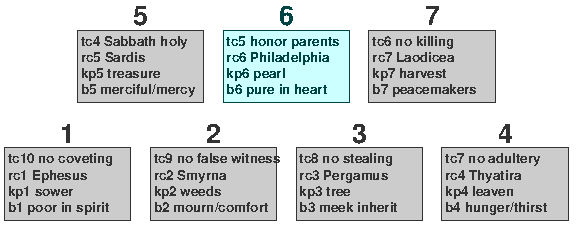
The "
winter" is "
cold". The "
love" of some may grow "
cold".
Matthew 24:20 But pray ye that your flight be not in the winter, neither on the sabbath day: [kjv]
προσευχεσθε δε ινα μη γενηται η φυγη υμων χειμωνος μηδε εν σαββατω [gnt]
41. Matthew 24:21
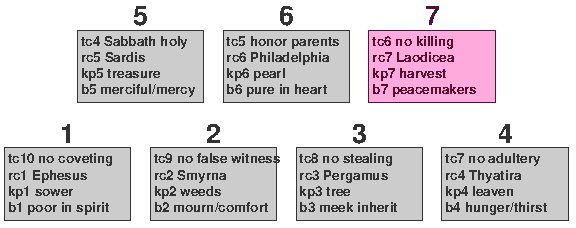
The "
great"
peer "
pressure" followed by a sequence of end time statements.
Matthew 24:21 For then shall be great tribulation, such as was not since the beginning of the world to this time, no, nor ever shall be. [kjv]
εσται γαρ τοτε θλιψις μεγαλη οια ου γεγονεν απ αρχης κοσμου εως του νυν ουδ ου μη γενηται [gnt]
42. TenPin
43. End of page