Send
Close Add comments:
(status displays here)
Got it! This site "creationpie.org" uses cookies. You consent to this by clicking on "Got it!" or by continuing to use this website. Note: This appears on each machine/browser from which this site is accessed.
Introduction: the Greek language
1. Introduction: the Greek language
This content is being developed.
2. General approach to semantics
The general approach to the meaning of any verse is the following.
Determine the meaning of the words of the verse. This may entail looking at the original Greek or Hebrew of the words.
In the process of determining the meaning, identify clarify difficult words or phrases.
Look at the context of the verse in that chapter and/or in the preceding or following chapter.
Look at the context of the verse in relation to the entire Bible.
Whenever multiple meanings are possible, provide them and the considerations for each of them.
3. Language learning
Which is a better way to learn a language?
Some schools and teachers: Learn the top-down grammar rules and use those rules to learn and work with the language.
Children: Learn patterns and piece those patterns together to learn the language - without a formal grammar.
How well does a normal child learn a language using the bottom-up process by the time they are six years old?
How well does an adult learn a language using the top-down process after, say, six years of study as part of an overall curriculum that includes other subjects?
4. Alan Kay and teaching children to program
Language learning:
Rules-based methods: traditional automatic language translation.
Pattern-based methods: Google translate
How might one go about writing a program to draw a circle?
Teen-ager using Cartesian coordinates and equation for a circle in a top-down deductive manner.
Teen-ager using polar coordinates and equation for a circle in a top-down deductive manner.
Child using a step and move idea in a bottom-up inductive manner.
5. Introduction: the Greek language
The Greek language has a long history going back about 3,000 years. During this time, there have been many variants of the Greek language (e.g. originally Attic, Doric, Ionic, etc.), but over the years there have been periodic attempts to take Greek back to its roots, so that many words from 2,500 years ago are still in common use, or at least recognized as part of the modern language.
6. Language evolution
The original
PIE (Proto Indo-European) languages (Latin-based, Germanic-based, Slavic-based, Greek-based, etc.) had many inflections (verbs, nouns, adjectives, etc.) and a very flexible word order. The natural tendency has been for these languages to simplify over time with limited separation (e.g., Latin). How did these languages ever start out that complex?
Coincidence: Many pre-Greek words just happen to make play on words with existing Greek words.
Example: Place names such as Corinth.
[technology development and language development]
7. Greek alphabet
Herodotus tell us, in part, that the Greek alphabet was developed as in improvement of the Phonetician alphabet. As a Semitic alphabet, it had consonants but no vowels. The Greeks added vowels which made it more flexible and easier to learn and use.
8. Ancient Greek texts
Ancient Greek texts were written an all uppercase letters and did not have spaces. If one read the text the meaning would be conveyed by the sounds made. So, as sounds changed the writing changed with it. This accounts for many textual differences in ancient Greek manuscripts.
Hebrew was more obtuse as there were no explicit vowels, only consonants.
9. The Greek alphabet
The early Greek manuscripts had only what we today call uppercase letters, with no spaces or punctuation. The order eventually became left to right, down the page. The early writing acted much as a compact audio recording. When one read the phonetic alphabet letters in a continuous manner, one heard what was being said. Local dialects would be taken into account by the spelling of words - before there were dictionaries, precise rules, teachers who enforced the rules, etc.
Astronomy often uses the Greek alphabet as part of star names or sequences.
αβγδεζηθικλμνξοπρστυφχψω
ΑΒΓΔΕΖΗΘΙΚΛΜΝΞΟΠΡΣΤΥΦΧΨΩ
10. Animal sounds
No one knows exactly how ancient languages such as Greek was spoken, but the onomatopoeia as sounds from animals can provide some clues. Note: there are other ways not covered here.
There are written accounts of sounds that animals make, as well as other onomatopoeia - words that sound like
what they represent.
11. Pronunciation
No one knows exactly how ancient Greek was spoken, but there are clues.
There are written accounts of sounds that animals make, as well as onomatopoeia (words that sound like what they represent).
Loan words to other languages help. For example, today the Greek «β» is pronounced in Greek as an English "v". If in ancient times, a word went from Greek into Latin with a Latin "b" sound, then it must have sounded like the Latin "b". If it were the Latin "v", then it would have been written in Latin with a "v".
Monuments have been found with inscriptions that show transitions in spellings of words.
Note that the traditional way that Bible Greek is traditionally taught and pronounced was developed by a Dutchman, Erasmus, in the Middle Ages, and has little or no resemblance to how Greek was actually pronounced (either in ancient or modern times).
12. Greek examples
There are several periods of interest for the Greek language as it relates to astronomy.
Classical Greek such as Herodotus, Xenophon, etc.
Septuagint - Old Testament scriptures translated from Hebrew to Greek about 270 B.C. in Egypt.
New Testament scriptures from about 100 A.D., using Koine Greek, the common Greek used by the common person.
Middle Age Greek (not really of interest here)
Modern Greek (for reference purposes using today's language)
For the present purposes, we are interested in the origin of words (mostly the Classical period) and the development and change of words, for which mainly the Septuagint and New Testament Greek are mainly used. These scripture translations have been well studied and documented, though at times translation issues and/or discrepancies can make them interesting from a theological point of view. We are not interested in any theological issues, just how the Greek was used, what the words meant, and how it relates to astronomy.
13. Narrowing the focus
There are many aspects of Greek and astronomy that are interesting.
How the constellations were named, including the zodiac?
What did the Greek astronomers know? When did they know it? How did the do it? And so on.
In many cases, the works of the original Greek astronomer (scientist, mathematician, etc.) have been lost and are only known (or have been pieced together) from accounts of writers after them (Greek, Latin, Arabic, etc.).
14. Astronomy
Astronomy has many applications outside of just watching stars, some of which are the following.
time measurement
space measurement
geometry of time and space
To narrow the focus, some of the ancient origins and linguistic development of selected terms and concepts from the field of astronomy are presented. In this context, some of the above topics will be discussed in a limited fashion.
Many of the astronomy terms to be discussed are linguistically related and will be presented in an order that fits together linguistically rather than an purely astronomical development.
15. Language translations
Languages are interesting, especially languages such as Greek that have a very long history of continuity.
The
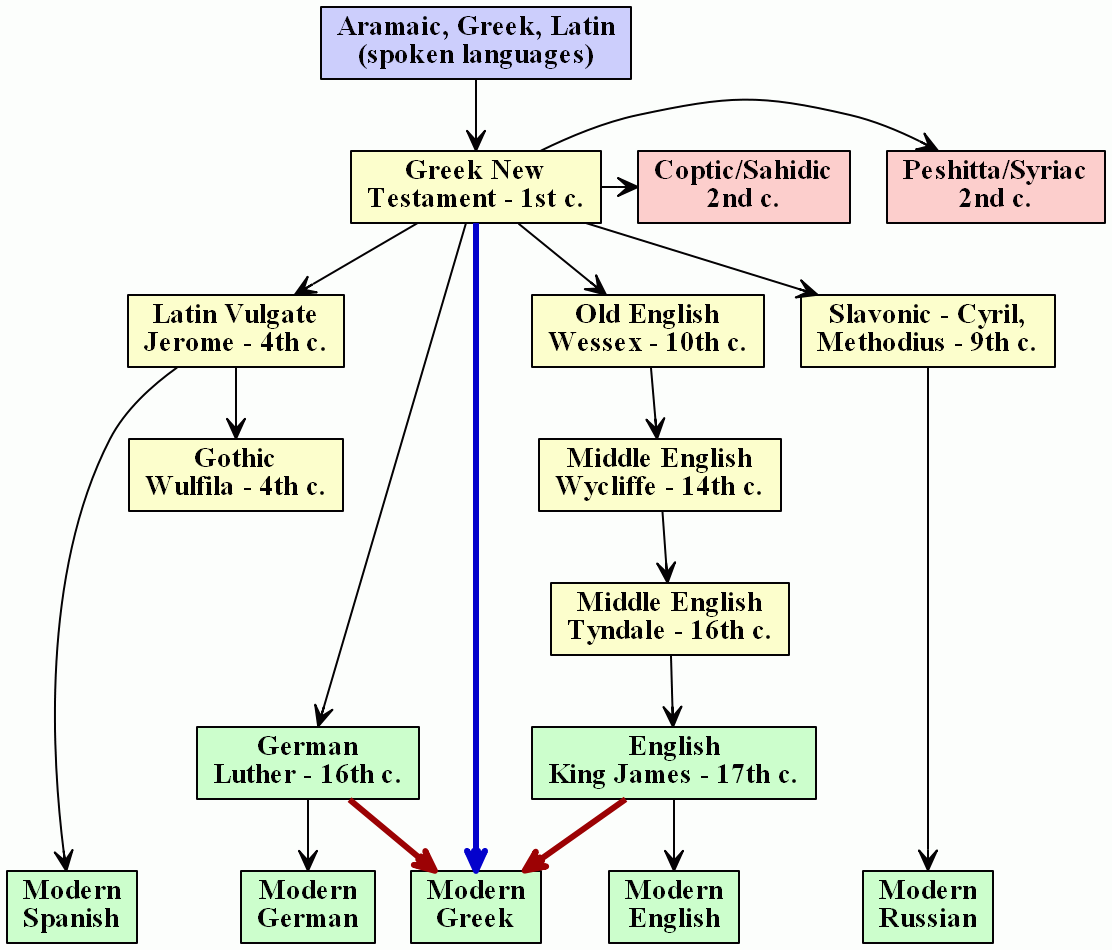
NT (New Testament) of the Bible was written about 2,000 years ago in Greek, the lingua franca at the time. Since then, the Bible has, at various times, been translated into many languages.
Here as a chart of some translation of the Greek
NT into other languages. The modern languages are those which I have spent some time studying.
16. PIE and translations
 PIE
PIE is the root of many modern languages.
17. The Greek language
The Greek language has a written history going back almost 3,000 years. Many words in use 2,000 years ago are still words today, written the same way, and with the same meaning. In many cases, the only difference is in the endings of the word.
Greek schools still teach some ancient/classical Greek and many Greeks can at least read some of the
NT in the original Greek.
18. The Greek language - then and now
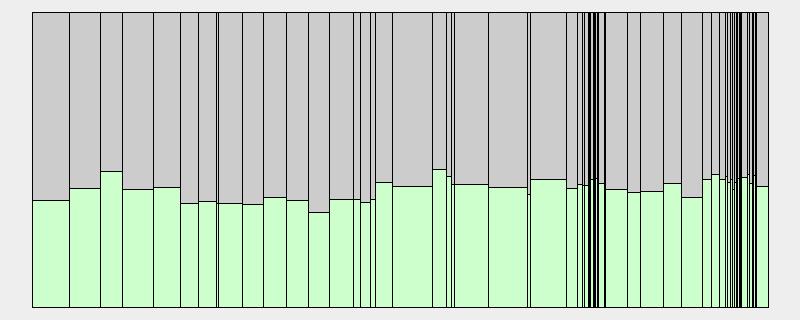
Here is an
incomplete custom-generated chart from 2015. Almost half of the words in a modern Greek translation of the Bible are the same as in the original.
Width of bar corresponds to book length. Genesis at left. Revelation at right.
Words are considered the same if a Bible Greek word is in a modern Greek dictionary.
Proper nouns are often the same but not accounted for here.
19. Method
The method used was the following, done automatically with a custom Python program/script.
Use the Greek for the LXX (Septuagint) Old Testament (from crosswire.org)
Use the Greek for the NT (Textus Receptus, from crosswire.org).
Convert every word to lower case and remove accents.
Get frequency counts for each word by book of the Bible and by overall usage.
For each word, use the Open Source Hunspell spell checker and a modern Greek dictionary.
If a word is spelled correctly (or in the suggested list of words) then it is a match. Otherwise it is not a match.
Note that many proper nouns (place names, names of people, etc.) are not handled by this method.
20. Spelling and meaning
One aspect of the Greek language that is interesting is a word in the
NT in the original Greek that has the same spelling and meaning today as it did then. The modern Greek translation, instead of using the original word, changes the word to match a modern Bible translation that has been influenced by scholars in the past 2,000 years.
Here we will look at and investigate some of these words. In some cases, one can see from the translation history when and where a word was changed to change the meaning of that text to something other than what appeared in the original text. This may or may not be important but it is interesting.
In some cases, the human mind can create and imagine meanings that are not in the original.
 |
Details are left as a future topic.
|
21. Matthew 5:15 Grip on a lightly taken opinion
Matthew 5:15 Neither do men light a candle, and put it under a bushel, but on a candlestick; and it giveth light unto all that are in the house. [kjv]
ουδε καιουσιν λυχνον και τιθεασιν αυτον υπο τον μοδιον αλλ επι την λυχνιαν και λαμπει πασιν τοις εν τη οικια [gnt]
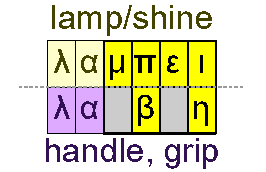
"λάμπει" ≈ "to shine, be bright, give light" (as used).
"λάβη" ≈ "handle, grip, hold" (play on words) from the verb for "take" or "seize".
Since ancient times, the Greek "
β" sound has changed from a "
b" sound to a "
v" sound. To obtain the "
b" sound, for words from other languages, Greek uses "
mp" as in "
μπ". The modern Greek word
"μπύρα" (BEE-ra) ≈ "beer". Thus, in ancient times, the "
mp" sound would approximate a "
b" sound as a play on words.
Might the
"opinion" held up provide
false "light" and act as a
"handle" or
"grip" on all those in the
"house"?
22. Usage - vain repetitions
*G945 *1 βαττολογέω (bat-tol-og-eh'-o) : from Battos (a proverbial stammerer) and G3056; to stutter, i.e. (by implication) to prate tediously:--use vain repetitions.
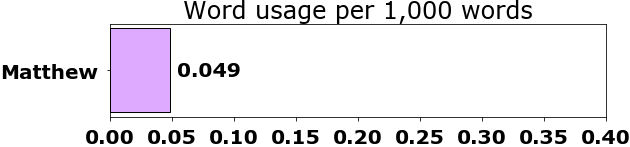 |
Words: βατταλογησητε=1
|
The Greek word may be related to the Hebrew or Aramaic.
To the Greek for "babbling".
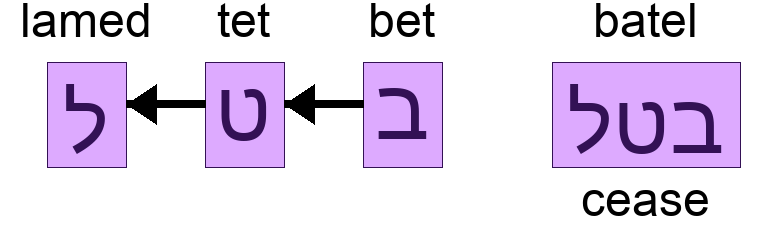
To the Hebrew for "batel" meaning "vain".
*H988 בָּטֵל (baw-tale') : a primitive root; to desist from labor:--cease.
Today the Greek «
β» (beta) is pronounced with a "
v" (English) sound. Words such as this (and others), coming from Hebrew/Aramaic and/or going into Latin, let us know that at the time of Christ, the Greek «
β» (beta) had a "
b" (English) sound and not a "
v" sound.
23. Aristotle: Sophistic Refutations
At the time of Aristotle, the words for
"definition" and
"mountain" were still somewhat distinct. This, however, does not prohibit their similarity from being used as a play on words. In the following passage in Sophistic Refutations, Aristotle uses as an example the Greek words for
"definition" and
"mountain".
English: For what turns on the division of words is not really ambiguous (for the expression when divided differently is not the same) unless indeed ὄρος and ὄρος, pronounced according to the breathing, constitute a single word with different meanings. (Loeb#100, p. 105)
Greek: οὐ γὰρ ὁ αὐτὸς λόγος γίνεται, διαιρούμενος, εἴπερ μὴ 〈ὡς〉 καὶ τὸ "ὄρος", [καὶ] "ὅρος" τῇ προσῳδίᾳ λεχθέν, σημαίνει ἕτερον. Aristotle: Sophistic Refutations [178a]
The ancient Greek word
"προσῳδία" ≈ "song with accompaniment, tone or pitch of a word, diacritic mark" and comes from two Greek words.
"πρός" ≈ "to, towards".
"ᾠδή" ≈ "song, ode" and is the source of the English word "ode".
24. Aristotle: Sophistic Refutations
Aristotle continues. At the time, the spoken words were not the same as the written words that appear to be the same. This distinction was in Attic Greek but had disappeared by the time of the
GNT (Greek New Testament).
English: (In written language a word is the same when it is written with the same letters and in the same manner, though people now put in additional signs, but the words when spoken are not the same.) (Loeb#100, p. 105)
Greek: Ἀλλ´ ἐν μὲν τοῖς γεγραμμένοις τὸ αὐτὸ 〈τὸ〉 ὄνομα, ὅταν ἐκ τῶν αὐτῶν στοιχείων γεγραμμένον ᾖ καὶ ὡσαύτως (κἀκεῖ δ´ ἤδη παράσημα ποιοῦνται), τὰ δὲ φθεγγόμενα οὐ ταὐτά. Aristotle: Sophistic Refutations [178a]
25. Aristotle: Sophistic Refutations
There are parts of the tone or pitch of a word that do not appear to make a difference in most people understanding what is being said.
English: for it does not seem ever, or seems very seldom, to alter the significance of the word whether it is pronounced with a lower or higher pitch. (Loeb#100, p. 42)
Greek: Ὁμοίως δὲ καὶ τῶν παρὰ τὴν προσῳδίαν· οὐ γὰρ ἄλλο δοκεῖ σημαίνειν ἀνιέμενος καὶ ἐπιτεινόμενος ὁ λόγος, ἐπ´ οὐδενὸς ἢ οὐκ ἐπὶ πολλῶν. Aristotle: Sophistic Refutations [169b]
The Greek for "
significance" is that of "
meaning" or "
semantics".
Aristotle is concerned with using similarities of words to deceive or mislead in logical or dialectic arguments that are not valid.
26. New Testament Greek: B. G. McClean
In his book,
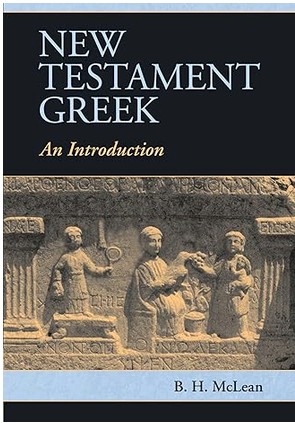
New Testament Greek: An Introduction (2011, Cambridge University Press), (then) Professor of New Testament Language and Literature at Knox College, University of Toronto, B. H. McLean explains some of the rough and smooth breathing issues in the
GNT.
The system of pronunciation developed by Erasmus is known as the Erasmian pronunciation system. It gives the same values to Greek letters as their corresponding Latin equivalents. It is also based on the non-linguistic principle that each letter should be pronounced differently. (p. 3)
According to the Erasmian system of pronunciation, a rough breathing mark adds an "h" sound (i.e., aspiration) to the pronunciation. (p. 17)
Using the Latin-based Erasmian system of pronunciation makes it hard to "
hear" play on words in the Greek.
27. Greek alphabet
The Greeks used the alphabet from the Phoneticians as did the Hebrews.
The Greeks added vowels to the alphabet.
The Greeks dropped letters that, to them, had the same sound.
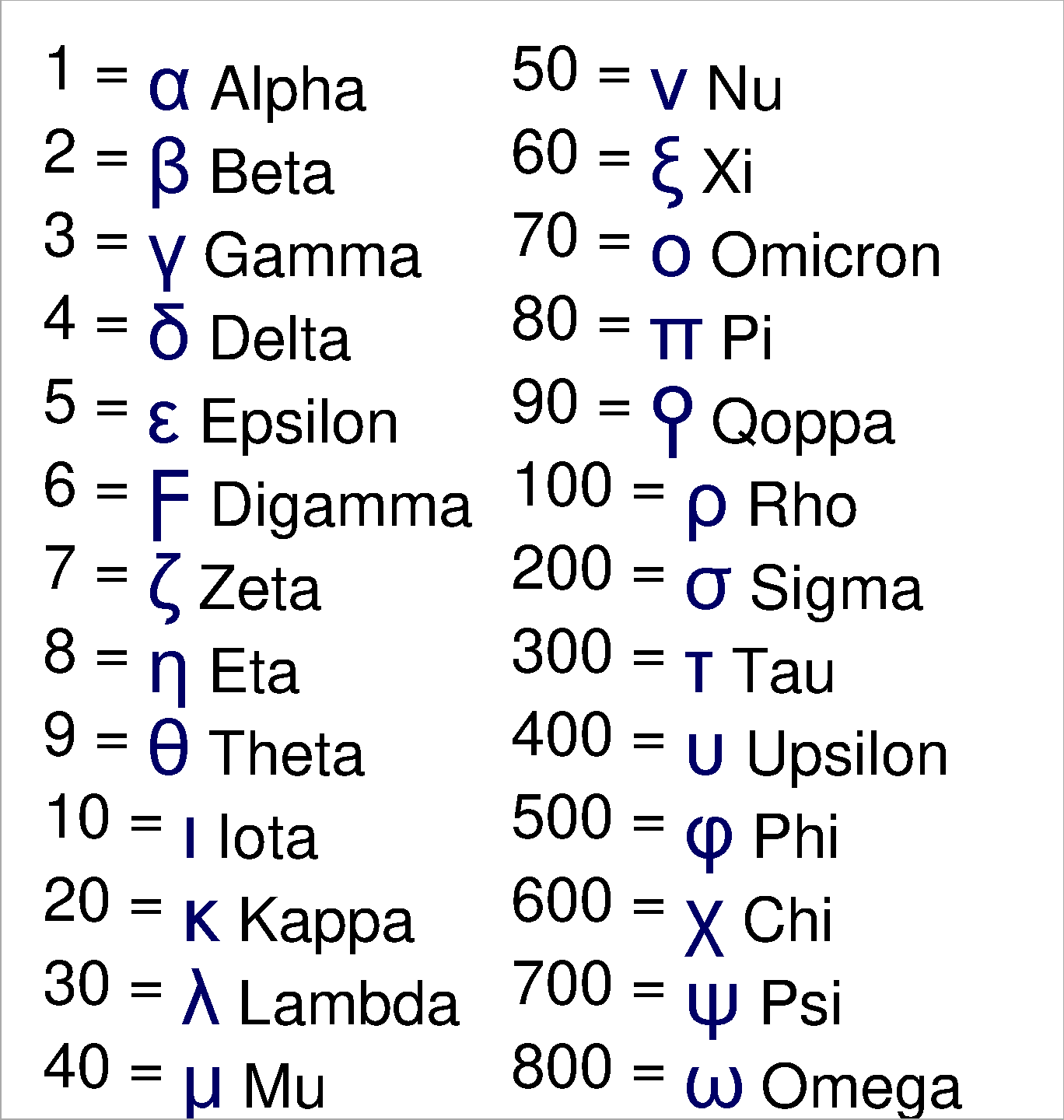
The "c" (sound of "k") was dropped while "k" (sound of "k") was kept. The Roman hard "c" and "k" were redundant. Later, the hard "c" softened as in "Kaiser" becoming "Caesar". Likewise, the qoppa (sound of "k") was dropped.
The digamma (sound of "f" or "v") was dropped while phi (sound of "f") was kept.
The digamma was kept for it's numerical value of six. The most famous and only digamma in the
GNT is the six in 666 as (lowercase) «
χξϚ» or (uppercase) «
ΧΞϜ».
28. New Testament Greek: B. G. McClean
Note that any play on word meanings would ignore any such artificial aspiration, such as
"mountain" and
"definition".
(smooth breathing) "ὄρος" ≈ "mountain".
(rough breathing) "ὅρος" ≈ "boundary, definition".
Note: The meaning is not determined by the breathing marks. The breathing marks were added to fit the decided meaning.
The rough breathing mark was used to indicate aspiration in Attic (Athenian) Greek ... The other main dialects of Greek, namely Ionic, Doric, and Aeolic, never employed aspiration. In fact, all aspiration in Greek died out prior to the first century AD. Therefore, there is no good reason to continue using these breathing marks in modern editions of the Greek New Testament. (p. 20-21)
From a historical perspective, it is clear that the addition of breathing marks to the Greek New Testament does [sic] is artificial. (p. 21)
29. End of page