Send
Close Add comments:
(status displays here)
Got it! This site "creationpie.org" uses cookies. You consent to this by clicking on "Got it!" or by continuing to use this website. Note: This appears on each machine/browser from which this site is accessed.
Matthew 16:1-3 Red sky at night
1. Verses with Greek
Matthew 16:1 The Pharisees also with the Sadducees came, and tempting desired him that he would shew them a sign from heaven. [kjv]
και προσελθοντες οι φαρισαιοι και σαδδουκαιοι πειραζοντες επηρωτησαν αυτον σημειον εκ του ουρανου επιδειξαι αυτοις [gnt]
16:2 He answered and said unto them, When it is evening, ye say, It will be fair weather: for the sky is red. [kjv]
ο δε αποκριθεις ειπεν αυτοις οψιας οψιας γενομενης λεγετε ευδια πυρραζει γαρ ο ουρανος [gnt]
16:3 And in the morning, It will be foul weather to day: for the sky is red and lowring. O ye hypocrites, ye can discern the face of the sky; but can ye not discern the signs of the times? [kjv]
και πρωι σημερον χειμων πυρραζει γαρ στυγναζων ο ουρανος υποκριται το μεν προσωπον του ουρανου γινωσκετε διακρινειν τα δε σημεια των καιρων ου δυνασθε δυνασθε [gnt]
16:4 A wicked and adulterous generation seeketh after a sign; and there shall no sign be given unto it, but the sign of the prophet Jonas. And he left them, and departed. [kjv]
γενεα πονηρα και μοιχαλις σημειον επιζητει και σημειον ου δοθησεται αυτη ει μη το σημειον ιωνα του προφητου και καταλιπων αυτους απηλθεν [gnt]
2. Red sky
Red sky at night, sailors' delight.
Red sky at morning, sailors take warning.
One common variant is the following.
Red sky at night, shepherds' delight.
Red sky in the morning, shepherds' warning.
Is the "sky" "red"?
Is the "sky" "orange"?
Does the "sky" appear as "fire"?
3. Genesis 25:25: Fire color as red or orange
Genesis 25:25 And the first came out red, all over like an hairy garment; and they called his name Esau. [kjv]
εξηλθεν δε ο υιος ο πρωτοτοκος πυρρακης ολος ωσει δορα δασυς επωνομασεν δε το ονομα αυτου ησαυ [lxx]
… rufus … [v]
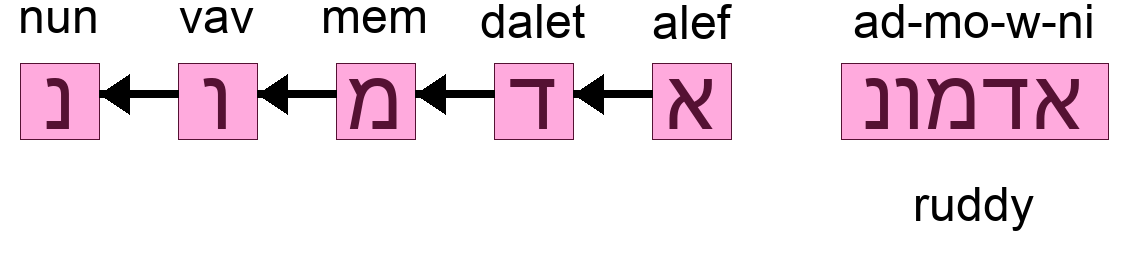
… אדמוני … [he]
Here, the
"red" in Hebrew is sometimes translated as
"ruddy". The
LXX (Septuagint) uses the ancient Greek word
"πυρράζω" ≈ "redden" as in
"fire" which can be a play on words with
"examine" as in
"tempt".
4. Revelation 12:3 Greek red fire
Revelation 12:3 And there appeared another wonder in heaven; and behold a great red dragon, having seven heads and ten horns, and seven crowns upon his heads. [kjv]
και ωφθη αλλο σημειον εν τω ουρανω και ιδου δρακων μεγας πυρρος εχων κεφαλας επτα και κερατα δεκα και επι τας κεφαλας αυτου διαδηματα επτα διαδηματα [gnt]
… rufus … [v]

The Greek word for
"red" is related to the ancient Greek word
"πῦρ" ≈ "fire" which is from the
PIE (Proto Indo-European) root
"*PEHWR" ≈ "fire" and is related to the English word
"fire" through Grimm's Law.
The German word "das Feuer" ≈ "fire".
The modern Greek word "πυρ" (peer) ≈ "fire".
Is this a
"red" "
dragon" or a
"fire" breathing "
dragon"?
Fire often appears more
orange than
red, but, remember, that distinction was not made at that time.
5. Matthew 16:1-4 Verses
Matthew 16:1 The Pharisees also with the Sadducees came, and tempting desired him that he would shew them a sign from heaven. [kjv]
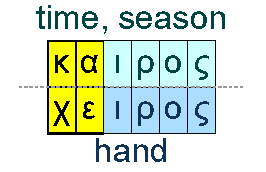
16:2 He answered and said unto them, When it is evening, ye say, It will be fair weather: for the sky is red. [kjv]
16:3 And in the morning, It will be foul weather to day: for the sky is red and lowring. O ye hypocrites, ye can discern the face of the sky; but can ye not discern the signs of the times? [kjv]
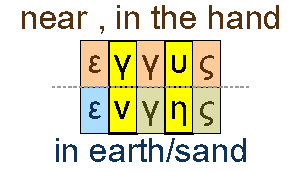
16:4 A wicked and adulterous generation seeketh after a sign; and there shall no sign be given unto it, but the sign of the prophet Jonas. And he left them, and departed. [kjv]
6. Matthew 16:1
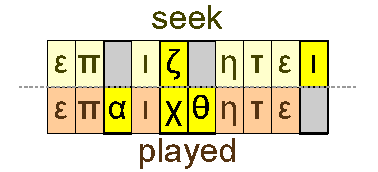
KJV: The Pharisees also with the Sadducees came, and tempting desired him that he would shew them a sign from heaven.
Greek: και προσελθοντες οι φαρισαιοι και σαδδουκαιοι πειραζοντες επηρωτησαν αυτον σημειον εκ του ουρανου επιδειξαι αυτοις
7. Matthew 16:2
KJV: He answered and said unto them, When it is evening, ye say, It will be fair weather: for the sky is red.
Greek: ο δε αποκριθεις ειπεν αυτοις οψιας οψιας γενομενης λεγετε ευδια πυρραζει γαρ ο ουρανος
8. Matthew 16:3
KJV: And in the morning, It will be foul weather to day: for the sky is red and lowring. O ye hypocrites, ye can discern the face of the sky; but can ye not discern the signs of the times?
Greek: και πρωι σημερον χειμων πυρραζει γαρ στυγναζων ο ουρανος υποκριται το μεν προσωπον του ουρανου γινωσκετε διακρινειν τα δε σημεια των καιρων ου δυνασθε δυνασθε
9. Matthew 16:4
KJV: A wicked and adulterous generation seeketh after a sign; and there shall no sign be given unto it, but the sign of the prophet Jonas. And he left them, and departed.
Greek: γενεα πονηρα και μοιχαλις σημειον επιζητει και σημειον ου δοθησεται αυτη ει μη το σημειον ιωνα του προφητου και καταλιπων αυτους απηλθεν
10. Matthew 16:1 Context
Matthew 16:1 The Pharisees also with the Sadducees came, and tempting desired him that he would shew them a sign from heaven. [kjv]
και προσελθοντες οι φαρισαιοι και σαδδουκαιοι πειραζοντες επηρωτησαν αυτον σημειον εκ του ουρανου επιδειξαι αυτοις [gnt]
Members of the religious establishment come to
"examine" Jesus in order to "
trick" him. The word translated as
"tempt" means to
"examine" using knowledge which the person knows or believes to be true.
The ancient Greek word
"πειράζω" ≈ "examine" and is often translated in the
KJV (King James Version) as
"tempt". The modern idea of the Greek
"temptation" is that of an interview where one examines someone about things they know or believe they know.
This word is important here as Jesus will make a play on words of this Greek word.
11. Matthew 16:1-3 Red sky at night
Matthew 16:2 He answered and said unto them, When it is evening, ye say, It will be fair weather: for the sky is red. [kjv]
16:3 And in the morning, It will be foul weather to day: for the sky is red and lowring. O ye hypocrites, ye can discern the face of the sky; but can ye not discern the signs of the times? [kjv]
Jesus provides the first recorded instance of a general saying through the ages used as a "
rule of thumb".
Red sky at night, sailors' delight.
Red sky at morning, sailors take warning.
What one calls
"red" is information and is dependent on one's viewpoint. The word used by Jesus here is derived from the Greek word for
"fire". That Greek word for
"red" is a
play on words that is not apparent in the English translation.
12. Matthew 16:4 Final verse
Matthew 16:4 A wicked and adulterous generation seeketh after a sign; and there shall no sign be given unto it, but the sign of the prophet Jonas. And he left them, and departed. [kjv]
γενεα πονηρα και μοιχαλις σημειον επιζητει και σημειον ου δοθησεται αυτη ει μη το σημειον ιωνα του προφητου και καταλιπων αυτους απηλθεν [gnt]
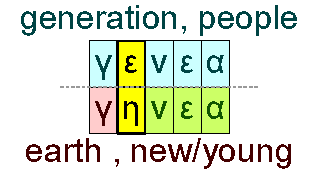
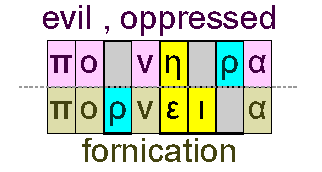
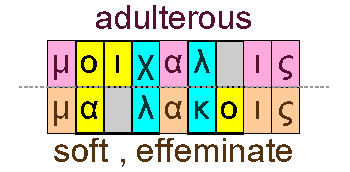
KJV: "wicked" and "adulterous" generation.
Greek: "oppressive" and "seductive" generation.
The
KJV translates as
"wicked" the Greek word that means
"oppressive". The
"oppression" is physical
"oppression" and mental
"oppression" through "
deception" and other means.
The
KJV translates as
"adulterous" the Greek word that can mean
"adulterous" but might be better translated as
"seductive". The
"seductive" is that of recruiting those into the system to avoid some of the
"oppression" by
"oppressing" others.
This reference to
"Jonah" appears to refer to Matthew 12 where a large number of play on words are made, as is done here in this part of Matthew 16.
13. Matthew 16:4 If not
Matthew 16:4 A wicked and adulterous generation seeketh after a sign; and there shall no sign be given unto it, but the sign of the prophet Jonas. And he left them, and departed. [kjv]
γενεα πονηρα και μοιχαλις σημειον επιζητει και σημειον ου δοθησεται αυτη ει μη το σημειον ιωνα του προφητου και καταλιπων αυτους απηλθεν [gnt]
14. Matthew 16:4 If not
Matthew 16:4 A wicked and adulterous generation seeketh after a sign; and there shall no sign be given unto it, but the sign of the prophet Jonas. And he left them, and departed. [kjv]
γενεα πονηρα και μοιχαλις σημειον επιζητει και σημειον ου δοθησεται αυτη ει μη το σημειον ιωνα του προφητου και καταλιπων αυτους απηλθεν [gnt]
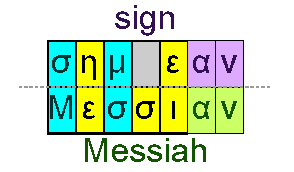
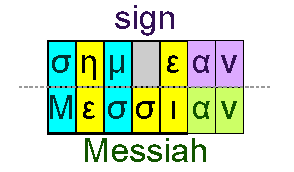
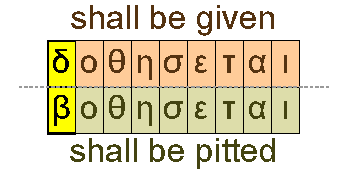
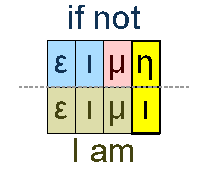
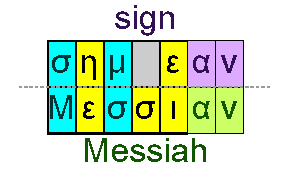
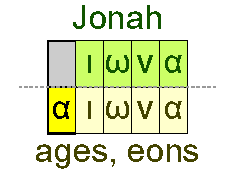
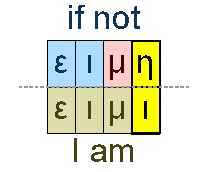
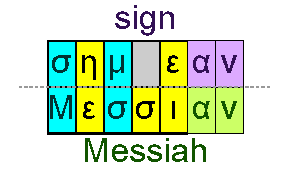
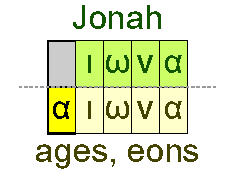
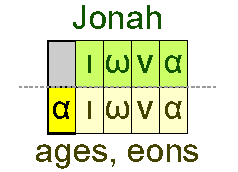
Greek:
... if not the sign of Jonah ...
Play:
... I am the Messiah of (the) ages ...
How well does the play on words fit?
15. Matthew 12:39 Miracle sign and Jonah
Matthew 12:39 But he answered and said unto them, An evil and adulterous generation seeketh after a sign; and there shall no sign be given to it, but the sign of the prophet Jonas: [kjv]
ο δε αποκριθεις ειπεν αυτοις γενεα πονηρα και μοιχαλις σημειον επιζητει και σημειον ου δοθησεται αυτη ει μη το σημειον ιωνα του προφητου [gnt]
"ιωνα" ≈ "Jonah".
"αἰῶνᾰ" ≈ "lifetime, age, forever" (accusative) of "αἰών" ≈ "lifetime, age, forever".
What is the
"sign" of the prophet
"Jonah", into the
"ages"?
Jonah is a
whale of a
tail! What are (
water) you saying? Some
spout off about it while others can't
swallow it and
sea it as
fishy.
16. Matthew 16:1 Context
Matthew 16:1 The Pharisees also with the Sadducees came, and tempting desired him that he would shew them a sign from heaven. [kjv]
και προσελθοντες οι φαρισαιοι και σαδδουκαιοι πειραζοντες επηρωτησαν αυτον σημειον εκ του ουρανου επιδειξαι αυτοις [gnt]
This series of verses spans only four verses. The first of these has
three words that are used in the two
"red" "sky" verses that follow.
"πειράζω" ≈ "examine" and is often translated in the KJV as "tempt".
"σημεῖον" ≈ "mark, sign, omen, flag" and is related to the English word "semantic" as in "meaning" and the first part of the English word "semaphore".
"οὑρανός" ≈ "sky, heaven".
17. Matthew 16:1 Examination
Matthew 16:1 The Pharisees also with the Sadducees came, and tempting desired him that he would shew them a sign from heaven. [kjv]
και προσελθοντες οι φαρισαιοι και σαδδουκαιοι πειραζοντες επηρωτησαν αυτον σημειον εκ του ουρανου επιδειξαι αυτοις [gnt]
*G3985 *38 πειράζω (pi-rad'-zo) : from G3984; to test (objectively), i.e. endeavor, scrutinize, entice, discipline:--assay, examine, go about, prove, tempt(-er), try.
The ancient Greek word
"πειράζω" ≈ "examine" and is often translated in the
KJV as
"tempt". The Greek meaning was one of
"examination" where the examiner uses things the examiner believes to be true, often to deceive that examinee. The same happens in modern job interviews, though not (usually) with the goal of deception.
18. Peirastic
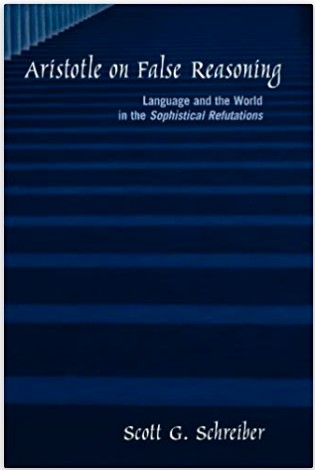
On page 2, Schreiber elaborates on
"peirastic" reasoning as distinguished by Aristotle.
... he (Aristotle) distinguishes another type of reasoning called "peirastic" (πειραστικός) or examinational reasoning. Peirastic proceeds from some belief of the person being examined. ... (1) it must be believed by the person being examined ... and (2) it need not be an endoxon (i.e., it may be an entirely idiosyncratic belief) ...
Aristotle's clarification of the word fits the
"temptations" of Jesus in the Gospels. The ancient Greek word
"πειράζω" ≈ "examine" and is often translated in the
KJV as
"tempt". The modern idea of the Greek
"temptation" is that of an interview where one examines someone about things they know or believe they know.
19. James 1:12 Happy Temptations
James 1:12 Blessed is the man that endureth temptation: for when he is tried, he shall receive the crown of life, which the Lord hath promised to them that love him. [kjv]
μακαριος ανηρ ος υπομενει πειρασμον οτι δοκιμος γενομενος ληψεται λημψεται τον στεφανον της ζωης ον επηγγειλατο ο κυριος τοις αγαπωσιν αυτον [gnt]
beatus … temptationem … probatus … coronam … [v]
The ancient Greek word
"μακάριος" ≈ "happy, content" but is often translated as
"blessed". The Latin word
"beati" ≈ "happy, fortunate" and is the origin of the English word
"beatitude" and the name of the
"Beatitudes".
The Latin word
"probo" ≈ "approve, test, inspect, examine, demonstrate, prove".
20. James 1:13 Tempted by God
James 1:13 Let no man say when he is tempted, I am tempted of God: for God cannot be tempted with evil, neither tempteth he any man: [kjv]
μηδεις πειραζομενος λεγετω οτι απο του θεου πειραζομαι ο γαρ θεος απειραστος εστιν κακων πειραζει δε αυτος ουδενα [gnt]
If God knows everything how can God be
"examined"? Does God
"examine" anyone? Is it an
"examination" when one must account for every "
idle word"?
James is filled with logical reasoning errors. As a
disputed, literally "
spoken against" in the Greek, book, James appears to have been included, in part, because some verses can be used to "
enslave" or "
oppress" the faithful to get them to do what the human church infrastructure (house of sand) desires.
21. James 1:13 Tempted by God
James 1:13 Let no man say when he is tempted, I am tempted of God: for God cannot be tempted with evil, neither tempteth he any man: [kjv]
μηδεις πειραζομενος λεγετω οτι απο του θεου πειραζομαι ο γαρ θεος απειραστος εστιν κακων πειραζει δε αυτος ουδενα [gnt]
The ancient Greek word
"πειράζω" ≈ "examine" is an examination, sometimes to deceive, using beliefs that the person being examined holds to be true. How can God be examined by what God believes to be true (since he knows what is true) in an attempt to deceive God?
Does God "examine" in order to "deceive"?
Does God allow "false teachers" to "examine" in order to "deceive"?
Should we pray that God not allow those "false teachers" to be able "examine" to "deceive" us?
22. James 1:14 Tempted by desire
James 1:14 But every man is tempted, when he is drawn away of his own lust, and enticed. [kjv]
εκαστος δε πειραζεται υπο της ιδιας επιθυμιας εξελκομενος και δελεαζομενος [gnt]
… temptatur … concupiscentia … abstractus … inlectus [v]
In simple terms, "
abstraction" is looking at
similarities and ignoring
differences. The English word
"abstract" comes from the Latin word
"abstractus" ≈ "take away from" used in this verse.
Compare and contrast the following ways of being
"drawn away". The Greek for "
wander away" is used in the next verse.
☐ 1. Greek meaning: abstractly deceived to follow desires and wander away
☐ 2. Latin meaning: physically enticed to follow desires and wander away.
From the context, which meaning does James appear to convey?
The Latin word
"inlectus" ≈ "enticed, seduced".
23. Strongs - mark, sign
- *G4592 *77 σημεῖον (say-mi'-on) : neuter of a presumed derivative of the base of G4591; an indication, especially ceremonially or supernaturally:--miracle, sign, token, wonder.
- σημειον *38
- Matthew 12:38 ... Master, we would see a sign from thee.
- Matthew 12:39 ... generation seeketh after a sign; and there shall no sign be given to it, ...
- Matthew 16:1 ... him that he would shew them a sign from heaven.
- Matthew 16:4 ... generation seeketh after a sign; and there shall no sign be given unto it, ...
- Matthew 24:3 ... be? and what shall be the sign of thy coming, ...
- Matthew 24:30 And then shall appear the sign of the Son of man in ...
- Matthew 26:48 ... him gave them a sign, saying, Whomsoever I shall kiss, ...
- Mark 8:11 ... seeking of him a sign from heaven, tempting him.
- Mark 8:12 ... generation seek after a sign? verily I say unto you, There shall no sign be given unto ...
- Mark 13:4 ... and what shall be the sign when all these things shall be fulfilled?
- Luke 2:12 And this shall be a sign unto you; Ye shall find the babe ...
- Luke 2:34 ... Israel; and for a sign which shall be spoken against;
- Luke 11:16 ... him, sought of him a sign from heaven.
- Luke 11:29 ... generation: they seek a sign; and there shall no sign be given it, ...
- Luke 11:30 For as Jonas was a sign unto the Ninevites, so shall ...
- Luke 21:7 ... be? and what sign will there be when these things shall come to pass?
- Luke 23:8 ... he hoped to have seen some miracle done by him.
- John 2:18 ... said unto him, What sign shewest thou unto us, seeing that ...
- John 4:54 This is again the second miracle that Jesus did, ...
- John 6:14 Then those men, when they had seen the miracle that Jesus did, ...
- John 6:30 They said therefore unto him, What sign shewest thou then, ...
- John 10:41 ... John did no miracle: but all things that ...
- John 12:18 ... he had done this miracle.
- Acts 4:16 ... that indeed a notable miracle hath been done by them ...
- Acts 4:22 ... on whom this miracle of healing was shewed.
- Romans 4:11 And he received the sign of circumcision, a seal of the righteousness ...
- 1 Corinthians 14:22 Wherefore tongues are for a sign, not to them that believe, ...
- 2 Thessalonians 3:17 ... hand, which is the token in every epistle: ...
- Revelation 12:1 And there appeared a great wonder in heaven; a woman ...
- Revelation 12:3 And there appeared another wonder in heaven; and ...
- Revelation 15:1 And I saw another sign in heaven, great ...
- σημεια *32
- Matthew 16:3 ... but can ye not discern the signs of the times?
- Matthew 24:24 ... and shall shew great signs and wonders; insomuch that, ...
- Mark 13:22 ... shall rise, and shall shew signs and wonders, to ...
- Mark 16:17 And these signs shall follow them that believe; ...
- Luke 21:11 ... fearful sights and great signs shall there be from heaven.
- Luke 21:25 And there shall be signs in the sun, and ...
- John 2:23 ... his name, when they saw the miracles which he did.
- John 3:2 ... can do these miracles that thou doest, ...
- John 4:48 ... him, Except ye see signs and wonders, ye will ...
- John 6:2 ... because they saw his miracles which he did on them that were diseased.
- John 6:26 ... not because ye saw the miracles, but because ye did eat ...
- John 7:31 ... cometh, will he do more miracles than these which this man hath done?
- John 9:16 ... that is a sinner do such miracles? And there was a division ...
- John 11:47 ... man doeth many miracles.
- John 12:37 ... he had done so many miracles before them, yet they believed ...
- John 20:30 And many other signs truly did Jesus ...
- Acts 2:19 ... heaven above, and signs in the earth beneath; ...
- Acts 2:43 ... many wonders and signs were done by the apostles.
- Acts 4:30 ... heal; and that signs and wonders may be done ...
- Acts 5:12 ... of the apostles were many signs and wonders wrought among ...
- Acts 6:8 ... great wonders and miracles among the people.
- Acts 7:36 ... after that he had shewed wonders and signs in the land of Egypt, ...
- Acts 8:6 ... hearing and seeing the miracles which he did.
- Acts 8:13 ... beholding the miracles and signs which were done.
- Acts 14:3 ... grace, and granted signs and wonders to be done ...
- Acts 15:12 ... Paul, declaring what miracles and wonders God ...
- 1 Corinthians 1:22 For the Jews require a sign, and the Greeks seek after wisdom:
- 2 Corinthians 12:12 Truly the signs of an apostle were wrought among you in all patience, in signs, and wonders, ...
- Revelation 13:13 And he doeth great wonders, so that he maketh ...
- Revelation 13:14 ... the earth by the means of those miracles which he had power ...
- Revelation 16:14 ... the spirits of devils, working miracles, which go forth unto the kings ...
- Revelation 19:20 ... him the false prophet that wrought miracles before him, with ...
- σημειοις *4
- Acts 2:22 ... and wonders and signs, which God did ...
- 2 Corinthians 12:12 Truly the signs of an apostle were wrought among you in all patience, in signs, and wonders, ...
- 2 Thessalonians 2:9 ... all power and signs and lying wonders,
- Hebrews 2:4 God also bearing them witness, both with signs and wonders, and ...
- σημειων *3
- Mark 16:20 ... confirming the word with signs following. Amen.
- John 2:11 This beginning of miracles did Jesus in ...
- Romans 15:19 Through mighty signs and wonders, by ...
24. Usage - mark, sign
*G4592 *77 σημεῖον (say-mi'-on) : neuter of a presumed derivative of the base of G4591; an indication, especially ceremonially or supernaturally:--miracle, sign, token, wonder.
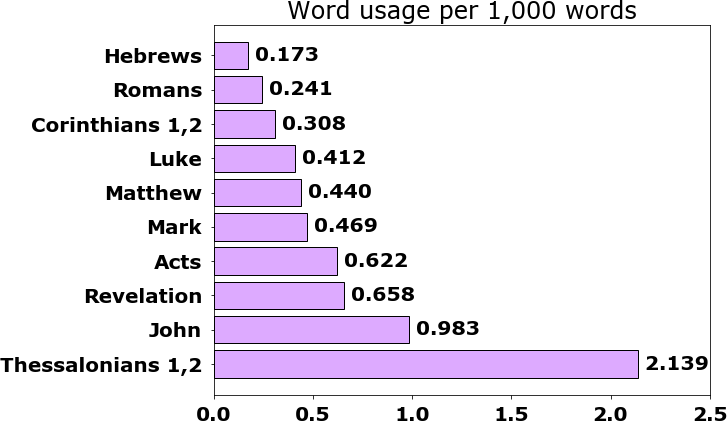 |
Words: σημεια=32 σημειοις=4 σημειον=38 σημειων=3
|
 |
Flag of Greece
|
The ancient Greek word
"σῆμα" ≈ "mark, sign" and is the source of the English word
"semaphore".
The modern Greek word
"σημαία" (see-MEH-a) ≈ "flag".
25. Sky and heaven
*G3772 *275 οὐρανός (oo-ran-os') : perhaps from the same as G3735 (through the idea of elevation); the sky; by extension, heaven (as the abode of God); by implication, happiness, power, eternity; specially, the Gospel (Christianity):--air, heaven(-ly), sky.
The ancient Greek word
"ουρανός" ≈ "sky, heaven".
The English word for the planet
"Uranus", discovered by William Hershel in 1781, is from the ancient Greek word
"Οὐρανός" ≈ "Uranus" who was a god in Greek mythology.
What is the difference in the following?
- Kingdom of "heaven".
- Kingdom of the "sky".
26. Usage - sky, heaven
*G4592 *77 σημεῖον (say-mi'-on) : neuter of a presumed derivative of the base of G4591; an indication, especially ceremonially or supernaturally:--miracle, sign, token, wonder.
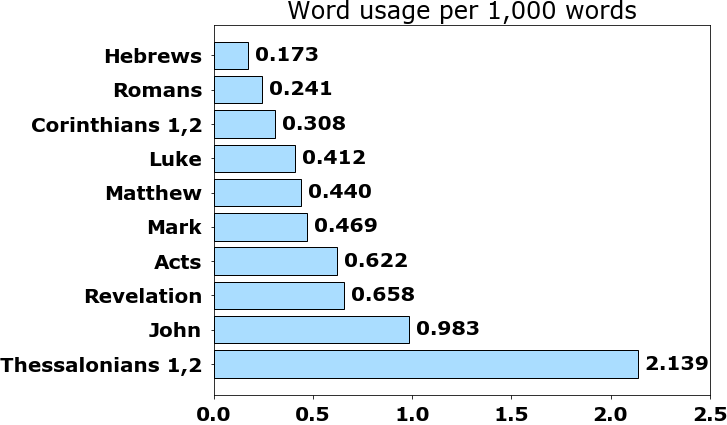 |
Words: σημεια=32 σημειοις=4 σημειον=38 σημειων=3
|
27. Matthew 16:1
KJV: The Pharisees also with the Sadducees came, and tempting desired him that he would shew them a sign from heaven.
Greek: και προσελθοντες οι φαρισαιοι και σαδδουκαιοι πειραζοντες επηρωτησαν αυτον σημειον εκ του ουρανου επιδειξαι αυτοις
28. Matthew 16:2 Answer
Matthew 16:2 He answered and said unto them, When it is evening, ye say, It will be fair weather: for the sky is red. [kjv]
ο δε αποκριθεις ειπεν αυτοις οψιας οψιας γενομενης λεγετε ευδια πυρραζει γαρ ο ουρανος [gnt]
The ancient Greek word
"ἀποκρίνω" ≈ "separate, distinguish".
The Greek word for "
answer" as in "
answering a question" has the Greek word for "
separate" as the second part. This word for "
separate" is translated by the
KJV as "
judge".
29. Strongs - evening
- *G3798 *14 ὄψιος (op'-see-os) : from G3796; late; feminine (as noun) afternoon (early eve) or nightfall (later eve):--even(-ing, (-tide)).
- οψιας *13
- Matthew 8:16 When the even was come, they brought unto him many ...
- Matthew 14:15 And when it was evening, his disciples came ...
- Matthew 14:23 ... apart to pray: and when the evening was come, he was there alone.
- Matthew 16:2 ... said unto them, When it is evening, ye say, It will be fair weather: for ...
- Matthew 20:8 So when even was come, the lord of the vineyard ...
- Matthew 26:20 Now when the even was come, he sat down with the twelve.
- Matthew 27:57 When the even was come, there came a rich man ...
- Mark 1:32 And at even, when the sun did set, ...
- Mark 4:35 ... same day, when the even was come, he saith unto them, ...
- Mark 6:47 And when even was come, the ship was in ...
- Mark 14:17 And in the evening he cometh with the twelve.
- Mark 15:42 And now when the even was come, because it was ...
- John 20:19 Then the same day at evening, being the first day of the week, ...
- οψια
- John 6:16 And when even was now come, his ...
30. Usage - evening
*G3798 *14 ὄψιος (op'-see-os) : from G3796; late; feminine (as noun) afternoon (early eve) or nightfall (later eve):--even(-ing, (-tide)).
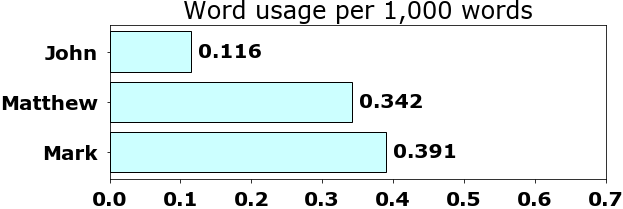 |
Words: οψια οψιας=13
|
31. Usage - evening
Matthew 16:2 He answered and said unto them, When it is evening, ye say, It will be fair weather: for the sky is red. [kjv]
ο δε αποκριθεις ειπεν αυτοις οψιας οψιας γενομενης λεγετε ευδια πυρραζει γαρ ο ουρανος [gnt]
*G3798 *14 ὄψιος (op'-see-os) : from G3796; late; feminine (as noun) afternoon (early eve) or nightfall (later eve):--even(-ing, (-tide)).
The Greek word often means "
late in the day" or "
late in time" which could have the idea of "
evening". English has the idea of "
the eleventh hour".
The ancient Greek word
"ὄψις" ≈ "view, sight, face, countenance" and is the source of English words such as
"optical". A synonym is the ancient Greek word
"πρόσοπον" ≈ "view, sight, face, countenance" which is used in the next verse.
A similar sounding word is the ancient Greek word
"ὀψάριον" ≈ "small plate of food, fish" which is made up of two parts.
- The ancient Greek word "ὄψον" ≈ "delicacy".
- The ancient Greek suffix "άριον" ≈ "diminutive suffix"
32. Matthew Snakes in the evening
Matthew 16:2 He answered and said unto them, When it is evening, ye say, It will be fair weather: for the sky is red. [kjv]
ο δε αποκριθεις ειπεν αυτοις οψιας οψιας γενομενης λεγετε ευδια πυρραζει γαρ ο ουρανος [gnt]
10:16 Behold, I send you forth as sheep in the midst of wolves: be ye therefore wise as serpents, and harmless as doves. [kjv]
ιδου εγω αποστελλω υμας ως προβατα εν μεσω λυκων γινεσθε ουν φρονιμοι ως οι οφεις και ακεραιοι ως αι περιστεραι [gnt]
23:33 Ye serpents, ye generation of vipers, how can ye escape the damnation of hell? [kjv]
οφεις γεννηματα εχιδνων πως φυγητε απο της κρισεως της γεεννης [gnt]
- "όψις" ≈ "view, sight, face, countenance".
- "ὄψεις" ≈ "evening".
- "ὄφεις" ≈ "serpents, snakes" (as a play on words).
33. Strongs - snakes
- *G3789 *14 ὄφις (of'-is) : probably from G3700 (through the idea of sharpness of vision); a snake, figuratively, (as a type of sly cunning) an artful malicious person, especially Satan:--serpent.
- οφις *4
- 2 Corinthians 11:3 But I fear, lest by any means, as the serpent beguiled Eve through ...
- Revelation 12:9 ... dragon was cast out, that old serpent, called the Devil, and ...
- Revelation 12:15 And the serpent cast out of his mouth ...
- Revelation 20:2 And he laid hold on the dragon, that old serpent, which is the Devil, ...
- οφιν *3
- Matthew 7:10 ... a fish, will he give him a serpent?
- Luke 11:11 ... a fish give him a serpent?
- John 3:14 And as Moses lifted up the serpent in the wilderness, even so ...
- οφεις *3
- Matthew 10:16 ... therefore wise as serpents, and harmless as doves.
- Matthew 23:33 Ye serpents, ye generation of vipers, how can ye escape the damnation of hell?
- Mark 16:18 They shall take up serpents; and if they drink any deadly thing, ...
- οφεων *2
- Luke 10:19 ... power to tread on serpents and scorpions, and ...
- 1 Corinthians 10:9 ... tempted, and were destroyed of serpents.
- οφεσιν
- Revelation 9:19 ... their tails were like unto serpents, and had heads, and ...
- οφεως
- Revelation 12:14 ... a time, from the face of the serpent.
34. Usage - snakes
*G3789 *14 ὄφις (of'-is) : probably from G3700 (through the idea of sharpness of vision); a snake, figuratively, (as a type of sly cunning) an artful malicious person, especially Satan:--serpent.
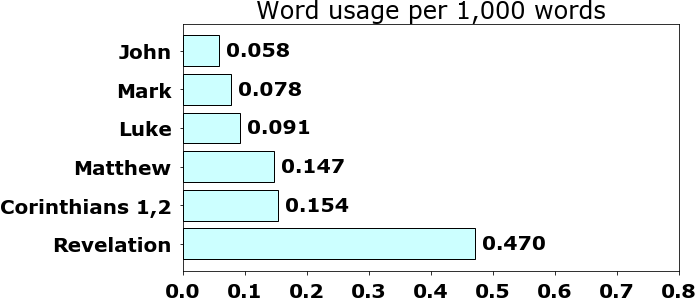 |
Words: οφεις=3 οφεσιν οφεων=2 οφεως οφιν=3 οφις=4
|
This exact Greek spelling of "
snakes" is used three times in the
GNT (Greek New Testament), all by Jesus.
35. Matthew 10:16
KJV: Behold, I send you forth as sheep in the midst of wolves: be ye therefore wise as serpents, and harmless as doves.
Greek: ιδου εγω αποστελλω υμας ως προβατα εν μεσω λυκων γινεσθε ουν φρονιμοι ως οι οφεις και ακεραιοι ως αι περιστεραι
36. Matthew 23:33
KJV: Ye serpents, ye generation of vipers, how can ye escape the damnation of hell?
Greek: οφεις γεννηματα εχιδνων πως φυγητε απο της κρισεως της γεεννης
37. Strongs - fair weather
- *G2105 *1 εὐδία (yoo-dee'-ah) : feminine from G2095 and the alternate of G2203 (as the god of the weather); a clear sky, i.e. fine weather:--fair weather.
- ευδια
- Matthew 16:2 ... When it is evening, ye say, It will be fair weather: for the sky is red.
38. Usage - fair weather
Matthew 16:2 He answered and said unto them, When it is evening, ye say, It will be fair weather: for the sky is red. [kjv]
ο δε αποκριθεις ειπεν αυτοις οψιας οψιας γενομενης λεγετε ευδια πυρραζει γαρ ο ουρανος [gnt]
*G2105 *1 εὐδία (yoo-dee'-ah) : feminine from G2095 and the alternate of G2203 (as the god of the weather); a clear sky, i.e. fine weather:--fair weather.
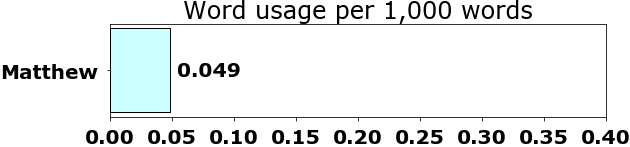 |
Words: ευδια
|
The ancient Greek word
"εὐδία" ≈ "calm weather" and means, literally, "
good thorough". This word is used only once in the
GNT but used often by Aristotle in his
Meteorology.
Any play on words might use the literal meaning of the constituent words such as "
good" followed by "
through".
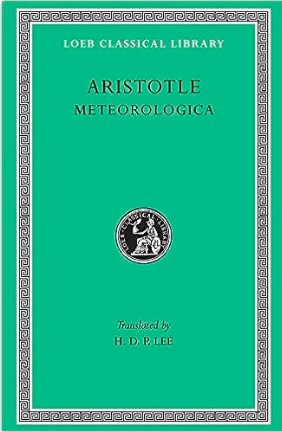
39. Aristotle: Meteorology
Aristotle uses some of the words in the "
red sky" verses in the same sentence in his work
Meteorology (English) or
Meteorologica (Latin)
English: ... it is clear that the vapour has not yet separated from the dry and fiery exhalation which causes fine weather. (Loeb#197, p. 249)
Greek: ... δῆλον ὡς οὔπω ἡ ἀτμὶς ἀποκέκριται τῆς ἀναθυμιάσεως τῆς ξηρᾶς καὶ πυρώδους· τοῦτο δὲ εὐδίας αἴτιον. [372b]
- "ἀτμὶς" ≈ "vapour" and is the source of the English word "atmosphere".
- "ξηρᾶς" ≈ "dry" and is the source of the English word "Xerox" (from a dry copy mechanism)
In this part of
Meteorology, Aristotle discusses the formation of "
halos" (in the sky). The word "
halo" comes from the Greek word for a "
threshing floor".
40. Ruth 3:2 Threshing floors and halos
Ruth 3:2 And now is not Boaz of our kindred, with whose maidens thou wast? Behold, he winnoweth barley to night in the threshingfloor. [kjv]
και νυν ουχι βοος γνωριμος ημων ου ης μετα των κορασιων αυτου ιδου αυτος λικμα τον αλωνα των κριθων ταυτη τη νυκτι [lxx]
The ancient Greek word
"ἅλως" ≈ "threshing floor" and is the source of the English word
"halo" since there tended to be a disk appearing as the sun or moon on the threshing floor.
- "λικμάω" ≈ "winnow" and "λίκνον" ≈ "winnowing fan, basket, cradle".
[hill, wind, security, rainbow in Revelation, salt of the earth]
41. Matthew 16:3 Morning
Matthew 16:3 And in the morning, It will be foul weather to day: for the sky is red and lowring. O ye hypocrites, ye can discern the face of the sky; but can ye not discern the signs of the times? [kjv]
και πρωι σημερον χειμων πυρραζει γαρ στυγναζων ο ουρανος υποκριται το μεν προσωπον του ουρανου γινωσκετε διακρινειν τα δε σημεια των καιρων ου δυνασθε δυνασθε [gnt]
The ancient Greek word
"πρωΐ" ≈ "early in the day, morning".
*G4404 *12 πρωΐ (pro-ee') : adverb from G4253; at dawn; by implication, the day-break watch:--early (in the morning), (in the) morning.
Might this group be compared to those "
workers" "
hired" in the
"early morning" in the Parable of the Vineyard Workers?
How does the
"on the one hand" and
"on the other hand" fit here?
b
42. Strongs - morning
*G4404 *12 πρωΐ (pro-ee') : adverb from G4253; at dawn; by implication, the day-break watch:--early (in the morning), (in the) morning.
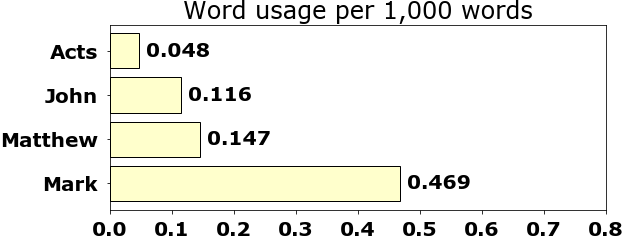 |
Words: πρωΐ=3 πρωι=9
|
43. Usage - morning
- *G4404 *12 πρωΐ (pro-ee') : adverb from G4253; at dawn; by implication, the day-break watch:--early (in the morning), (in the) morning.
- πρωι *9
- Matthew 20:1 ... which went out early in the morning to hire labourers into ...
- Matthew 21:18 Now in the morning as he returned into the city, he hungered.
- Mark 1:35 And in the morning, rising up a great while before day, he went out, ...
- Mark 11:20 And in the morning, as they passed by, they saw the fig tree dried up ...
- Mark 15:1 And straightway in the morning the chief priests held a consultation ...
- Mark 16:2 And very early in the morning the first day of the week, they came ...
- Mark 16:9 Now when Jesus was risen early the first day of the week, he appeared ...
- John 20:1 ... cometh Mary Magdalene early, when it was yet dark, ...
- Acts 28:23 ... and out of the prophets, from morning till evening.
- πρωΐ *3
- Matthew 16:3 And in the morning, It will be foul weather to day: for the sky ...
- Mark 13:35 ... or at the cockcrowing, or in the morning:
- John 18:28 Then led they Jesus from Caiaphas unto ...
44. Matthew 16:3 Hypocrites
Matthew 16:3 And in the morning, It will be foul weather to day: for the sky is red and lowring. O ye hypocrites, ye can discern the face of the sky; but can ye not discern the signs of the times? [kjv]
και πρωι σημερον χειμων πυρραζει γαρ στυγναζων ο ουρανος υποκριται το μεν προσωπον του ουρανου γινωσκετε διακρινειν τα δε σημεια των καιρων ου δυνασθε δυνασθε [gnt]
The Greek word "
hypocrite" meant "
acting" or "
pretending". The
KJV has
"o ye hypocrites" which is
not in some Greek manuscripts. Assume that the "
hypocrites" was an addition to some Greek text. Does what Jesus say apply to our modern meaning of "
hypocrite"? If so, the addition was added
after that meaning was established (from a misunderstanding of Matthew 7). If it fits the
GNT meaning of "
acting" or "
pretending", the addition was made before the meaning change happened.
45. Matthew 16:3 Discerning the weather
Matthew 16:3 And in the morning, It will be foul weather to day: for the sky is red and lowring. O ye hypocrites, ye can discern the face of the sky; but can ye not discern the signs of the times? [kjv]
και πρωι σημερον χειμων πυρραζει γαρ στυγναζων ο ουρανος υποκριται το μεν προσωπον του ουρανου γινωσκετε διακρινειν τα δε σημεια των καιρων ου δυνασθε δυνασθε [gnt]
The
KJV translates as the first "
discern" the Greek word that means
"know" (in depth).
The
KJV translates as the second "
discern" the Greek word that means
"through separation" as in
"discern". [Aristotle and meteorology]
Most translations (omitted) use the same word for the two (different) Greek words.
How would you describe a meteorologist who cannot make up his or her mind?
Under the whether from a cloudy mind.
46. Matthew 16:3-4 Signs
Matthew 16:3 And in the morning, It will be foul weather to day: for the sky is red and lowring. O ye hypocrites, ye can discern the face of the sky; but can ye not discern the signs of the times? [kjv]
και πρωι σημερον χειμων πυρραζει γαρ στυγναζων ο ουρανος υποκριται το μεν προσωπον του ουρανου γινωσκετε διακρινειν τα δε σημεια των καιρων ου δυνασθε δυνασθε [gnt]
16:4 A wicked and adulterous generation seeketh after a sign; and there shall no sign be given unto it, but the sign of the prophet Jonas. And he left them, and departed. [kjv]
γενεα πονηρα και μοιχαλις σημειον επιζητει και σημειον ου δοθησεται αυτη ει μη το σημειον ιωνα του προφητου και καταλιπων αυτους απηλθεν [gnt]
Jesus says they cannot "
discern", as "
through separation", the
"signs" of the "
times".
47. Discerning doubts about doubts
Matthew 21:21 Jesus answered and said unto them, Verily I say unto you, If ye have faith, and doubt not, ye shall not only do this which is done to the fig tree, but also if ye shall say unto this mountain, Be thou removed, and be thou cast into the sea; it shall be done. [kjv]
αποκριθεις δε ο ιησους ειπεν αυτοις αμην λεγω υμιν εαν εχητε πιστιν και μη διακριθητε ου μονον το της συκης ποιησετε αλλα καν τω ορει τουτω ειπητε αρθητι και βληθητι εις την θαλασσαν γενησεται [gnt]
The
KJV, and most English translations, use
"doubt" for the ancient Greek word
"διάκρινω" ≈ "separate, distinguish, discern" which is, literally,
"though separation".
The
KJV translation as
"doubt" appears to have been influenced by the Latin word
"haesito" ≈ "remain fixed in place, hesitate, be uncertain".
Does this mean that if one does not
"discern" properly, one can do the same to a fig tree or to a mountain? Does this mean that if one does not "
think about it", one can do the same to a fig tree or mountain? Is this a good or a bad idea? Let us investigate.
48. Matthew 16:3 Play on words
Matthew 16:3 And in the morning, It will be foul weather to day: for the sky is red and lowring. O ye hypocrites, ye can discern the face of the sky; but can ye not discern the signs of the times? [kjv]
και πρωι σημερον χειμων πυρραζει γαρ στυγναζων ο ουρανος υποκριται το μεν προσωπον του ουρανου γινωσκετε διακρινειν τα δε σημεια των καιρων ου δυνασθε δυνασθε [gnt]
There appears to be some play on words here by Jesus (in the Greek). Jesus does this often when speaking in front of the religious establishment, especially when common people are is present.
The ancient Greek word
"πυρράζω" ≈ "redden". This word appears only in these two verses in Matthew in the
GNT.
The ancient Greek word
"πειράζω" ≈ "examine" and is often translated in the
KJV as
"tempt". The Greek meaning was one of
"examination" where the examiner uses things the examinee believes to be true, often to deceive that examinee. The same happens in modern job interviews, though not (usually) with the goal of deception.
At the time, there was a small difference in the sound of the first vowels. Today, that difference has disappeared.
49. Strongs - red
- *G4449 *2 πυρῥάζω (poor-hrad'-zo) : from G4450; to redden (intransitively):--be red.
- πυρραζει *2
- Matthew 16:2 ... It will be fair weather: for the sky is red.
- Matthew 16:3 ... to day: for the sky is red and lowring. O ye hypocrites, ye can ...
50. Usage - red
*G4449 *2 πυρῥάζω (poor-hrad'-zo) : from G4450; to redden (intransitively):--be red.
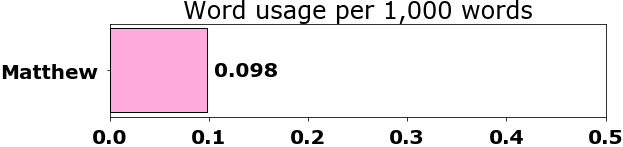 |
Words: πυρραζει=2
|
The ancient Greek word
"πυρράζω" ≈ "redden".
The ancient Greek word
"πειράζω" ≈ "examine" and is often translated in the
KJV as
"tempt".
*G3985 *38 πειράζω (pi-rad'-zo) : from G3984; to test (objectively), i.e. endeavor, scrutinize, entice, discipline:--assay, examine, go about, prove, tempt(-er), try.
Today the Greek vowels "υ" and "
ει" have merged to sound the same. It appears that they would have been close enough for the play on words to be understood. When making such a play on words, one usually makes the pronounced sound between the two different sounds.
51. Strongs - winter
- *G5494 *6 χειμών (khi-mone') : from a derivative of cheo (to pour; akin to the base of G5490 through the idea of a channel), meaning a storm (as pouring rain); by implication, the rainy season, i.e. winter:--tempest, foul weather, winter.
- χειμωνος *4
- Matthew 24:20 ... flight be not in the winter, neither on the sabbath day:
- Mark 13:18 ... flight be not in the winter.
- Acts 27:20 ... and no small tempest lay on us, all hope ...
- 2 Timothy 4:21 Do thy diligence to come before winter. Eubulus greeteth thee, ...
- χειμων *2
- Matthew 16:3 And in the morning, It will be foul weather to day: for the sky ...
- John 10:22 ... the feast of the dedication, and it was winter.
52. Usage - winter
*G5494 *6 χειμών (khi-mone') : from a derivative of cheo (to pour; akin to the base of G5490 through the idea of a channel), meaning a storm (as pouring rain); by implication, the rainy season, i.e. winter:--tempest, foul weather, winter.
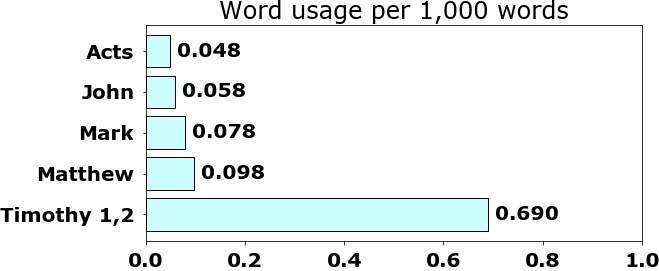 |
Words: χειμων=2 χειμωνος=4
|
The Greek for
"foul weather" is elsewhere translated as
"winter".
The ancient Greek word
"χειμών" ≈ "winter, cold chill, winter storm". The figurative meaning is that of adversity or disaster or madness, especially as sent from the gods. Only here, in this verse, is the meaning
"foul weather" in the
GNT.
53. John 10:22 Hanukkah
John 10:22 And it was at Jerusalem the feast of the dedication, and it was winter. [kjv]
εγενετο δε τοτε τα εγκαινια εν τοις ιεροσολυμοις και χειμων ην [gnt]
… encenia … hiemps … [v]
… зима. [rus]
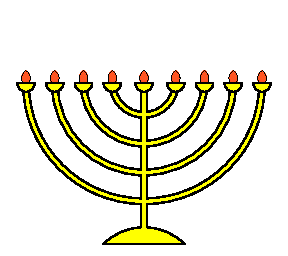
John refers the this "
Feast of Dedication" known as
Hanukkah (in December) in John 10:22. The origin of the "
Feast of Dedication" is recorded in
Maccabees. These history books were removed by the Protestant Church and placed in what is called the
Apocrypha.
The Latin word
"hiems" ≈ "winter" which is related to the modern Greek word
"χειμώνας" (hee-MO-nas) ≈ "winter". The Russian word
"зима" (zeem-ya) ≈ "winter" is related via a
PIE connection.
54. John 10:22
KJV: And it was at Jerusalem the feast of the dedication, and it was winter.
Greek: εγενετο δε τοτε τα εγκαινια εν τοις ιεροσολυμοις και χειμων ην
Latin: facta sunt autem encenia in Hierosolymis et hiemps erat
Wessex: Þa waeron tempel-halgunga on ierusalem aend hyt waes winter.
Wycliffe: But the feestis of halewyng of the temple weren maad in Jerusalem, and it was wyntir.
Tyndale: And it was at Ierusalem ye feaste of the dedicacion and it was wynter:
Luther: Es war aber Kirchweih zu Jerusalem und war Winter.
Russian: Настал же тогда в Иерусалиме праздник обновления, и была зима.
55. Strongs - overcast
- *G4768 *2 στυγνάζω (stoog-nad'-zo) : from the same as G4767; to render gloomy, i.e. (by implication) glower (be overcast with clouds, or sombreness of speech):--lower, be sad.
- στυγναζων
- Matthew 16:3 ... for the sky is red and lowring. O ye hypocrites, ye can discern ...
- στυγνασας
- Mark 10:22 And he was sad at that saying, and went away grieved: ...
56. Usage - overcast
Mark 10:22 And he was sad at that saying, and went away grieved: for he had great possessions. [kjv]
ο δε στυγνασας επι τω λογω απηλθεν λυπουμενος ην γαρ εχων κτηματα πολλα [gnt]
*G4768 *2 στυγνάζω (stoog-nad'-zo) : from the same as G4767; to render gloomy, i.e. (by implication) glower (be overcast with clouds, or sombreness of speech):--lower, be sad.
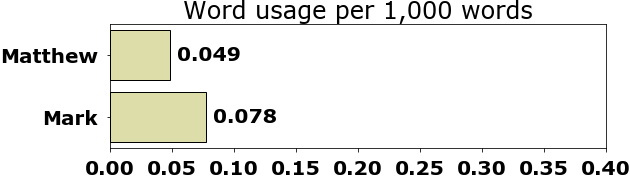 |
Words: στυγναζων στυγνασας
|
The ancient Greek word
"στυγνός" ≈ "hatred, hostility, gloomy".
The usage in Mark is translated by the
KJV as
"sad" but, as elsewhere, the Latin influences the change from the original meaning.
57. Mark 10:22
KJV: And he was sad at that saying, and went away grieved: for he had great possessions.
Greek: ο δε στυγνασας επι τω λογω απηλθεν λυπουμενος ην γαρ εχων κτηματα πολλα
58. Matthew 16:3 Play on words
Matthew 16:3 And in the morning, It will be foul weather to day: for the sky is red and lowring. O ye hypocrites, ye can discern the face of the sky; but can ye not discern the signs of the times? [kjv]
και πρωι σημερον χειμων πυρραζει γαρ στυγναζων ο ουρανος υποκριται το μεν προσωπον του ουρανου γινωσκετε διακρινειν τα δε σημεια των καιρων ου δυνασθε δυνασθε [gnt]
Here are some important words.
- "στυγνός" ≈ "hatred, hostility, gloomy".
- "στυγνάζω" ≈ "look hostile, grim, gloomy".
- "ουρανός" ≈ "sky, heaven".
- "χειμών" ≈ "winter, cold chill, winter storm".
To extend the play on words, consider the following.
- "καιρών" ≈ "of the season".
- "χείρων" ≈ "of the hands" as in the "hands" doing the "signs", perhaps as nonverbal communication.
59. Revelation 1:3 Greek for time as in season
Revelation 1:3 Blessed is he that readeth, and they that hear the words of this prophecy, and keep those things which are written therein: for the time is at hand. [kjv]
μακαριος ο αναγινωσκων και οι ακουοντες τους λογους της προφητειας και τηρουντες τα εν αυτη γεγραμμενα ο γαρ καιρος εγγυς [gnt]
The
ancient Greek word
"καιρός" ≈ "measure, period of time, season" and had a connotation of being the right moment, the critical moment, the opportune moment, etc. What constitutes the
"time" or
"season" and
"near" is
not specified.
The
same modern Greek word
"καιρός" (keh-ROS) ≈ "weather, time, events" as in
"from time to time".
The
ancient Greek word
"μακάριος" ≈ "happy, content" but is often translated as
"blessed".
60. Revelation 1:3 Greek for near
Revelation 1:3 Blessed is he that readeth, and they that hear the words of this prophecy, and keep those things which are written therein: for the time is at hand. [kjv]
μακαριος ο αναγινωσκων και οι ακουοντες τους λογους της προφητειας και τηρουντες τα εν αυτη γεγραμμενα ο γαρ καιρος εγγυς [gnt]
The Greek says that the "
time is near" were
"time" as in
"season" and
"near" is not specified.
- The ancient Greek word "ἐγγύς" ≈ "near" which appears to come from the ancient Greek word "γυῖον" ≈ "hand" so that the meaning is, literally, something that is "at hand" and therefore "near".
61. Matthew 26:18 Pass-code play on words
Matthew 26:18 And he said, Go into the city to such a man, and say unto him, The Master saith, My time is at hand; I will keep the passover at thy house with my disciples. [kjv]
ο δε ειπεν υπαγετε εις την πολιν προς τον δεινα και ειπατε αυτω ο διδασκαλος λεγει ο καιρος μου εγγυς εστιν προς σε ποιω το πασχα μετα των μαθητων μου [gnt]
- Jesus: ... my time is near ...
- Play: ... my hand is in the hand ...
Jesus provides a
pass-code based on the
hard "κ" ("
k") sound and the
guttural "χ" sound. [hand, (young) pig, bad, mistress/harlot]
62. Lead-in verse
Matthew 16:2 He answered and said unto them, When it is evening, ye say, It will be fair weather: for the sky is red. [kjv]
ο δε αποκριθεις ειπεν αυτοις οψιας οψιας γενομενης λεγετε ευδια πυρραζει γαρ ο ουρανος [gnt]
The "
He answered and said unto them" is provided by Matthew as connecting text.
As translated by the
KJV: (Jesus says)
- When it is evening, you say it will be fair weather for the sky is red.
Play on words paraphrase: (to those questioning him)
- In the evening (you snakes), you say it is good weather (through which) to examine heaven (Jesus).
Can the "
In the morning" be taken as a reference to the "
resurrection"?
63. Matthew 16:3 Red sky
Matthew 16:3 And in the morning, It will be foul weather to day: for the sky is red and lowring. O ye hypocrites, ye can discern the face of the sky; but can ye not discern the signs of the times? [kjv]
As translated by the
KJV:
- In the morning, it will be foul weather to day: for the sky is red and lowring.
- You can discern the face of the sky;
- but can ye not discern the signs of the times?
Play on words paraphrase: (to those questioning him)
- In the morning, it will be a bitter cold adversity (for you): for heaven is examining (by fire) and you appear hostile/grim.
- You know well the face of heaven (you are looking at him).
- but can you not discern (through separation) the miracles/indications done of the season (hand)?
64. New Living Translation
Matthew 16:3 And in the morning, It will be foul weather to day: for the sky is red and lowring. O ye hypocrites, ye can discern the face of the sky; but can ye not discern the signs of the times? [kjv]
Here is the
NLT (New Living Translation).
Red sky in the morning means foul weather all day.’ You know how to interpret the weather signs in the sky, but you don’t know how to interpret the signs of the times!
Note the following that lose any secondary (or more) meanings of the text.
- The Greek has "today", not "all day".
- The Greek has "know", not "interpret" (first "discern").
- The Greek has "face of the sky" not "weather signs in the sky".
- The Greek has "discern", not "interpret" (second "discern").
- The Greek has "do you not know" as a question. The NLT uses "you don't know how" as a statement.
65. Matthew 16:2-3 Review
Matthew 16:2 He answered and said unto them, When it is evening, ye say, It will be fair weather: for the sky is red. [kjv]
ο δε αποκριθεις ειπεν αυτοις οψιας οψιας γενομενης λεγετε ευδια πυρραζει γαρ ο ουρανος [gnt]
16:3 And in the morning, It will be foul weather to day: for the sky is red and lowring. O ye hypocrites, ye can discern the face of the sky; but can ye not discern the signs of the times? [kjv]
και πρωι σημερον χειμων πυρραζει γαρ στυγναζων ο ουρανος υποκριται το μεν προσωπον του ουρανου γινωσκετε διακρινειν τα δε σημεια των καιρων ου δυνασθε δυνασθε [gnt]
Paraphrase:
In the evening [you snakes], you say it is good weather (through which) to examine heaven (Jesus). In the morning, it will be a bitter cold adversity (for you): for heaven is examining (by fire) and you appear hostile/grim. You know well the face of heaven [tail of the mind] (you are looking at the real heaven). Can you not discern (through separation) the miracles/indications done of the season [hand]?
Only
one of the four "
heaven" or "
sky" words, the last one by Jesus, fits the play on words with "
tail" "
of the mind".
66. End of page