Send Close Add comments: (status displays here)
Got it!  This site "creationpie.org" uses cookies. You consent to this by clicking on "Got it!" or by continuing to use this website.  Note: This appears on each machine/browser from which this site is accessed.
Rome in the Bible
by RS  admin@creationpie.org : 1024 x 640


1. Rome in the Bible
This content is being developed.

2. Rome in the Bible
The Roman Empire is mentioned in the Bible explicitly, prophetically, in play on words by Jesus, etc. Here we look at some of these references.

Among the characteristics of Rome are included the color red, the apple and the eagle.

This is a start at collecting and organizing existing content while adding new content.

3. Internalize
SPQR
The play on words appears to be "together with the eagles" as in "collaborating with Rome". The "eagle" is a bird of prey and was a symbol of the Roman Empire (and following empires). Had the religious establishment conspired or worked with the Roman government for their own personal benefit (as a bird in the pecking order) and against the best interests of the people and God?

Rome often used the letters SPQR (Senatus Populusque Romanus) which means "The Roman Senate and People".

The "two birds sold (selling themselves) for a farthing" uses the Roman name for the coin and a play on words on the sound made by a bird.


Information sign More: Matthew 10: 28-31 Taking care of the sparrows
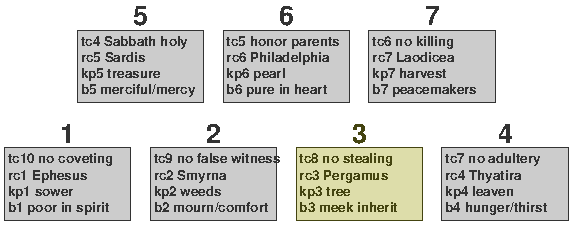
Information sign More: Matthew 13:3-23 KP1 Parable of the sower

4. Strongs - learned
*G4908 *4 συνετός (soon-et'-os) : from G4920; mentally put (or putting) together, i.e. sagacious:--prudent. Compare G5429.
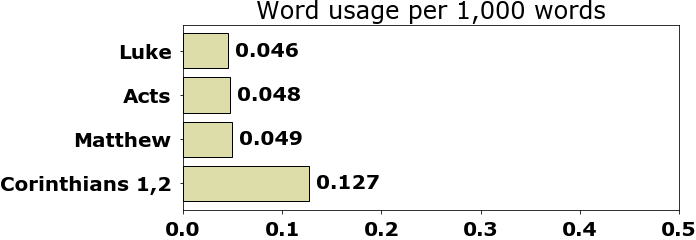
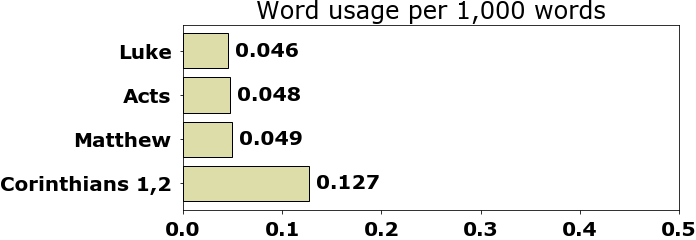
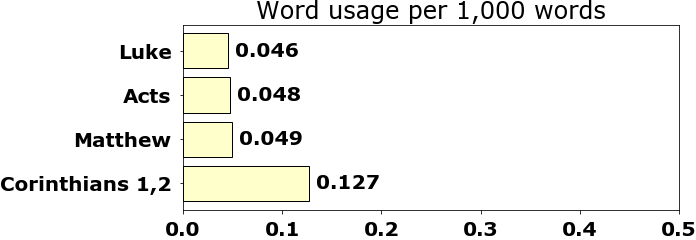
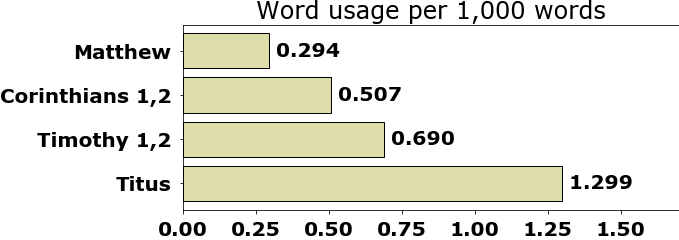
Word usage per chapter Words: συνετω συνετων=3

The ancient Greek word "συνετός""having understanding, intelligent, sagacious". Jesus uses this word as meaning "snobbish elite". The Greek word comes from "συνίημι""send together, perceive, understand". Here is a play on words meaning of "working together with Rome".

5. Usage - learned
  • *G4908 *4 συνετός (soon-et'-os) : from G4920; mentally put (or putting) together, i.e. sagacious:--prudent. Compare G5429.
  •  Usage 
     All 
    • συνετων *3
      •   Matthew 11:25 ... from the wise and prudent, and hast revealed them unto babes.
      •   Luke 10:21 ... from the wise and prudent, and hast revealed them ...
      •   1 Corinthians 1:19 ... and will bring to nothing the understanding of the prudent.
    • συνετω
      •   Acts 13:7 ... the deputy of the country, Sergius Paulus, a prudent man; who called for ...


Information sign More: Matthew 11:20-30 Upgraded baby yokes revealed

6. A prudent approach to a wise understanding
Matthew 11:25 At that time Jesus answered and said, I thank thee, O Father, Lord of heaven and earth, because thou hast hid these things from the wise and prudent, and hast revealed them unto babes. [kjv]
εν εκεινω τω καιρω αποκριθεις ο ιησους ειπεν εξομολογουμαι σοι πατερ κυριε του ουρανου και της γης οτι εκρυψας ταυτα απο σοφων και συνετων και απεκαλυψας αυτα νηπιοις [gnt]

The word translated as "prudent" is not the usual Greek word for "prudent". That idea appears to come through the Latin Vulgate which uses the Latin word "prudentibus""prudent" and is the source of the English word "prudent".

The way Jesus says this, it is clear that being "wise" and the second Greek word, which appears not to mean "prudent", is not a compliment. Jesus repeats the same idea in Matthew 15:16 when talking to the disciples.

15:16 And Jesus said, Are ye also yet without understanding? [kjv]
ο δε ειπεν ακμην και υμεις ασυνετοι εστε [gnt]
adhucsine intellectu … [v]


Information sign More: A prudent approach to a wise understanding

7. A prudent approach to a wise understanding
It appears that the word "wise" means that one knows a lot of "facts" but not necessarily "rules" and how to apply them with any consistency.

It appears that the above word as "understanding" means that one knows a lot of "rules" but not necessarily "facts" to go with them.

It appears that the word "prudent" means knowing how to use some "facts" and some "rules" and account for what is not known to balance multiple and sometimes conflicting objectives.

Future topic Details are left as a future topic.


Information sign More: A prudent approach to a wise understanding

8. Matthew 13:23 Gematria
Matthew 13:23 But he that received seed into the good ground is he that heareth the word, and understandeth it; which also beareth fruit, and bringeth forth, some an hundredfold, some sixty, some thirty. [kjv]
… ο μεν εκατον ο δε εξηκοντα ο δε τριακοντα [gnt]

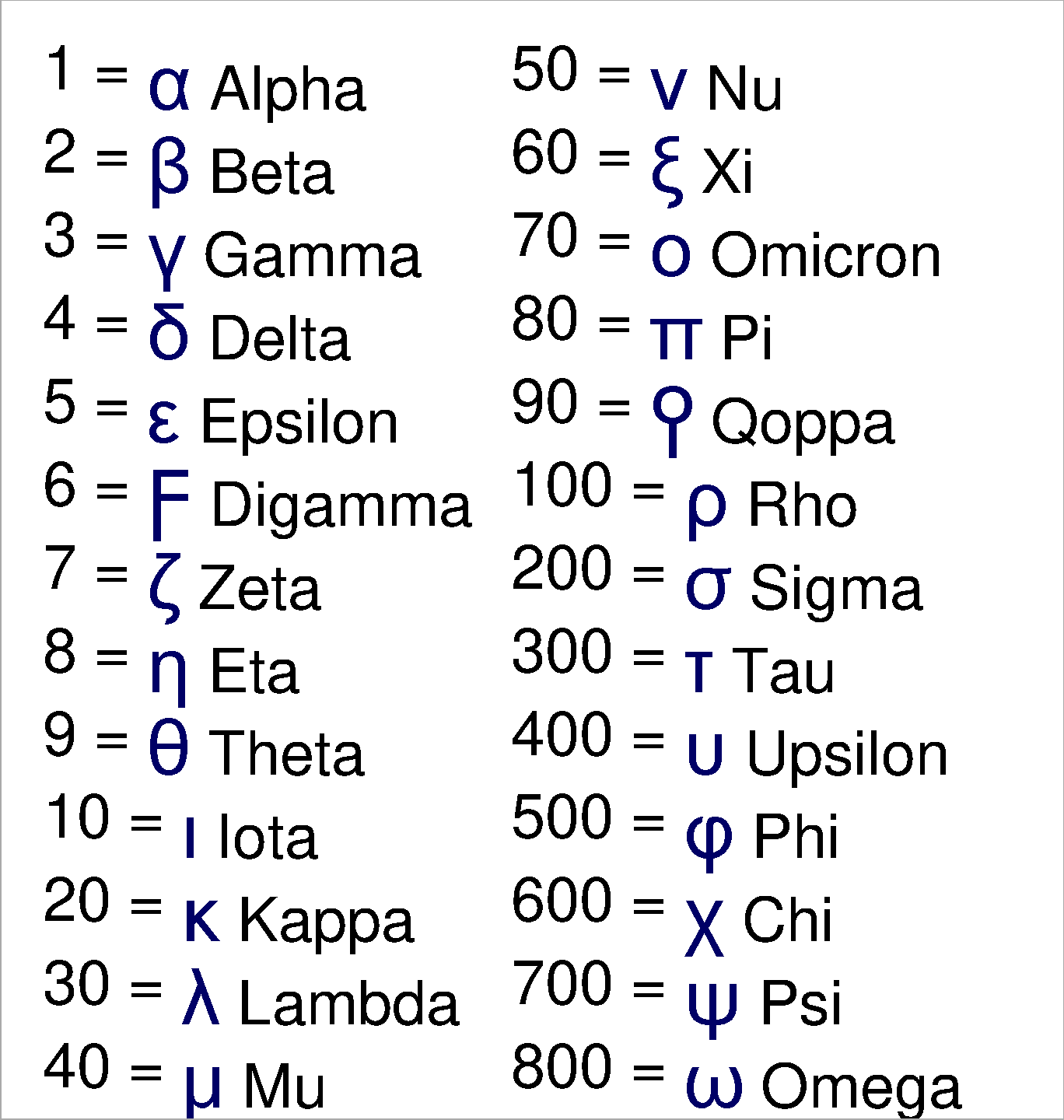
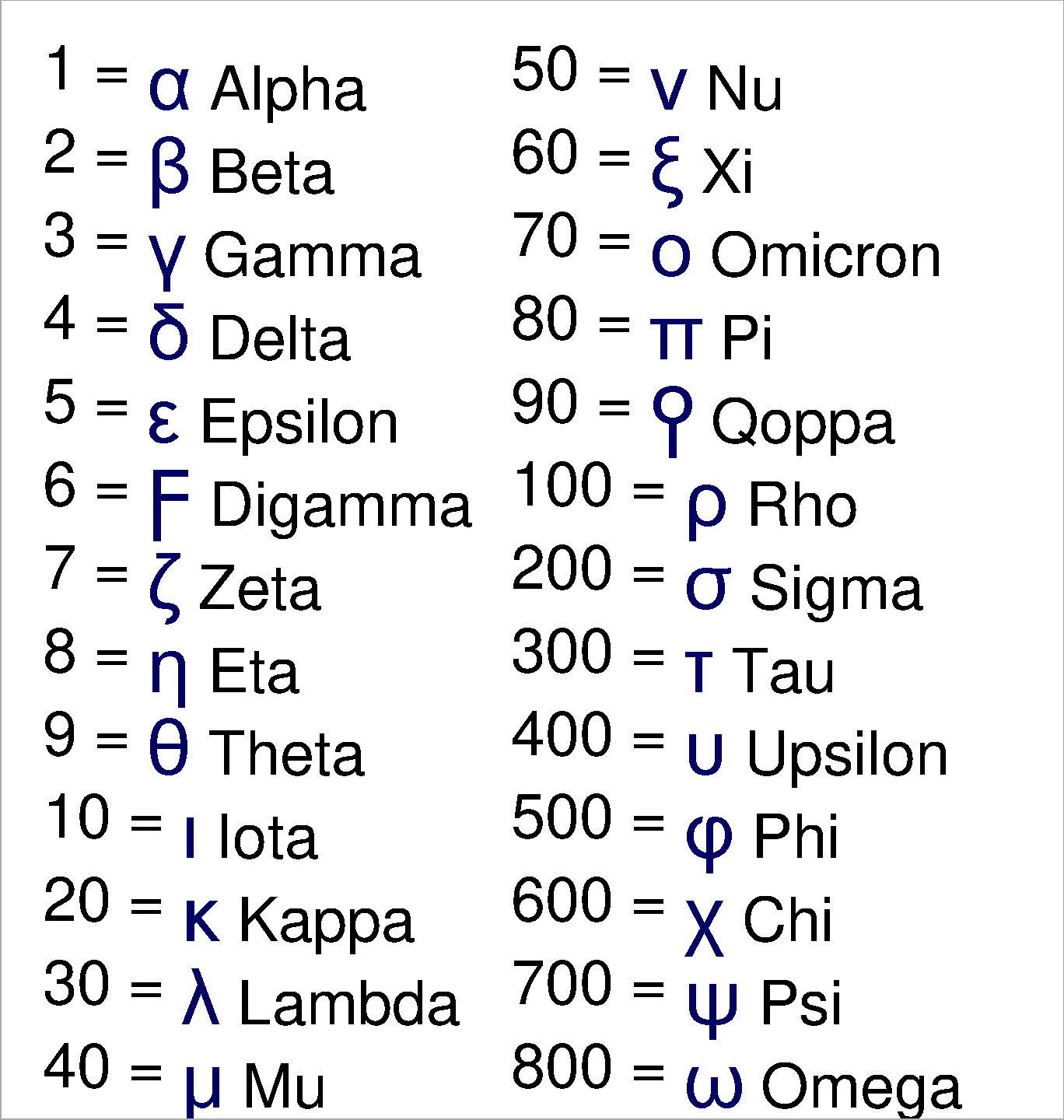
Greek gematriaGreek, like Hebrew, associated letters with numbers. The study of this is called gematria. The most famous instance of gematria is the 666 from Revelation 13. Any gematria meaning of 100, 60 and 30 is not clear but may indicate some interesting connections.

Keep in mind that the historical connection of this parable is that of the time of Jesus in Judea where the Romans ruled and had let Herod (and descendent's) have some local rule.

Information sign More: Matthew 13:3-23 KP1 Parable of the sower

9. Gematria of decreasing yields
SPQRThe symbol of Rome, the ruling power of the world at that time, in letters was SPQR (as an initialism) from the Latin phrase "senātus populusque rōmānus""The Roman Senate and People".

Gematria
value upper lower letter connection
100 Ρ ρ rho R for "Rome" (Latin and Greek)
60 Ξ ξ ski (composite letter KS)
Κ κ kappa K for "and" (Greek)
Σ σ sigma S for "Senate" (Latin)
30 Λ λ lambda L for "people" (Greek)
This is just one of many possible gematria connections.

10. Matthew and Mark
Matthew 13:23 But he that received seed into the good ground is he that heareth the word, and understandeth it; which also beareth fruit, and bringeth forth, some an hundredfold, some sixty, some thirty. [kjv]
ο δε επι την καλην γην σπαρεις ουτος εστιν ο τον λογον ακουων και συνιεις ος δη καρποφορει και ποιει ο μεν εκατον ο δε εξηκοντα ο δε τριακοντα [gnt]

Mark 4:8 And other fell on good ground, and did yield fruit that sprang up and increased; and brought forth, some thirty, and some sixty, and some an hundred. [kjv]
και αλλα επεσεν εις την γην την καλην και εδιδου καρπον αναβαινοντα και αυξανομενα και εφερεν εις εν τριακοντα και εν εξηκοντα και εν εκατον [gnt]

Mark repeats some of what Matthew writes but also changes and adds some things. Many details in Matthew are not in Mark (or Luke). Note the order of the numbers. Discuss:

11. Strongs - learned
*G4908 *4 συνετός (soon-et'-os) : from G4920; mentally put (or putting) together, i.e. sagacious:--prudent. Compare G5429.
Word usage per chapter Words: συνετω συνετων=3

The ancient Greek word "συνετός""having understanding, intelligent, sagacious". Jesus uses this word as meaning "snobbish elite". The Greek word comes from "συνίημι""send together, perceive, understand". Here is a play on words meaning of "working together with Rome".

12. Usage - learned
  • *G4908 *4 συνετός (soon-et'-os) : from G4920; mentally put (or putting) together, i.e. sagacious:--prudent. Compare G5429.
  •  Usage 
     All 
    • συνετων *3
      •   Matthew 11:25 ... from the wise and prudent, and hast revealed them unto babes.
      •   Luke 10:21 ... from the wise and prudent, and hast revealed them ...
      •   1 Corinthians 1:19 ... and will bring to nothing the understanding of the prudent.
    • συνετω
      •   Acts 13:7 ... the deputy of the country, Sergius Paulus, a prudent man; who called for ...


Information sign More: Matthew 11:20-30 Upgraded baby yokes revealed

13. Internalize
SPQR
The play on words appears to be "together with the eagles" as in "collaborating with Rome". The "eagle" is a bird of prey and was a symbol of the Roman Empire (and following empires). Had the religious establishment conspired or worked with the Roman government for their own personal benefit (as a bird in the pecking order) and against the best interests of the people and God?

Rome often used the letters SPQR which means "The Roman Senate and People".

The "two birds sold (selling themselves) for a farthing" uses the Roman name for the coin and a play on words on the sound made by a bird.


Information sign More: Matthew 10: 28-31 Taking care of the sparrows
Information sign More: Matthew 13:3-23 KP1 Parable of the sower

14. Rome
The Latin word "aquia""eagle" was used as a standard of a Roman legion. Each legion had one such "eagle". The capture of such an "eagle" was prized by opposing troops.

Information sign More: Eagles and woeful eagle sounds

15. Matthew 24:28
TenPin 0The eagles, representing Rome, gathered together at the mustard tree. Oaths and peer pressure (tribulation) to conform as desired by the birds.

Matthew 24:28 For wheresoever the carcase is, there will the eagles be gathered together. [kjv]
οπου εαν η το πτωμα εκει συναχθησονται οι αετοι [gnt]

The "fallen" ones, or "poor" in "spirit", the "fallen" being related to "carcase", need the Good News. The "birds" are waiting to provide their version of that news.

The "tribulation", or "pressure" to take oaths, etc. starts here and can be inferred from the next verse.

Information sign More: Matthew 24:25-31 Told before

16. Woe
The Greek word for "woe" is used 8 times in Matthew 23. The onomatopoeic (sound allusion) meaning is that of a bird ready to swoop down on the prey. This usage of "woe" predisposes one towards any play on words that might relate to birds. Rome was known for the "eagle" - a bird of prey (or pray).
The Roman eagle was one-headed eagle. Though used in ancient times, the double-headed eagle later became a symbol of parts of European empires such as the later Byzantine Empire and the following Austria-Hungarian empire, Russia, Prussia, etc.

Information sign More: Matthew 23:24 So far as the net gain of a gnat into a canopy

17. Play on words
Camel Apple
The ancient Greek word "κάμηλος""camel" and comes from the Semitic.
As a possible play on words, consider the following.
Greek: κάμηλον καταπινοντες (as written) for "camel swallow".
Greek: και μυλόν καταπινοντες (play on words) for "and apple swallow/drink down".
In play on words, one takes the written meaning and adds the imagery created by the play on words. The imagery of "drinking blood" is present.

Greek had the legend of the "Apple of discord".

Information sign More: Matthew 23:24 So far as the net gain of a gnat into a canopy

18. Matthew 23:24 Put it together
Matthew 23:24 Ye blind guides, which strain at a gnat, and swallow a camel. [kjv]
οδηγοι τυφλοι διυλιζοντες τον κωνωπα την δε καμηλον καταπινοντες [gnt]

English: strain the gnat the of/which the camel swallow
Greek: διυλιζοντες τον κωνωπα την δε κάμηλον καταπινοντες (as written)
Greek: δια λιζοντες τον κωνο πετεινα και μυλόν καταπινοντες (play on words)
English: through the matter/play the cone/hemlock/poison birds and apple swallow

Blood drop Apple Gnat Camel
The flexible Greek word order is sometimes used to create a play on words that adds the imagery and meaning to the actual words.
Had the religious establishment in Judea attempted to "swallow" the "poison" and/or "blood" of the (Roman) "birds" and "apple"? There are other ways that the play on words could create mental imagery.

The Greek for "gnat" is the source of the English word "canopy".

Information sign More: Matthew 23:24 So far as the net gain of a gnat into a canopy

19. Isaiah 1:18 red grain seed
*G4908 *4 συνετός (soon-et'-os) : from G4920; mentally put (or putting) together, i.e. sagacious:--prudent. Compare G5429.
Word usage per chapter Words: συνετω συνετων=3

Isaiah 1:18 Come now, and let us reason together, saith the LORD: though your sins be as scarlet, they shall be as white as snow; though they be red like crimson, they shall be as wool. [kjv]
και δευτε και διελεγχθωμεν λεγει κυριος και εαν ωσιν αι αμαρτιαι υμων ως φοινικουν ως χιονα λευκανω εαν δε ωσιν ως κοκκινον ως εριον λευκανω [lxx]

The "seed" (an insect that looked like a seed) was used to make a "red" dye.

Information sign More: Matthew 13:31-32 KP3 Parable of the mustard seed

20. Red grain seed
SPQR
The following are similar and related ancient Greek words. A possible play on words would require a "bird" and the color "red". The ruling power in Judea, Rome used both the "eagle" and the color "red" as a symbol. This presence would continue for many centuries.

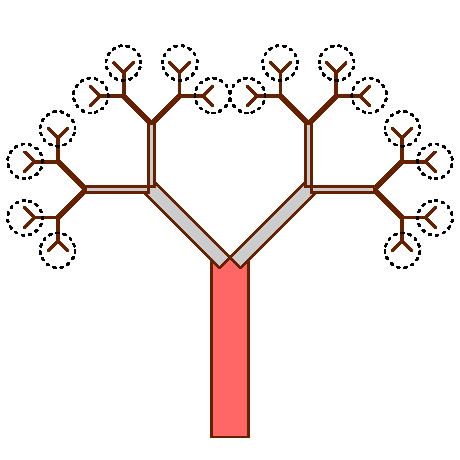
The historical interpretation of this parable is during the time of Rome and Constantine when the church went from a relatively flat organization into a larger hierarchical tree-structured organization.

Information sign More: Matthew 13:31-32 KP3 Parable of the mustard seed

21. Matthew 13:31 Play on words
Matthew 13:31 Another parable put he forth unto them, saying, The kingdom of heaven is like to a grain of mustard seed, which a man took, and sowed in his field: [kjv]
αλλην παραβολην παρεθηκεν αυτοις λεγων ομοια εστιν η βασιλεια των ουρανων κοκκω σιναπεως ον λαβων ανθρωπος εσπειρεν εν τω αγρω αυτου [gnt]

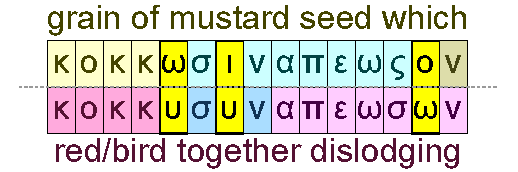
mustard seed grain and red/bird together dislodging
There were no spaces in the Greek.

Play on word sayings need not follow grammar nor spelling rules.
Greek: κοκκω σιναπεως ον (as written) for "seed of the mustard plant which".
Greek: κοκκυ συν απεωςων (play on words) for "red/bird together dislodging/pushing".

One can pronounce it in such a way that the secondary meaning is known to those who use their "ears" to "hear". Sometimes one just wants to add an additional idea to the mind.

22. The Roman Empire under Constantine
In 325 Constantine became emperor. He recognized and officially tolerated Christianity, which soon became the official religion of Rome.
The relatively flat structure of the church (mustard seeds and plants) soon grew into a large tree structure. Birds came to make homes and reside in that tree.

Under Constantine, Rome extended from England in the north-east to Spain in the south-east across north Africa to Egypt and the Sinai Peninsula in the south-west up through Palestine and Syria and Turkey (Asia), and across Europe to France, essentially south of the Danube, Alps, and west of the Rhine river.


Information sign More: Matthew 13:31-32 KP3 Parable of the mustard seed
Information sign More: The Roman Empire under Constantine

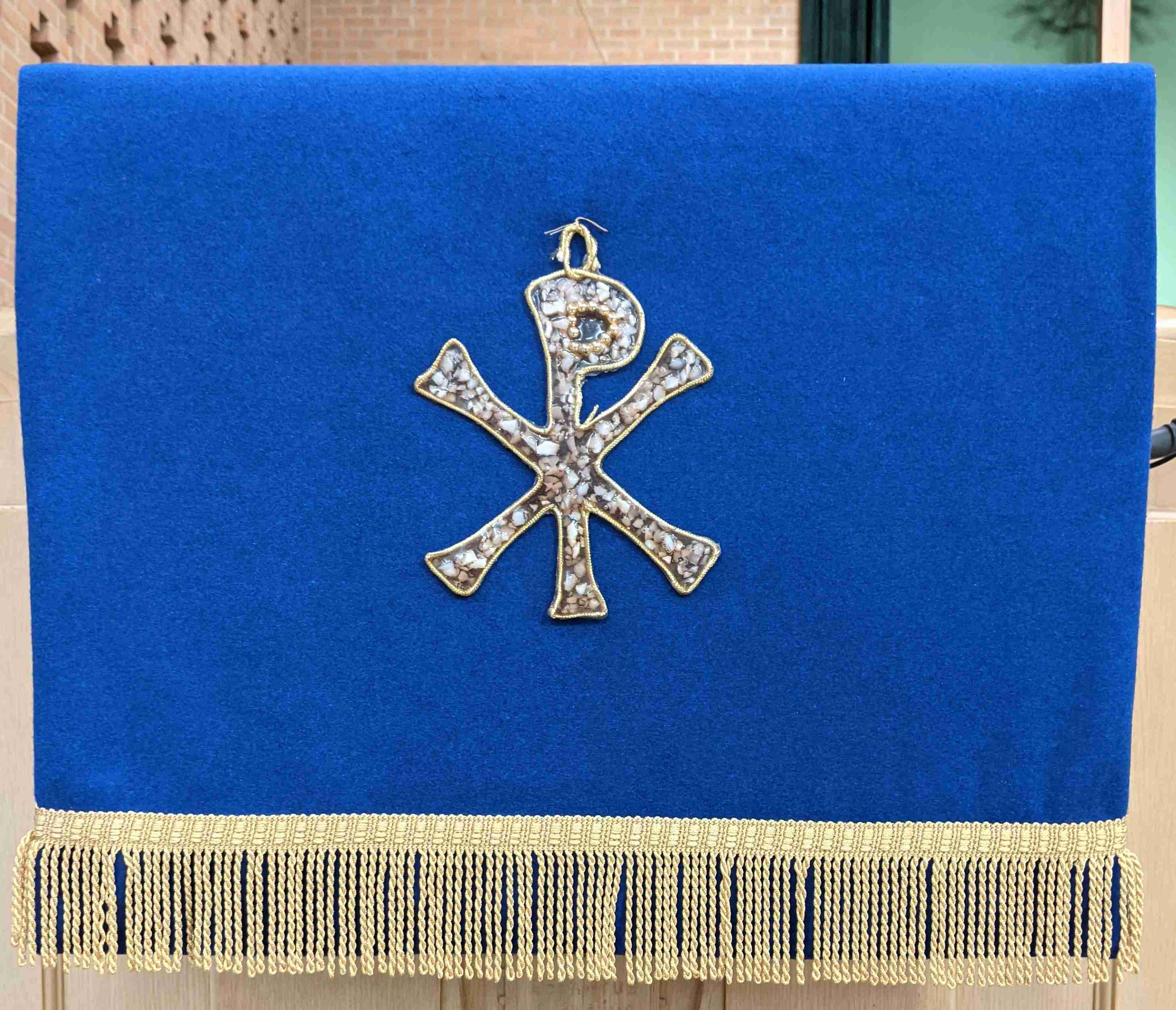
23. Chi Rho
Chess pieces Chi Rho

 χ + ρ = ☧ = Χ + Ρ 
Greek gematria
The "chi rho" symbol became established under Constantine as a combination of two Greek letters, "chi" and "rho", the first two letters of "Χριστός""Christ".

Might there by any interesting gematria meanings from the two letters?


Future topic Details are left as a future topic.

The Unicode for "Chi Rho" in the miscellaneous symbols block is "U+2627" or ☧.

Information sign More: The Roman Empire under Constantine

24. Helena and Rome under Constantine
The mother of Constantine, Helena, toured the Roman Empire looking for historical sites of the Bible. Wherever these sites were declared, religious sites, churches, monasteries, etc., sprang up.

It was convenient that two important sites were found by Helena within the bounds of the Roman Empire at that time, despite Biblical indications that the site was elsewhere.

25. Constantine and the deep state
Tree with twigs - no fruit

Emperor Constantine (275-337) was so disgusted by the politics and deep state in Rome in the 4th Century, that he ordered (commanded) that the capitol of Rome be moved to a new city, soon named Constantinople. Within a short time, a new deep state (tree with birds nesting) was established in Constantinople.

Information sign More: The deep state is everywhere

26. Constantinople
Κωνσταντινούπολη or "Constantinople" is, literally, the "City of Constantine".

The Turkish word is "Istanbul" where the "bul" at the end is from "pol" and the "Istan" is how they appeared to have heard the first part "Constantin" (omitting the first part).


Information sign More: The Roman Empire under Constantine

27. Matthew Move a mountain
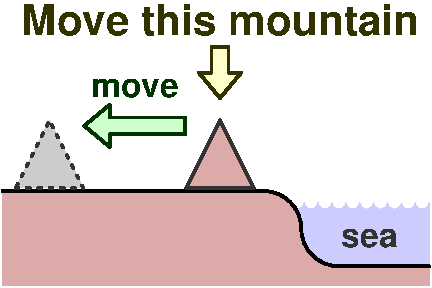
Matthew 17:20 And Jesus said unto them, Because of your unbelief: for verily I say unto you, If ye have faith as a grain of mustard seed, ye shall say unto this mountain, Remove hence to yonder place; and it shall remove; and nothing shall be impossible unto you. [kjv]

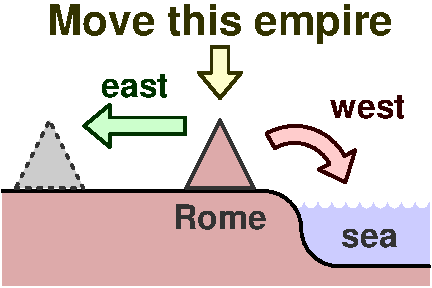
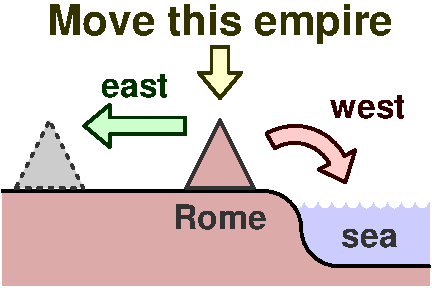
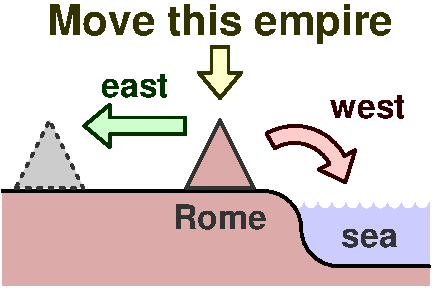
Move this mountain Move this empire

If Rome is considered a "mountain", as in an "empire", then Constantine, through "faith", did "move" the "mountain" of Rome to Constantinople.

28. Constantine and Rome
Move this empire

If Constantine (and Rome) did not divide, as "through division" or "discernment", translated "doubt" in the KJV (King James Version), into east and west, that entire "mountain" could have been moved into the "sea".

Most empires are taken over by another stronger empire. Rome is a conspicuous exception. This was predicted by Daniel in several prophecies. The most familiar is the dream and golden statue that led to the fiery furnace.


Information sign More: Daniel 2: I have a forgotten dream
Information sign More: Daniel: world empires
Information sign More: Matthew Mustard seeds and moving mountains

29. Matthew 21:21 Mountain into the sea
Matthew 21:21 Jesus answered and said unto them, Verily I say unto you, If ye have faith, and doubt not, ye shall not only do this which is done to the fig tree, but also if ye shall say unto this mountain, Be thou removed, and be thou cast into the sea; it shall be done. [kjv]
αποκριθεις δε ο ιησους ειπεν αυτοις αμην λεγω υμιν εαν εχητε πιστιν και μη διακριθητε ου μονον το της συκης ποιησετε αλλα καν τω ορει τουτω ειπητε αρθητι και βληθητι εις την θαλασσαν γενησεται [gnt]

If Constantine (and Rome) did not divide, as "through division" or "discernment", translated "doubt" in the KJV, into east and west, that entire "mountain" could have been moved into the "sea".

Information sign More: Matthew Mustard seeds and moving mountains

30. Matthew 17:20 Latin Vulgate conjecture
Matthew 17:20 And Jesus said unto them, Because of your unbelief: for verily I say unto you, If ye have faith as a grain of mustard seed, ye shall say unto this mountain, Remove hence to yonder place; and it shall remove; and nothing shall be impossible unto you. [kjv]

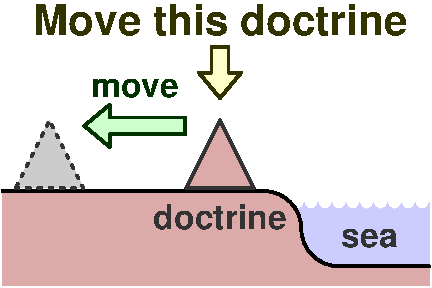
Move this empire Move this doctrine
Consider the play on words between "mountain" and "definition" in Greek.
Late in the fourth century, Jerome translated what was to be called the Latin Vulgate. The definitions of many words of the "doctrine" or "teaching" were "moved" to be something other than what appears to have been meant in the Greek. The woman "encrypted" or "baked" false doctrine (leaven) with true doctrine (wheat flour) until it was all mixed together but appeared as true doctrine.

The moving of this mountain (i.e., many definitions) did put that present and future church in a position to do what might have been considered "impossible" before that time.


Information sign More: Matthew 13:33 KP4 Parable of the leaven
Information sign More: Teaching and learning sound and healthy doctrine
Information sign More: Matthew Mustard seeds and moving mountains

31. Ephesians 6: Defending the full armor of God
Ephesians 6:11 Put on the whole armour of God, that ye may be able to stand against the wiles of the devil. [kjv]
ενδυσασθε την πανοπλιαν του θεου προς το δυνασθαι υμας στηναι προς τας μεθοδειας του διαβολου [gnt]

Sword vertical
Paul concludes his letter to the Ephesians in chapter 6 by talking about "clothing" oneself with the full "armor" of God. One should "stand" up for Jesus against the "wiles" or "methods" as in "following after the path" of the "devil" or "accuser".
All the armaments mentioned are defensive and require teamwork and not individual combat. The exception is the sword (of truth, of the spirit, etc.) which can be both an offensive and a defensive weapon.

This conclusion has many military allusions but, as a conclusion, each refers to things already said in the letter and not completely new ideas.

Information sign More: Ephesians 6: Defending the full armor of God

32. Chariots
The ancient Greek word "ἅρμα""chariot" comes from the idea of "fitting together" or "joining". The word is related to the ancient Greek word "ἁρμός""join" and is the source of English words such as "harmony" and "harmonica".
The modern Greek word "άρμα" (AR-ma) ≈ "military tank, carnival chariot".

The English word "armada" comes from the Spanish word "armade""fleet, navy" which comes from the Latin word "arme""arms, weapons" which itself is the source of the English word "arms" as in weapons.

Information sign More: Ephesians 6: Defending the full armor of God

33. Chariots
The Romans, and others, use chariots for races but not for military use. Instead, cavalry was used.
Alexander the Great ended the use of the chariot in 331 BC at the Battle of Gaugamela when he defeated Darius III (and effectively the Persian Empire) by spreading out and letting the chariots go through and then attacked them from their vulnerable back side.

Information sign More: Ephesians 6: Defending the full armor of God

34. Shields
Most people think of a shield as a pointed shield, which is fine for one-person battle. What is the purpose of a "wind" "shield"?
The Romans used a door-like shield in a formation called a "tortoise" where the shields were used as a shield above and to the front in a manner similar to a tortoise.

This shield was most useful when in a group where every solider had to work together to be protected, especially from arrows which could come from the front or from above.

You want to be protected against "wind" "shield" "vipers"!

Information sign More: Ephesians 6: Defending the full armor of God

35. Sword usage
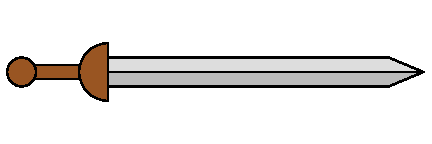
Sword horizontalMost people think of a sword as a long sharp pointed weapon used for individual combat.
The Roman sword was about 18 inches long and the effective use was in close combat in formation and used as a trained group of soldiers. Again, Paul is using an analogy about working together to achieve a goal.

Of course, the "sword" of Jesus is the sword of truth which divides people and is part of the truth of the Holy Spirit.

Information sign More: A peace of the mouth of the sword
Information sign More: Ephesians 6: Defending the full armor of God

36. Strongs - foolish
*G3474 *12 μωρός (mo-ros') : probably from the base of G3466; dull or stupid (as if shut up), i.e. heedless, (morally) blockhead, (apparently) absurd:--fool(-ish, X -ishness).
Word usage per chapter Words: μωρα μωραι=3 μωρας=2 μωρε=1 μωροι=2 μωρον μωρος μωρω

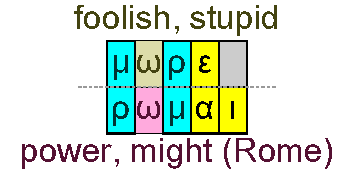
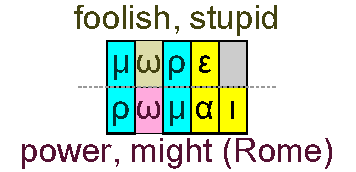
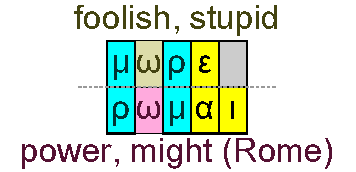
Foolish and Rome


Information sign More: Punishment by Spoonerisms: switched consonants
Information sign More: A wise fool should not be prudish about being prudent

37. Usage - foolish
  • *G3474 *12 μωρός (mo-ros') : probably from the base of G3466; dull or stupid (as if shut up), i.e. heedless, (morally) blockhead, (apparently) absurd:--fool(-ish, X -ishness).
  •  Usage 
     All 
    • μωραι *3
      •   Matthew 25:2 ... wise, and five were foolish.
      •   Matthew 25:3 They that were foolish took their lamps, and took ...
      •   Matthew 25:8 And the foolish said unto the wise, Give us ...
    • μωροι *2
      •   Matthew 23:17 Ye fools and blind: for whether is ...
      •   1 Corinthians 4:10 We are fools for Christ's sake, but ye ...
    • μωρας *2
      •   2 Timothy 2:23 But foolish and unlearned questions avoid, ...
      •   Titus 3:9 But avoid foolish questions, and genealogies, ...
    • μωρε
      •   Matthew 5:22 ... but whosoever shall say, Thou fool, shall be in danger of ...
    • μωρω
      •   Matthew 7:26 ... not, shall be likened unto a foolish man, which built ...
    • μωρον
      •   1 Corinthians 1:25 Because the foolishness of God is wiser than men; ...
    • μωρα
      •   1 Corinthians 1:27 But God hath chosen the foolish things of the world to confound ...
    • μωρος
      •   1 Corinthians 3:18 ... this world, let him become a fool, that he may be wise.


Information sign More: A wise fool should not be prudish about being prudent

38. Matthew 5:22 Foolish Rome connection
Matthew 5:22 But I say unto you, That whosoever is angry with his brother without a cause shall be in danger of the judgment: and whosoever shall say to his brother, Raca, shall be in danger of the council: but whosoever shall say, Thou fool, shall be in danger of hell fire. [kjv]
εγω δε λεγω υμιν οτι πας ο οργιζομενος τω αδελφω αυτου ενοχος εσται τη κρισει ος δ αν ειπη τω αδελφω αυτου ρακα ενοχος εσται τω συνεδριω ος δ αν ειπη μωρε ενοχος εσται εις την γεενναν του πυρος [gnt]


39. Matthew 5:22
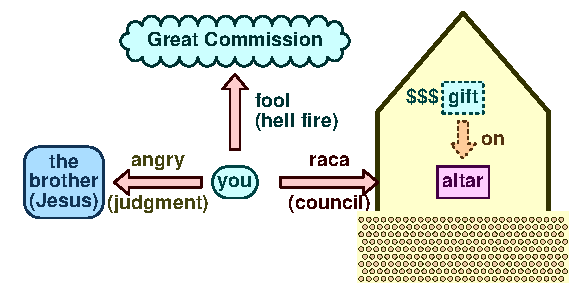
Matthew 5:22 But I say unto you, That whosoever is angry with his brother without a cause shall be in danger of the judgment: and whosoever shall say to his brother, Raca, shall be in danger of the council: but whosoever shall say, Thou fool, shall be in danger of hell fire. [kjv]
εγω δε λεγω υμιν οτι πας ο οργιζομενος τω αδελφω αυτου ενοχος εσται τη κρισει ος δ αν ειπη τω αδελφω αυτου ρακα ενοχος εσται τω συνεδριω ος δ αν ειπη μωρε ενοχος εσται εις την γεενναν του πυρος [gnt]

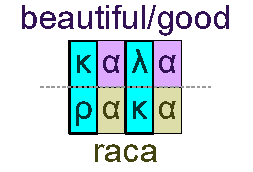
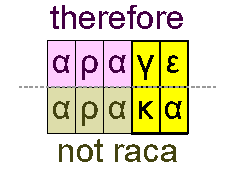
Foolish and Rome Beautiful and raca Therefore and not raca


Information sign More: Matthew 5:22 The danger of brotherly anger

40. Matthew 5:22 Joyous fool connection
Matthew 5:22 But I say unto you, That whosoever is angry with his brother without a cause shall be in danger of the judgment: and whosoever shall say to his brother, Raca, shall be in danger of the council: but whosoever shall say, Thou fool, shall be in danger of hell fire. [kjv]

Does it make any sense to make comparisons of the following, using Spoonerisms of the Greek with Latin (transliteration)? [chicken coop]

Information sign More: Matthew 5:22 The danger of brotherly anger

41. Matthew 25:2 Ten virgins
There are "ten" virgins divided into groups of "five".
Matthew 25:2 And five of them were wise, and five were foolish. [kjv]
πεντε δε εξ αυτων ησαν μωραι και πεντε φρονιμοι [gnt]

The TR (Textus Receptus) changes the order of "foolish" and "prudent", mistranslated as "wise", which breaks a play on words.

Greek word order: five but out-of [but a shad-ow] them were foolish and five prudent.

The ancient Greek word "φρόνιμος""sensible, mindful" and comes from the ancient Greek word "φρήν""midriff, stomach". A "sensible" approach requires that trade-offs be made.

The ancient Greek word "μωρός""foolish, stupid" as in the English word "moron". The modern Greek word "μωρό" (mo-RO) ≈ "baby, infant". The Latin word "fatuus""foolish, stupid".

It appears that "five" were "opportunistic" or "mindful" and the other "five" were the opposite.

Information sign More: The number five
Information sign More: A wise opportunity to be prudent
Information sign More: Matthew 25:1-13 Parable of the ten virgins

42. Matthew 25:3 Early birds
Matthew 25:3 They that were foolish took their lamps, and took no oil with them: [kjv]
αι γαρ μωραι λαβουσαι τας λαμπαδας αυτων ουκ ελαβον μεθ εαυτων ελαιον [gnt]

Jesus, as the observer, said that they "took no oil with them". What does Jesus consider "oil"? Might "oil" be a code word?

Discuss: Consider a sports team that thinks it is prepared but, once the game starts, discovers that they were mistaken. Might there be weeping and gnashing of teeth?

Information sign More: Matthew 25:1-13 Parable of the ten virgins

43. Matthew 23:17 Fools
Matthew 23:17 Ye fools and blind: for whether is greater, the gold, or the temple that sanctifieth the gold? [kjv]
μωροι και τυφλοι τις γαρ μειζων εστιν ο χρυσος η ο ναος ο αγιασας τον χρυσον [gnt]

Altar 7
Jesus uses the idea of "greater" in terms of "gold" and the "temple".

Jesus calls the religious elite "fools" or, in Aramaic, "raca". Is Jesus then "liable" or in "danger" of the "council"? He will be at the crucifixion.


Information sign More: Matthew 5:22 The danger of brotherly anger
Information sign More: Matthew 23:13-23 Woe to the hypocrites

44. Matthew 7:26 House on sand
Matthew 7:26 And every one that heareth these sayings of mine, and doeth them not, shall be likened unto a foolish man, which built his house upon the sand: [kjv]
και πας ο ακουων μου τους λογους τουτους και μη ποιων αυτους ομοιωθησεται ανδρι μωρω οστις ωκοδομησεναυτου την οικιαν επι την αμμον [gnt]

The Greek is that of "foolish" one which [hostile] builds/edifies of him (self) a house on the sand [mammon, Mommy].

... more to be added ...

Information sign More: Matthew 7:24-27 Building a house on sand

45. Future additions
Some of this content already exists, either on this site or waiting to be put on this site, but needs to be located and organized and linked with this content.

46. End of page

by RS  admin@creationpie.org : 1024 x 640