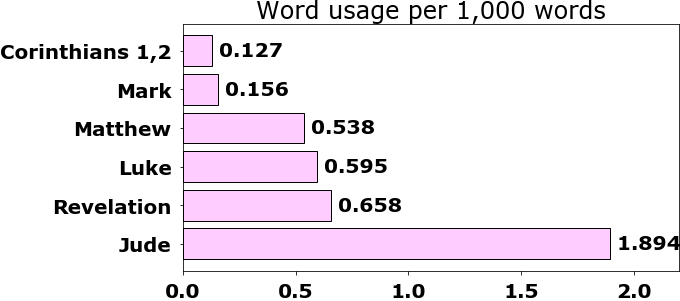
- *G3759 *46 οὐαί (oo-ah'-ee) : a primary exclamation of grief; "woe":--alas, woe.
- ουαι *46
- Matthew 11:21 Woe unto thee, Chorazin! woe unto thee, Bethsaida! for ...
- Matthew 18:7 Woe unto the world because of offences! for it must needs be that offences come; but woe to that man ...
- Matthew 23:13 But woe unto you, scribes and Pharisees, hypocrites! ...
- Matthew 23:15 Woe unto you, scribes and Pharisees, hypocrites! ...
- Matthew 23:16 Woe unto you, ye blind guides, which say, Whosoever ...
- Matthew 23:23 Woe unto you, scribes and Pharisees, hypocrites! ...
- Matthew 23:25 Woe unto you, scribes and Pharisees, hypocrites! ...
- Matthew 23:27 Woe unto you, scribes and Pharisees, hypocrites! ...
- Matthew 23:29 Woe unto you, scribes and Pharisees, hypocrites! ...
- Matthew 24:19 And woe unto them that are with child, and to them that give suck ...
- Matthew 26:24 ... of him: but woe unto that man ...
- Mark 13:17 But woe to them that are with child, ...
- Mark 14:21 ... of him: but woe to that man by ...
- Luke 6:24 But woe unto you that are rich! for ye have received ...
- Luke 6:25 Woe unto you that are full! for ye shall hunger. Woe unto you that laugh now! ...
- Luke 6:26 Woe unto you, when all men shall speak ...
- Luke 10:13 Woe unto thee, Chorazin! woe unto thee, Bethsaida! for ...
- Luke 11:42 But woe unto you, Pharisees! for ye tithe ...
- Luke 11:43 Woe unto you, Pharisees! for ye love the uppermost seats ...
- Luke 11:44 Woe unto you, scribes and Pharisees, hypocrites! ...
- Luke 11:46 And he said, Woe unto you also, ye lawyers! ...
- Luke 11:47 Woe unto you! for ye build the sepulchres of the prophets, ...
- Luke 11:52 Woe unto you, lawyers! for ye have taken away the key ...
- Luke 17:1 ... that offences will come: but woe unto him, through whom they come!
- Luke 21:23 But woe unto them that are with child, ...
- Luke 22:22 ... as it was determined: but woe unto that man by ...
- 1 Corinthians 9:16 ... is laid upon me; yea, woe is unto me, if ...
- Jude 1:11 Woe unto them! for they have gone in the way of Cain, ...
- Revelation 8:13 ... a loud voice, Woe, woe, woe, to the ...
- Revelation 9:12 One woe is past; and, behold, there come two woes more hereafter.
- Revelation 11:14 The second woe is past; and, behold, the third woe cometh quickly.
- Revelation 12:12 ... that dwell in them. Woe to the inhabiters of the earth and ...
- Revelation 18:10 ... torment, saying, Alas, alas, that great ...
- Revelation 18:16 And saying, Alas, alas, that great city, ...
- Revelation 18:19 ... wailing, saying, Alas, alas, that great ...
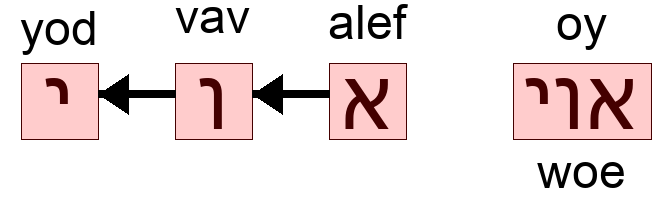
26. Semitic origins
Amos 6:1 Woe to them that are at ease in Zion, and trust in the mountain of Samaria, which are named chief of the nations, to whom the house of Israel came ! [kjv]
הוי … [he]
ουαι τοις εξουθενουσιν σιων και τοις πεποιθοσιν επι το ορος σαμαρειας απετρυγησαν αρχας εθνων και εισηλθον αυτοι οικος του ισραηλ [lxx]
The ancient Greek word
"οὐαί" ≈ "woe, alas" and appears to come from the Latin word
"vae" ≈ "woe, alas". Some attribute both words to a Semitic loan word.
There are three places in the
GNT where the some word is repeated three times in a row.
"Jerusalem Jerusalem Jerusalem" in Luke (crosses a verse boundary)
"Holy Holy Holy" in Revelation.
"Woe Woe Woe" in Revelation.
27. Usage - woe
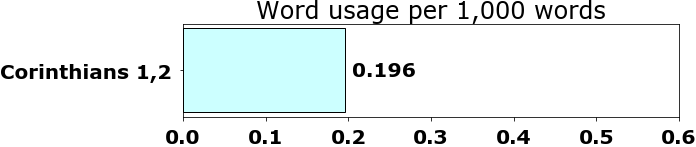
*G3759 *46 οὐαί (oo-ah'-ee) : a primary exclamation of grief; "woe":--alas, woe.
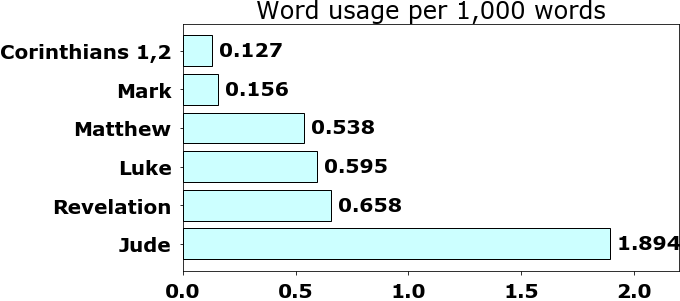 |
Words: ουαι=46
|
The ancient Greek word
"οὐαί" ≈ "woe, alas" and appears to come from the Latin word
"vae" ≈ "woe, alas". Some attribute both words to a Semitic loan word.
*H1945 הוֹי (hoh'ee) : a prolonged form of H1930 (akin to H188); oh!:--ah, alas, ho, O, woe.
28. Revelation 8:13
KJV: And I beheld, and heard an angel flying through the midst of heaven, saying with a loud voice, Woe, woe, woe, to the inhabiters of the earth by reason of the other voices of the trumpet of the three angels, which are yet to sound!
Greek: και ειδον και ηκουσα ενος αγγελου πετωμενου αετου πετομενου εν μεσουρανηματι λεγοντος φωνη μεγαλη ουαι ουαι ουαιτοις κατοικουσιν τους κατοικουντας επι της γης εκ των λοιπων φωνων της σαλπιγγος των τριων αγγελων των μελλοντων σαλπιζειν
29. Revelation 18:19
KJV: And they cast dust on their heads, and cried, weeping and wailing, saying, Alas, alas that great city, wherein were made rich all that had ships in the sea by reason of her costliness! for in one hour is she made desolate.
Greek: και εβαλον χουν επι τας κεφαλας αυτων και εκραζον εκραξαν κλαιοντες και πενθουντες λεγοντες ουαι ουαι η πολις η μεγαλη εν η επλουτησαν παντες οι εχοντες τα πλοια εν τη θαλασση εκ της τιμιοτητος αυτης οτι μια ωρα ηρημωθη
30. Amos 6:1
KJV: Woe to them that are at ease in Zion, and trust in the mountain of Samaria, which are named chief of the nations, to whom the house of Israel came !
Hebrew: הוי השאננים בציון והבטחים בהר שמרון נקבי ראשית הגוים ובאו להם בית ישראל׃
Greek: ουαι τοις εξουθενουσιν σιων και τοις πεποιθοσιν επι το ορος σαμαρειας απετρυγησαν αρχας εθνων και εισηλθον αυτοι οικος του ισραηλ
31. Luke 22:22
Luke 22:22 And truly the Son of man goeth, as it was determined: but woe unto that man by whom he is betrayed! [kjv]
και οτι ο μεν υιος μεν του ανθρωπου πορευεται κατα το ωρισμενον πορευεται πλην ουαι τω ανθρωπω εκεινω δι ου παραδιδοται [gnt]
32. Luke 22:22
KJV: And truly the Son of man goeth, as it was determined: but woe unto that man by whom he is betrayed!
Greek: και οτι ο μεν υιος μεν του ανθρωπου πορευεται κατα το ωρισμενον πορευεται πλην ουαι τω ανθρωπω εκεινω δι ου παραδιδοται
33. 1 Corinthians 9:16
1 Corinthians 9:16 For though I preach the gospel, I have nothing to glory of: for necessity is laid upon me; yea, woe is unto me, if I preach not the gospel! [kjv]
εαν γαρ ευαγγελιζωμαι ουκ εστιν μοι καυχημα αναγκη γαρ μοι επικειται ουαι δε γαρ μοι εστιν εαν μη ευαγγελιζωμαι ευαγγελισωμαι [gnt]
34. 1 Corinthians 9:16
KJV: For though I preach the gospel, I have nothing to glory of: for necessity is laid upon me; yea, woe is unto me, if I preach not the gospel!
Greek: εαν γαρ ευαγγελιζωμαι ουκ εστιν μοι καυχημα αναγκη γαρ μοι επικειται ουαιδε γαρ μοι εστιν εαν μη ευαγγελιζωμαι ευαγγελισωμαι
35. Job 10:15
Job 10:15 If I be wicked, woe unto me; and if I be righteous, yet will I not lift up my head. I am full of confusion; therefore see thou mine affliction; [kjv]
εαν τε γαρ ασεβης ω οιμμοι εαν τε ω δικαιος ου δυναμαι ανακυψαι πληρης γαρ ατιμιας ειμι [lxx]
36. Job 10:15
KJV: If I be wicked, woe unto me; and if I be righteous, yet will I not lift up my head. I am full of confusion; therefore see thou mine affliction;
Hebrew: אם רשעתי אללי לי וצדקתי לא אשא ראשי שבע קלון וראה עניי׃
Greek: εαν τε γαρ ασεβης ω οιμμοι εαν τε ω δικαιος ου δυναμαι ανακυψαι πληρης γαρ ατιμιας ειμι
37. Amos 5:18
Amos 5:18 Woe unto you that desire the day of the LORD! to what end is it for you? the day of the LORD is darkness, and not light. [kjv]
ουαι οι επιθυμουντες την ημεραν κυριου ινα τι αυτη υμιν η ημερα του κυριου και αυτη εστιν σκοτος και ου φως [lxx]
38. Amos 5:18
KJV: Woe unto you that desire the day of the LORD! to what end is it for you? the day of the LORD is darkness, and not light.
Hebrew: הוי המתאוים את יום יהוה למה זה לכם יום יהוה הוא חשך ולא אור׃
Greek: ουαι οι επιθυμουντες την ημεραν κυριου ινα τι αυτη υμιν η ημερα του κυριου και αυτη εστιν σκοτος και ου φως
39. Gnashing of teeth
Matthew 13:42 And shall cast them into a furnace of fire: there shall be wailing and gnashing of teeth. [kjv]
και βαλουσιν αυτους εις την καμινον του πυρος εκει εσται ο κλαυθμος και ο βρυγμος των οδοντων [gnt]
… stridor dentium [v]
What is "
gnashing" of teeth?
40. Matthew 13:42
KJV: And shall cast them into a furnace of fire: there shall be wailing and gnashing of teeth.
Greek: και βαλουσιν αυτους εις την καμινον του πυρος εκει εσται ο κλαυθμος και ο βρυγμος των οδοντων
Latin: et mittent eos in caminum ignis ibi erit fletus et stridor dentium
41. Spit into the wind
All languages have words that are onomatopoeic. That is, they sound like what they represent.
Take the idea of "
spitting". Take a big breath and then say something like "
ptu-ee" as might be done in English. Now use more of an "
oh" sound with an "
s". Now use a "
d" rather than a "
t".
Result "eh" (audible big breath followed by) "pdo-see".
How might you write this down as a word in a language? One would need to
transliterate that word.
Now say
"επιδωσει" (eh-PDO-see) ≈ "give, grant". This word is not found in Greek dictionaries. It is as stretch to come up with the meaning decided. And a proper way to say "
give" is used
twice just two verses later.
A Greek word close to the one used is that of
"ἐπιδόσις" ≈ "donation, advance, progress" and is used by Aristotle a number of times.
[Jim Croce]
42. Matthew 6:7 German
Matthew 6:7 But when ye pray, use not vain repetitions, as the heathen do: for they think that they shall be heard for their much speaking. [kjv]
προσευχομενοι δε μη βαττολογησητε βατταλογησητε ωσπερ οι εθνικοι δοκουσιν γαρ οτι εν τη πολυλογια αυτων εισακουσθησονται [gnt]
… betet… nicht viel plappern … Heiden… meinen… werden erhöret… viel Worte … [lu]
"plappern" ≈ "babble" and is onomatopoeic.
"viel" ≈ "many".
"Wort" ≈ "word" and "Worte" ≈ "words".
"Heide" ≈ "pagan, heathen, gentile".
The English
KJV (King James Version) and German Luther Bible change the Greek
and Latin to get the idea of "
vain" "
repetitions". Why might that be?
43. Animal sounds
No one knows exactly how ancient languages such as Greek was spoken, but the onomatopoeia as sounds from animals can provide some clues. Note: there are other ways not covered here.
There are written accounts of sounds that animals make, as well as other onomatopoeia - words that sound like
what they represent.
44. The panther as an all-beast
The English word
"pather" comes, through French, from the Latin word
"panthere" ≈ "panther" which is from the ancient Greek word
"πάνθηρ" ≈ "panther" and may be related to the Sanskrit word
"पुण्डरीक" (pundanka) ≈ "tiger".
In ancient Greece, the "
panther" was a mythical beast - appearing as a big cat with multiple colors. The "
panther" was believed to be ridden (as a horse) by the god
Dionysus, the Greek god of wine who in Roman culture was
Bacchus. A lot of mystical writings have been attributed to Dionysus.
45. Everything being equal: To biff a translation
In algebra, one learns that equals can always be substituted for equals. This often cannot be done in language translation.
The English word "
biff" is onomatopoeic and refers to a "
hit" or "
strike" on someone.
Puns and play on words are especially susceptible to this problem.
A "
biffed" translation, from "
Biff" in the movie "
Back to the future", is where substituting "
equals for equals" results in a loss of meaning . Biff says "
Make like a tree and get out of here". His same self from the past calls him a butt-head for not knowing how to tell the joke.
After you eat something from a fallen tree, you might say automate (Autumn ate) it.
Fall for Jesus before he leaves.
46. Flipping the pigeon bird as reality or perception
People tend to get ideas in their mind that may or may not relate to reality. Do people really tend to create realities based on fantasy?
How many women expect a Valentine on Valentine's Day?
How many women expect a groundhog and Groundhog Day?
What is your perceived difference in the following paraphrased statements?
Noah sent out a pigeon which came back with an olive branch.
Noah sent out a dove which came back with an olive branch.
47. Owls and howls
48. Turtle doves are not turtles
Song of Solomon 2:12 The flowers appear on the earth; the time of the singing of birds is come, and the voice of the turtle is heard in our land; [kjv]
τα ανθη ωφθη εν τη γη καιρος της τομης εφθακεν φωνη του τρυγονος ηκουσθη εν τη γη ημων [lxx]
flores apparuerunt … tempus putationis advenit … turturis audita … terra nostra [v]
What sound does a
"turtle" make? A
"turtle dove" is a type of bird called a "
dove" or "
pigeon". The Latin word
"turturum" ≈ "turtle doves" comes from the onomatopoeic words
"tur, tur" as the sound made by these birds.
The Latin word "turtla" ≈ "male turtle dove".
The Latin word "turtle" ≈ "female turtle dove".
The word
"turtle" was influenced by
"turtle dove" but the two creatures are quite different.
49. Eagle sounds and woe
Revelation 8:13 And I beheld, and heard an angel flying through the midst of heaven, saying with a loud voice, Woe, woe, woe, to the inhabiters of the earth by reason of the other voices of the trumpet of the three angels, which are yet to sound! [kjv]
και ειδον και ηκουσα ενος αγγελου πετωμενου αετου πετομενου εν μεσουρανηματι λεγοντος φωνη μεγαλη ουαι ουαι ουαι τοις κατοικουσιν τους κατοικουντας επι της γης εκ των λοιπων φωνων της σαλπιγγος των τριων αγγελων των μελλοντων σαλπιζειν [gnt]
The word repeated three times in Revelation 8:13 the ancient Greek word
"οὐαί" ≈ "woe, alas". The Greek word, and the English word to some extent, is onomatopoeic in that, if one thinks of eagles (or vultures) lurking overhead ready to feast making a screeching sound as they swoop one gets an idea of the meaning. Unlike "
Holy, holy, holy", there does not appear to be any popular hymn with the title "
woe, woe, woe".
What is a song that uses "woe" three times? Hint: Sung by a cartoon character.
Elmer Fudd: Row, row, row your boat.
50. A pretender to superior knowledge
James 4:16 But now ye rejoice in your boastings: all such rejoicing is evil. [kjv]
νυν δε καυχασθε εν ταις αλαζονειαις υμων πασα καυχησις τοιαυτη πονηρα εστιν [gnt]

The ancient Greek word
"ἀλαζονεία" ≈ "pretense to superior knowledge or skill". This definition appears to be along the lines of what would later be called a "
Gnostic". It appears to be similar to the English term
"know it all".
The
KJV usually translates this word as
"boast" even though ancient Greek had a more common word for
"boast", used
57 times in the
GNT.
"καυχάομαι" ≈ "boast".
"καύχημα" ≈ "boast".
"καύχησις" ≈ "boast".
This word appears to be
onomatopoeic in that it sounds like what it describes. Interestingly, Jesus does not use either word in the Gospels nor in Revelation.
51. Utterances
Some human utterances include the following.
whisper
murmur
grumble
Words for these sounds are often onomatopoeia, from the Greek for "
name" and "
make". That is, the words sound like what they describe.
52. Writing sounds
The Greek word for "
I write", today as in Bible times, is «
γράφω» (gra-fo), from which we get words such as "
graph", "
graphic", "
photograph", etc.
Many Greek linguistics books describe the word «
γράφω» is onomatopoeic in that it sounds like what it describes. That is, in ancient times.
Whenever, in ancient times, scribes would create a scripts (both "
scribe" and "
script" are from the Latin "
scriba" and "
scriptor") they would use sharp tools to inscribe the letters onto stones or clay tablets.
Listening to all those tools inscribing one would hear the sound of "
grph", "
grph", "
grph", from which came the Greek word «
γράφω» (gra-fo).
53. German taste
The German word
"schmecken" ≈ "taste" from which we get the Pennsylvania Dutch onomatopoeic expression "
das schmecht gut" for "
that tastes good". Move your lips as if you were tasting something when you say "
schmecht".
54. Animal sounds
There are written accounts of sounds that animals make, as well as onomatopoeia (words that sound like what they represent).
There are animal names and references that that come from the sounds made by those animals, birds, etc.
55. German
The Luther German uses "
Glucke" as "
mother hen" (think "
cluck cluck") as the name of a constellation in the night sky.
The German word "Glucke" ≈ "mother hen".
Job 9:9 Which maketh Arcturus, Orion, and Pleiades, and the chambers of the south. [kjv]
Amos 5:8 Seek him that maketh the seven stars and Orion, and turneth the shadow of death into the morning, and maketh the day dark with night: that calleth for the waters of the sea, and poureth them out upon the face of the earth: The LORD is his name: [kjv]
56. Job 9:9
KJV: Which maketh Arcturus, Orion, and Pleiades, and the chambers of the south.
Hebrew: עשה עש כסיל וכימה וחדרי תמן׃
Greek: ο ποιων πλειαδα και εσπερον και αρκτουρον και ταμιεια νοτου
57. Amos 5:8
KJV: Seek him that maketh the seven stars and Orion, and turneth the shadow of death into the morning, and maketh the day dark with night: that calleth for the waters of the sea, and poureth them out upon the face of the earth: The LORD is his name:
Hebrew: עשה כימה וכסיל והפך לבקר צלמות ויום לילה החשיך הקורא למי הים וישפכם על פני הארץ יהוה שמו׃
Greek: ποιων παντα και μετασκευαζων και εκτρεπων εις το πρωι σκιαν θανατου και ημεραν εις νυκτα συσκοταζων ο προσκαλουμενος το υδωρ της θαλασσης και εκχεων αυτο επι προσωπου της γης κυριος ο θεος ο παντοκρατωρ ονομα αυτω
58. Hammer sounds
There are many words that come from the sounds that are made by objects (i.e., sounds that are not human nor animal sounds).
Genesis 4:22 And Zillah, she also bare Tubal-cain, an instructer of every artiificer in brass and iron: and the sister of Tubal-cain was Naamah. [kjv]
σελλα δε ετεκεν και αυτη τον θοβελ και ην σφυροκοπος χαλκευς χαλκου και σιδηρου αδελφη δε θοβελ νοεμα [lxx]
The modern Greek word "σφυροκόπος" (sfee-ro-KO-pos) ≈ "hammerhead", similar to the above, and made up of the following words.
The modern Greek word "σφυρί" (sfee-REE) ≈ "hammer", which has origins in the onomatopoeia of the sound mode by a hammer on metal and the whistle of the heat used to bend and cool the metals.
59. Genesis 4:22
KJV: And Zillah, she also bare Tubal-cain, an instructer of every artiificer in brass and iron: and the sister of Tubal-cain was Naamah.
Hebrew: וצלה גם הוא ילדה את תובל קין לטש כל חרש נחשת וברזל ואחות תובל קין נעמה׃
Greek: σελλα δε ετεκεν και αυτη τον θοβελ και ην σφυροκοπος χαλκευς χαλκου και σιδηρου αδελφη δε θοβελ νοεμα
60. Unquenchable
A sense of unquenchable has to do with the concept of extinguishing. In the verses below, the Greek word for "
quenched" is similar to the modern Greek word
"σβήνω" (SVEE-no) ≈ "extinguish". This is partly an onomatopoeia. Say the phrase "svee" fast several times, as if you are extinguishing or blowing out a candle. Here are some corresponding Latin words.
61. Extinguish
Another sense of unquenchable has to do with the concept of extinguishing. In the verses below, the Greek word for "
quenched" is similar to the modern Greek word
"σβήνω" (SVEE-no) ≈ "extinguish". This is partly an onomatopoeia. Say the phrase "svee" fast several times, as if you are extinguishing or blowing out a candle.
62. Revelation 16:13 Frogs
Revelation 16:13 And I saw three unclean spirits like frogs come out of the mouth of the dragon, and out of the mouth of the beast, and out of the mouth of the false prophet. [kjv]
και ειδον εκ του στοματος του δρακοντος και εκ του στοματος του θηριου και εκ του στοματος του ψευδοπροφητου πνευματα τρια ακαθαρτα ομοια βατραχοις ως βατραχοι [gnt]
The
ancient Greek word
"βάτραχος" ≈ "frog, angler-fish" and appears to be onomatopoeic in origin..
63. End of page