Send
Close Add comments:
(status displays here)
Got it! This site "creationpie.org" uses cookies. You consent to this by clicking on "Got it!" or by continuing to use this website. Note: This appears on each machine/browser from which this site is accessed.
Matthew 6:3-4 Left and right in secret
1. Matthew 6:3
KJV: But when thou doest alms, let not thy left hand know what thy right hand doeth:
Greek: σου δε ποιουντος ελεημοσυνην μη γνωτω η αριστερα σου τι ποιει η δεξια σου
2. Matthew 6:4
KJV: That thine alms may be in secret: and thy Father which seeth in secret himself shall reward thee openly.
Greek: οπως η σου η ελεημοσυνη εν τω κρυπτω και ο πατηρ σου ο βλεπων εν τω κρυπτω αυτος αποδωσει σοι εν τω φανερω
3. Matthew 25:33 Left and right
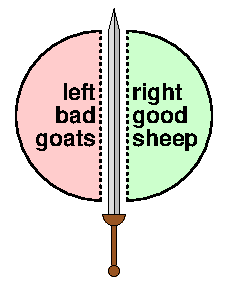
Matthew 25:33 And he shall set the sheep on his right hand, but the goats on the left. [kjv]
και στησει τα μεν προβατα εκ δεξιων αυτου τα δε εριφια εξ ευωνυμων [gnt]
The terms
"left" and
"right" can be ambiguous depending on
POV (Point Of View).
Theater: stage right or stage left from the point of view of the performer on the stage facing the audience.
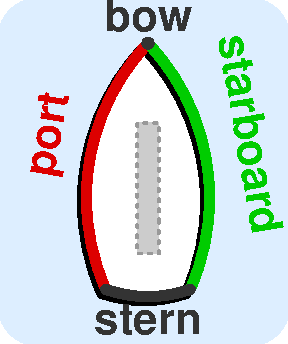
Sailing: starboard (right) or port (left) from the point of view of being on the ship and looking to the front or bow of the ship. The color of the lights is important.
What is your "military left"?
It means the opposite of whatever it was you were doing. This appears to be related to the branch called "military intelligence".
4. Matthew 25:33 Left word
Matthew 25:33 And he shall set the sheep on his right hand, but the goats on the left. [kjv]
και στησει τα μεν προβατα εκ δεξιων αυτου τα δε εριφια εξ ευωνυμων [gnt]
The word used in Matthew 25:34 and usually translated as
"left" is the ancient Greek word
"εὐώνυμος" ≈ "of good name, honored, fortunate, ominous, ill-boding". This word has two parts.
The ancient Greek word "εύ" ≈ "good".
The ancient Greek word "ὄνομα" ≈ "name, reputation, noun".
Did those on the
"left" think that they had a
"good name" in the eyes of the world? Did the immature
"kid goats" on the
"left", of "
good name" and "
honored" and "
fortunate" have some evil omen associated with them? This is similar to the Latin word for
"left" becoming the English word
"sinister".
Another ancient Greek word for "
left" was
"ἀριστερός" ≈ "left, ominous, clumsy".
5. Verses with Greek
Matthew 6:3 But when thou doest alms, let not thy left hand know what thy right hand doeth: [kjv]
σου δε ποιουντος ελεημοσυνην μη γνωτω η αριστερα σου τι ποιει η δεξια σου [gnt]
6:4 That thine alms may be in secret: and thy Father which seeth in secret himself shall reward thee openly. [kjv]
οπως η σου η ελεημοσυνη εν τω κρυπτω και ο πατηρ σου ο βλεπων εν τω κρυπτω αυτος αποδωσει σοι εν τω φανερω [gnt]
6. Sermon on the Mount: Combined verse model build
7. Matthew 6:1-2 The right secret left with alms
Matthew 6:1 Take heed that ye do not your alms before men, to be seen of them: otherwise ye have no reward of your Father which is in heaven. [kjv]
6:2 Therefore when thou doest thine alms, do not sound a trumpet before thee, as the hypocrites do in the synagogues and in the streets, that they may have glory of men. Verily I say unto you, They have their reward. [kjv]
6:1:
you have no reward [hate] of your Father ...
6:2:
they have their reward [hate].
Social media site for Christians with a lisp: faith-book.
Lisp: A thlap in the faith.
These verses are a setup for the Lord's Prayer
five verses later in Matthew 6:9. The
TR (Textus Receptus) changed the Greek word for
"righteousness" to
"alms" to match the following three verses,
Doing what is
"right" is what is
"righteous" and is related to "
opinion", "
glory" and "
law". One must always determine if what is meant is God's
"righteousness" or man's
"righteousness" (or both).
8. Matthew 6:3-4 Left and right in secret
Matthew 6:3 But when thou doest alms, let not thy left hand know what thy right hand doeth: [kjv]
σου δε ποιουντος ελεημοσυνην μη γνωτω η αριστερα σου τι ποιει η δεξια σου [gnt]
6:4 That thine alms may be in secret: and thy Father which seeth in secret himself shall reward thee openly. [kjv]
οπως η σου η ελεημοσυνη εν τω κρυπτω και ο πατηρ σου ο βλεπων εν τω κρυπτω αυτος αποδωσει σοι εν τω φανερω [gnt]
The
KJV (King James Version) translates as
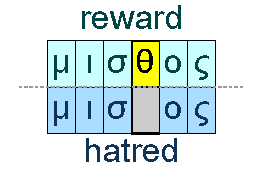
"reward" the Greek word
"give over" that is not the Greek word for
"reward" that is a play on words with
"hate".
The original Saint Nicholas gave his "
alms" to the "
poor" in
"secret". As a result, he was the patron saint of bankruptcy. That is, Saint
Nickleless.
9. Matthew and Mark Left and right
Matthew 20:21 And he said unto her, What wilt thou? She saith unto him, Grant that these my two sons may sit, the one on thy right hand, and the other on the left, in thy kingdom. [kjv]
ο δε ειπεν αυτη τι θελεις λεγει αυτω ειπε ινα καθισωσιν ουτοι οι δυο υιοι μου εις εκ δεξιων σου και εις εξ ευωνυμων σου εν τη βασιλεια σου [gnt]
Mark 10:36 And he said unto them, What would ye that I should do for you? [kjv]
ο δε ειπεν αυτοις τι θελετε ποιησαι με ποιησω υμιν [gnt]
10:37 They said unto him, Grant unto us that we may sit, one on thy right hand, and the other on thy left hand, in thy glory. [kjv]
οι δε ειπον ειπαν αυτω δος ημιν ινα εις σου εκ δεξιων σου και εις εξ ευωνυμων σου αριστερων καθισωμεν εν τη δοξη σου [gnt]

In Matthew, the mother wants one to sit on the
"right" and one on the
"left". The
TR changes the
"left" in Mark to match the
"left" in Matthew.
The terms
"left" and
"right" are relative to the viewer and context, so we will not be concerned about the absolute
"left" and
"right" directions and assume that they refer to one generic "
side" .
10. Matthew 6:3 Left and right
Matthew 6:3 But when thou doest alms, let not thy left hand know what thy right hand doeth: [kjv]
σου δε ποιουντος ελεημοσυνην μη γνωτω η αριστερα σου τι ποιει η δεξια σου [gnt]
The ancient Greek word
"εὐώνυμος" ≈ "of good name, honored, fortunate, ominous, ill-boding" also meant
"left". This is not used in this verse.
Another ancient Greek word for
"left" was
"ἀριστερός" ≈ "left, ominous, clumsy". This is the word used in this verse. This word is from
"ἀριστος" ≈ "best".
The meaning of "
ominous" and/or "
clumsy" is dependent on point of view. There may be a play on words here with the "
best part".
Perhaps
both "
hands" are meant in a
negative sense. In that sense, since the "
pigs" are represented by "
hands", perhaps one should not facilitate, as a "
messenger", communication between two "
bad" parts that should be "
cut off".
11. Matthew 6:3 Left and right
Matthew 6:3 But when thou doest alms, let not thy left hand know what thy right hand doeth: [kjv]
σου δε ποιουντος ελεημοσυνην μη γνωτω η αριστερα σου τι ποιει η δεξια σου [gnt]
What is meant by
"left" and
"right"? Is it
hyperbole? Are they
code words? The "
hand" is often the inferred meaning but may not be in this case. The meaning of
"right" and
"left" is dependent on
point of view.
Greek:
... not know the left yours what does the right yours.
There are sometimes connotations as the
"right" hand being the "
stronger" or "
better" side and, conversely, the
"left" hand being the "
weaker" or "
sinister" side. However, there is a play on words in Greek.
"right" is a play on words on "but a shadow of".
"left" could be a play on words on "better part of" since this word for "left" is not the usual Greek word for "left".
12. Matthew 5:39 Right cheek
Matthew 5:39 But I say unto you, That ye resist not evil: but whosoever shall smite thee on thy right cheek, turn to him the other also. [kjv]
εγω δε λεγω υμιν μη αντιστηναι τω πονηρω αλλ οστις σε ραπισει επι ραπιζει εις την δεξιαν σου σιαγονα σου στρεψον αυτω και την αλλην [gnt]
Most people are right-handed. If you hit with your right hand, it is easiest to hit the
left cheek/jawbone. To hit the
right cheek/jawbone may be more of a
slap or
backhand than a hit. There may be a play on words here between the sounds of "
ks" and "
sk".
"δεξιά" ≈ "right (hand side)" (feminine)
"δε" ≈ "but (not)" and "σκιά" ≈ "shadow".
English: right
Greek: δεξιά
Greek: δε σκιά
English: but not (even a) shadow
Jesus appears to have used a similar play on words back in verse 13 about the "
salt" being "
ineffective" or "
not strong" or "
not even a shadow".
13. Matthew 6:3 Left and right
Matthew 6:3 But when thou doest alms, let not thy left hand know what thy right hand doeth: [kjv]
σου δε ποιουντος ελεημοσυνην μη γνωτω η αριστερα σου τι ποιει η δεξια σου [gnt]
Back in Matthew 5:30, Jesus uses
"left" but adds the word for
"hand". The missing noun should be grammatically feminine and, as most nouns for which a pronoun is used, appear previously in the text - unless context dictates otherwise (such as in the "
go a mile" verse).
"χείρ" ≈ "hand" (grammatically feminine). Used in Matthew 5:30 (20 verses earlier).
"δικαιοσύνη" ≈ "righteousness, justice" (grammatically feminine). Used in Matthew 6:1 (2 verses earlier).
One meaning: Do not let the "
left (hand) righteousness" (good part of God's righteousness, done in secret) know or be influenced by what the "
right (hand) righteousness" (but a shadow of man's righteousness, done with trumpets blaring).
Another meaning: Do not facilitate the communication between the "
left (hand) righteousness" (clumsy part of man's righteousness) and the "
right (hand) righteousness" (but a shadow of man's righteousness).
14. Matthew 6:3 Left and right
Matthew 6:3 But when thou doest alms, let not thy left hand know what thy right hand doeth: [kjv]
σου δε ποιουντος ελεημοσυνην μη γνωτω η αριστερα σου τι ποιει η δεξια σου [gnt]
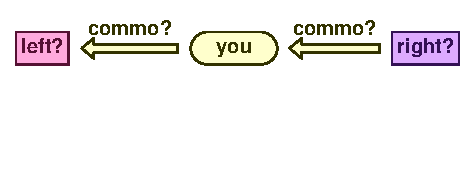 |
You may be facilitating communication between the "right" and "left". That is, whatever "right" and "left" represent. In modern terms, a committee meeting where there is a lot of talk but not much getting done.
|
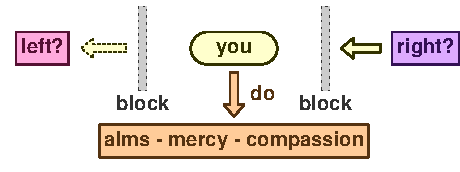 |
When you "do" "alms", whatever communication existed before should not be done.
Does this restriction apply to anything done that is not classified as "alms"?
|
You
should be "
doing"
"alms" or "
good works" on a
regular basis. Does this mean that you should
not be facilitating communication between
"left" and
"right" on a
regular basis?
15. Matthew 6:3 Left and right
Matthew 6:3 But when thou doest alms, let not thy left hand know what thy right hand doeth: [kjv]
σου δε ποιουντος ελεημοσυνην μη γνωτω η αριστερα σου τι ποιει η δεξια σου [gnt]
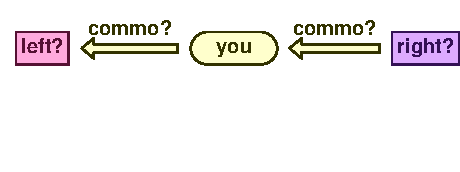 |
Before: What you
may be doing.
|
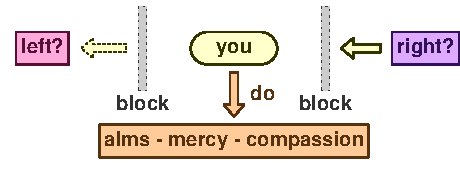 |
After: What you
should not do.
|
Whatever the communication facilitation would otherwise be going on between
"left" and
"right", this communication should not be facilitated.
The idea of
"left" and
"right" brain thinking is a modern concept.
This reminds one of the "
plucking out" of the "
eyes" and "
cutting off" of the "
hands" in the "
adultery" and "
divorce" verses.
16. Proverbs 1:10 Enticement
Proverbs 1:10 My son, if sinners entice thee, consent thou not. [kjv]
υιε μη σε πλανησωσιν ανδρες ασεβεις μηδε βουληθης εαν παρακαλεσωσι σε λεγοντες [lxx]
My son, let not ungodly men lead you astray, neither consent you to them. [bs3]
If sinners, such as "
pigs" as the "
hands" block the way of sinners wanting to repent, or false leaders or "
birds" as the "
eyes" deceive in order to
prey on others, one should not "
consent" but find a way to "
pluck out" that "
eye" or "
cut off" that "
hand".
17. Matthew 13:33 Encryption
Matthew 13:33 Another parable spake he unto them; The kingdom of heaven is like unto leaven, which a woman took, and hid in three measures of meal, till the whole was leavened. [kjv]
αλλην παραβολην ελαλησεν αυτοις ομοια εστιν η βασιλεια των ουρανων ζυμη ην λαβουσα γυνη ενεκρυψεν εις αλευρου σατα τρια εως ου εζυμωθη ολον [gnt]
The ancient Greek word
"κρυπτός" ≈ "hidden, secret" and is from the ancient Greek word
"κρύπτω" ≈ "hide, cover" and whose meaning may have been influenced by the ancient Greek word
"καλύπτω" ≈ "cover" with the related "
R" and "
L" sounds.
This Greek word for
"hide" is part of the Greek word for
"Revelation" which means
"uncovering" or
"revealing" as in a
"revelation" (the Latin word).
18. Matthew 6:4 Hidden secrecy
Matthew 6:4 That thine alms may be in secret: and thy Father which seeth in secret himself shall reward thee openly. [kjv]
οπως η σου η ελεημοσυνη εν τω κρυπτω και ο πατηρ σου ο βλεπων εν τω κρυπτω αυτος αποδωσει σοι εν τω φανερω [gnt]
Jesus uses words for
"secret" or
"hidden" often in the Sermon on the Mount and elsewhere.
The idea of
"secrecy" has to do with "
information". That is, what is known and what is
not known between people in the world.
[security clearances, common knowledge, common sense]
19. Matthew 6:4 Rewards
Matthew 6:4 That thine alms may be in secret: and thy Father which seeth in secret himself shall reward thee openly. [kjv]
οπως η σου η ελεημοσυνη εν τω κρυπτω και ο πατηρ σου ο βλεπων εν τω κρυπτω αυτος αποδωσει σοι εν τω φανερω [gnt]
The "
openly" was added later in the
TR.
The
KJV translates as
"reward" the Greek word that means
"giving" with an idea of
"separation". This word appears in two previous verses in the Sermon on the Mount.
20. Matthew 6:5 Prayer acting in a corner
Matthew 6:5 And when thou prayest, thou shalt not be as the hypocrites are: for they love to pray standing in the synagogues and in the corners of the streets, that they may be seen of men. Verily I say unto you, They have their reward. [kjv]
και οταν προσευχη προσευχησθε ουκ εση ωσπερ εσεσθε ως οι υποκριται οτι φιλουσιν εν ταις συναγωγαις και εν ταις γωνιαις των πλατειων εστωτες προσευχεσθαι οπως αν φανωσιν τοις ανθρωποις αμην λεγω υμιν οτι απεχουσιν τον μισθον αυτων [gnt]
The Greek word for
"prayer" as a
"request" appears
four times in
four verses in Matthew 6:5-8, right
before the Lord's Prayer in Matthew 5:9-13.
The word translated as "hypocrite" means "acting" or "pretending".
The word translated as "reward" is a play on words with "hate".
21. Matthew 6:6 A storehouse of secret chambers: praying in the closet
Matthew 6:6 But thou, when thou prayest, enter into thy closet, and when thou hast shut thy door, pray to thy Father which is in secret; and thy Father which seeth in secret shall reward thee openly. [kjv]
The following ancient Greek words are related.
"ταμεῖον" ≈ "storehouse, storeroom"
"ταμιεῖον" ≈ "storehouse, storeroom"
"ταμιεύω" ≈ "run a household, look after stores".
The word appears in the
GNT (Greek New Testament) four times and a similar word eleven times in the
LXX (Septuagint). The
KJV translates this word in the
GNT several ways.
closet (2)
secret chambers (1)
storehouse (1)
Sometimes the word used in a literal sense, sometimes in a figurative sense and sometimes both ways at the same time.
Despite the explanation given by Strongs, It is not clear where this meaning originated. The English word
"closet" is, through French, from the Latin word
"clausum" ≈ "enclosed space" as in "
claustrophobia",
22. Matthew 6:7-8 Vain repetitions of vain repetitions
Matthew 6:7 But when ye pray, use not vain repetitions, as the heathen do: for they think that they shall be heard for their much speaking. [kjv]
προσευχομενοι δε μη βαττολογησητε βατταλογησητε ωσπερ οι εθνικοι δοκουσιν γαρ οτι εν τη πολυλογια αυτων εισακουσθησονται [gnt]
orantes autem nolite multum loqui sicut ethnici putant enim quia in multiloquio suo exaudiantur [v]

In Matthew 6:7, as part of the "
Sermon on the Mount", Jesus says not to pray using
"vain repetitions" as the "
heathen" do.
This is a specific instance of the idea that "
if some is good then more is better". Some pastors (and others) boast that as a child (or even now) they repeat the Lord's Prayer every night.
A few verses later is the "
Lord's Prayer" which, as an example, does not have repetitions within itself, but could be repeated at different times.
Some pastor appear to think that they get "
paid by the word" according to quantity and not quality. At times producing meaningless or even deceptive content, they may lecture their congregations about trying to keep the pastor to any time schedule.
23. End of page