- *G3939 *2 παροικέω (par-oy-keh'-o) : from G3844 and G3611; to dwell near, i.e. reside as a foreigner:--sojourn in, be a stranger.
- παροικεις
- Luke 24:18 ... unto him, Art thou only a stranger in Jerusalem, ...
- παρωκησεν
- Hebrews 11:9 By faith he sojourned in the land of promise, as ...
- *G3940 *2 παροικία (par-oy-kee'-ah) : from G3941 πάροικος; foreign residence:--sojourning, X as strangers.
- παροικια
- Acts 13:17 ... exalted the people when they dwelt as strangers in the land of Egypt, ...
- παροικιας
- 1 Peter 1:17 ... pass the time of your sojourning here in fear:
- *G3941 *4 πάροικος (par'-oy-kos) : from G3844 and G3624; having a home near, i.e. (as noun) a by-dweller (alien resident):--foreigner, sojourn, stranger.
- παροικον
- Acts 7:6 ... his seed should sojourn in a strange land; ...
- παροικος
- Acts 7:29 ... saying, and was a stranger in the land of Madian, ...
- παροικοι
- Ephesians 2:19 ... no more strangers and foreigners, but fellowcitizens with the saints, ...
- παροικους
- 1 Peter 2:11 Dearly beloved, I beseech you as strangers and pilgrims, abstain ...
8. 1 Peter 2:11 Pilgrim
The English word
"pilgrim" and comes from the Middle English word
"pilegrim" ≈ "pilgrim" which comes, through French, from the Latin word
"peregrinus" ≈ "foreigner" from
"peregre" ≈ "abroad" as in "
beyond the surrounding land".
In many cases, the
KJV (King James Version) appears to be influenced by the Latin word for "
stranger" or "
foreigner". A "
pilgrimage" is, thus, a journey made to a place where one would be a "
stranger" or "
foreigner".
1 Peter 2:11 Dearly beloved, I beseech you as strangers and pilgrims, abstain from fleshly lusts, which war against the soul; [kjv]
αγαπητοι παρακαλω ως παροικους και παρεπιδημους απεχεσθαι των σαρκικων επιθυμιων αιτινες στρατευονται κατα της ψυχης [gnt]
… advenas … peregrinos … [v]
9. 1 Peter 2:11
KJV: Dearly beloved, I beseech you as strangers and pilgrims, abstain from fleshly lusts, which war against the soul;
Greek: αγαπητοι παρακαλω ως παροικους και παρεπιδημους απεχεσθαι των σαρκικων επιθυμιων αιτινες στρατευονται κατα της ψυχης
Latin: carissimi obsecro tamquam advenas et peregrinos abstinere vos a carnalibus desideriis quae militant adversus animam
Wycliffe: Moost dere, Y biseche you, as comelyngis and pilgrymys, to absteine you fro fleischli desiris, that fiyten ayens the soule;
Luther: Liebe Brüder, ich ermahne euch, als die Fremdlinge und Pilgrime, enthaltet euch von fleischlichen Lüsten, welche wider die Seele streiten,
Spanish: Amados, yo os ruego como a extranjeros y peregrinos, que os abstengáis de los deseos carnales que batallan contra el alma;
Portuguese: Caríssimos, rogo-vos que, como estrangeiros e peregrinos, vos abstenhais dos desejos carnais, que combatem contra a alma.
10. Psalms 119:54 Pilgrims
Psalms 119:54 Thy statutes have been my songs in the house of my pilgrimage. [kjv]
ψαλτα ησαν μοι τα δικαιωματα σου εν τοπω παροικιας μου [lxx]
… peregrinationis … [v]
11. Psalms 119:54
KJV: Thy statutes have been my songs in the house of my pilgrimage.
Hebrew: זמרות היו לי חקיך בבית מגורי׃
Greek: ψαλτα ησαν μοι τα δικαιωματα σου εν τοπω παροικιας μου
Latin: carmina erant mihi praecepta tua in domo peregrinationis meae
Luther: Deine Rechte sind mein Lied in dem Hause meiner Wallfahrt.
Spanish: Cánticos han sido para mí tus estatutos en la casa de mis peregrinaciones.
Portuguese: Os teus preceitos são o motivo dos meus cânticos na terra do meu peregrinar.
12. Acts 7:6 Sojourn
Acts 7:6 And God spake on this wise, That his seed should sojourn in a strange land; and that they should bring them into bondage, and entreat them evil four hundred years. [kjv]
ελαλησεν δε ουτως ο θεος οτι εσται το σπερμα αυτου παροικον εν γη αλλοτρια και δουλωσουσιν αυτο και κακωσουσιν ετη τετρακοσια [gnt]
13. Acts 7:6
KJV: And God spake on this wise, That his seed should sojourn in a strange land; and that they should bring them into bondage, and entreat them evil four hundred years.
Greek: ελαλησεν δε ουτως ο θεος οτι εσται το σπερμα αυτου παροικον εν γη αλλοτρια και δουλωσουσιν αυτο και κακωσουσιν ετη τετρακοσια
14. Acts 7:29 Strangers
Acts 7:29 Then fled Moses at this saying, and was a stranger in the land of Madian, where he begat two sons. [kjv]
εφυγεν δε μωσης μωυσης εν τω λογω τουτω και εγενετο παροικος εν γη μαδιαμ ου εγεννησεν υιους δυο [gnt]
15. Acts 7:29
KJV: Then fled Moses at this saying, and was a stranger in the land of Madian, where he begat two sons.
Greek: εφυγεν δε μωσης μωυσης εν τω λογω τουτω και εγενετο παροικος εν γη μαδιαμ ου εγεννησεν υιους δυο
16. Ephesians 2:19 Strangers
Ephesians 2:19 Now therefore ye are no more strangers and foreigners, but fellowcitizens with the saints, and of the household of God; [kjv]
αρα ουν ουκετι εστε ξενοι και παροικοι αλλα εστε συμπολιται των αγιων και οικειοι του θεου [gnt]
… hospites … advenae … [v]
17. Ephesians 2:19
KJV: Now therefore ye are no more strangers and foreigners, but fellowcitizens with the saints, and of the household of God;
Greek: αρα ουν ουκετι εστε ξενοι και παροικοι αλλα εστε συμπολιται των αγιων και οικειοι του θεου
Latin: ergo iam non estis hospites et advenae sed estis cives sanctorum et domestici Dei
Luther: So seid ihr nun nicht mehr Gäste und Fremdlinge, sondern Bürger mit den Heiligen und Gottes Hausgenossen,
18. Roosters and weather vanes
In the Middle Ages, the Catholic church wanted each
parish church (area around the church) to have a rooster to remind everyone of Peter's literal
denial that night.
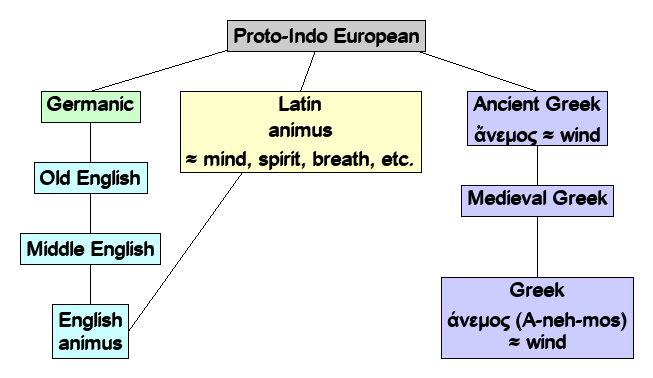
This reminder often became a weather vane. The modern Greek word
"ανεμοδείκτης" (a-neh-mo-THEE-ktees) ≈ "weather vane" is, literally, a "
wind pointer" where the prefix is the modern Greek word
"άνεμος" (A-neh-mos) ≈ "wind".
The Greek word for "
deny" is a play on words with "
bird". To "
bird" Christ is to "
deny" Christ. He will then "
deny" or "
bird" you. Do "
birds" as
false leaders,
false teachers, etc., "
crow" when they deceptively get someone to "
deny" Christ? Do we see this in what happened, as an example, to Peter?
19. Notre Dame Cathedral rooster
 |
 |
 |
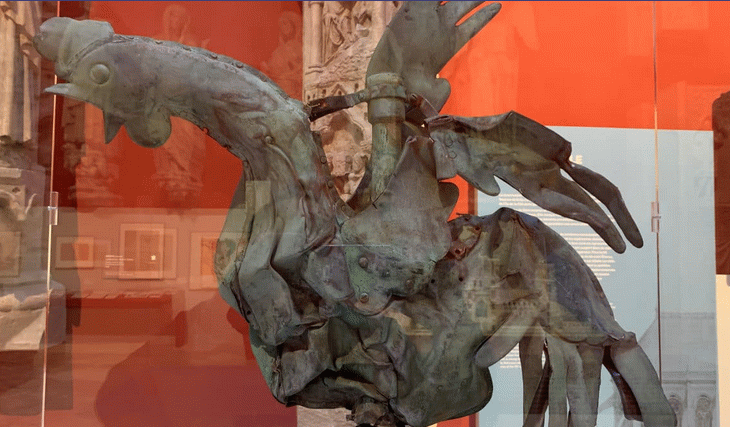
The rooster at Notre Dame Cathedral in France is well-known.
|
 |
|
 |
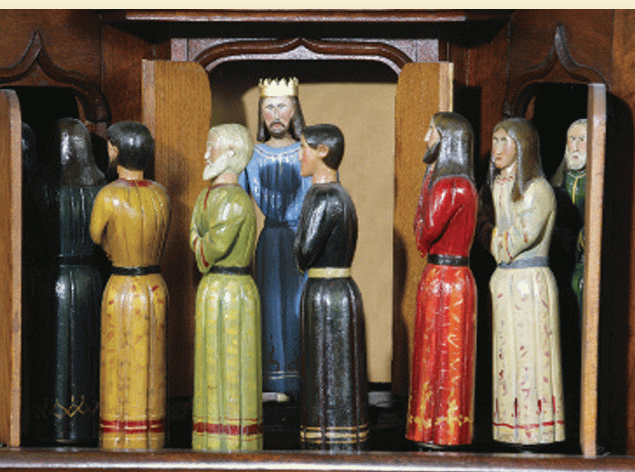
The Apostolic Clock at the Hershey Museum has a depiction of Peter's denial of Jesus. At the denial, the Jesus figure turns his back.
|
A "
rooster" makes a "
voice" just as a "
pipe" in on "
organ" is said to make a "
voice". The settings on an "
organ" are called "
voices".
20. Matthew 26:75 Crow of a rooster
Matthew 26:75 And Peter remembered the word of Jesus, which said unto him, Before the cock crow, thou shalt deny me thrice. And he went out, and wept bitterly. [kjv]
και εμνησθη ο πετρος του ρηματος του ιησου ειρηκοτος αυτω οτι πριν αλεκτορα φωνησαι τρις απαρνηση με και εξελθων εξω εκλαυσεν πικρως [gnt]
Did the
"rooster" "crow" in approval when Peter
"denied" Christ? Do "
birds" as
false leaders "crow" when followers, through
bird deceptions,
"deny" Christ? Do they do it three times or, like
"rooster" "
birds", continue to do it again and again. Jesus uses the Greek word for "
wind" as a play on words for "
against the law" which is often translated as "
iniquity".
21. Wind and animals
22. Diagram
23. Parochial
24. All the ecumenical world
Luke 2:1 And it came to pass in those days, that there went out a decree from Caesar Augustus, that all the world should be taxed. [kjv]
εγενετο δε εν ταις ημεραις εκειναις εξηλθεν δογμα παρα καισαρος αυγουστου απογραφεσθαι πασαν την οικουμενην [gnt]
In Luke, we have the start of the Christmas story to Bethlehem initiated by the taxation decree of Caesar Augustus.
The Greek word is
"οικουμένην" (ee-ku-MEH-neen) ≈ "inhabited world". Note that the The modern Greek word The
"οικουμένη" (ee-ku-MEH-nee) ≈ "inhabited world" is much the same (except for the ending).
The Greek word for "
house" (as a prefix) is sometimes used to refer to the "
entire world" as in "
inhabited world" as in, at times, "
the Roman Empire"
25. Diocese
26. Ezra 8:36 Lieutenants
Ezra 8:36 And they delivered the king's commissions unto the king's lieutenants, and to the governors on this side the river: and they furthered the people, and the house of God. [kjv]
και εδωκαν το νομισμα του βασιλεως τοις διοικηταις του βασιλεως και επαρχοις περαν του ποταμου και εδοξασαν τον λαον και τον οικον του θεου [lxx]
… edicta … conspectu … [v]
The king's "
lieutenants" are those who are performing "
internal administration".
27. Ezra 8:36
KJV: And they delivered the king's commissions unto the king's lieutenants, and to the governors on this side the river: and they furthered the people, and the house of God.
Hebrew: ויתנו את דתי המלך לאחשדרפני המלך ופחוות עבר הנהר ונשאו את העם ואת בית האלהים׃
Greek: και εδωκαν το νομισμα του βασιλεως τοις διοικηταις του βασιλεως και επαρχοις περαν του ποταμου και εδοξασαν τον λαον και τον οικον του θεου
Latin: dederunt autem edicta regis satrapis qui erant de conspectu regis et ducibus trans Flumen et elevaverunt populum et domum Dei
28. End of page
 The Greek prefix "para" appears to mean "beyond" and not "parallel" which is the sense often used in English. The ancient Greek word "παρά" ≈ "beyond", although some prefer the meaning of "beside" because of the influence of Euclid's definition of a parallel line as a line "beyond" another line in a plane such that the lines never touch.


 The Bible times and modern Greek word "οίκος" (EE-kos) ≈ "house" comes from the same ancient Greek word.