Send Close Add comments: (status displays here)
Got it!  This site "creationpie.org" uses cookies. You consent to this by clicking on "Got it!" or by continuing to use this website.  Note: This appears on each machine/browser from which this site is accessed.
Calque: The good news
by RS  admin@creationpie.org : 1024 x 640


1. Calques and loan translations
How does a meaning for a word (or phrase) move from language A to language B? There are (at least) three primary ways. The English word "calque" is from the French word "calque""trace, imitation, close copy" and is sometimes called a "loan translation".

Thus, a calque is a "word-for-word" translation which itself is a calque from the Latin phrase "verbum pro verbo""word for word". Note that it is possible that this phrase could have originated independently of the Latin phrase, so sometimes some historical linguistics research is needed.

Information sign More: Calques and loan translations

2. Calque: The good news
One often hears the Bible message presented as the "Good News". This saying is a calque of the Greek.

The modern Greek word "ευαγγέλιον" (ev-agh-Y-lee-on) ≈ "good news" where the modern Greek prefix "ευ" (ev) ≈ "good" and the modern Greek word "άγγελμα" (AGH-yl-ma) ≈ "message, announcement" from which we get the English word "angel" as a "messenger". Los Angeles is named as the city of "angels".

The English word "evangelical" literally means "good news". The word "gospel" is a calque from Old English.

Information sign More: Calques and loan translations

3. Matthew 24:14 Gospel
Matthew 24:14 And this gospel of the kingdom shall be preached in all the world for a witness unto all nations; and then shall the end come. [kjv]
και κηρυχθησεται τουτο το ευαγγελιον της βασιλειας εν ολη τη οικουμενη εις μαρτυριον πασιν τοις εθνεσιν και τοτε ηξει το τελος [gnt]
evangelium … [v]
godspel … [wes]
gladtidingees … [ty]
Evangelium … [lu]
Евангелие … [rus]
evangelio … [es]


4. Matthew 24:14
 All 
KJV: And this gospel of the kingdom shall be preached in all the world for a witness unto all nations; and then shall the end come.
Greek: και κηρυχθησεται τουτο το ευαγγελιον της βασιλειας εν ολη τη οικουμενη εις μαρτυριον πασιν τοις εθνεσιν και τοτε ηξει το τελος
Latin: et praedicabitur hoc evangelium regni in universo orbe in testimonium omnibus gentibus et tunc veniet consummatio
Wessex: & þis godspel byð boded ofer ealle eorðan. on witnyssen eallen þeoden & þanne cymð seo ge-endunge.
Tyndale: And this gladtidingees of the kyngdome shalbe preached in all the worlde for a witnes vnto all nacions: and then shall the ende come.
Luther: Und es wird geprediget werden das Evangelium vom Reich in der ganzen Welt zu einem Zeugnis über alle Völker; und dann wird das Ende kommen.
Russian: И проповедано будет сие Евангелие Царствия по всей вселенной, во свидетельство всем народам; и тогда придет конец.
Spanish: Y será predicado este evangelio del reino en todo el mundo, para testimonio a todas las naciones; y entonces vendrá el fin.


5. Gospel
The Old English word "godspel""Gospel" which is, literally, a "good spell" where spell has to do with speaking, as in a witch casting a "spell" by speaking.

Note that the Old English word which had been "good spell" had changed via association with "God" to "god spell" and then to "gospell" as the words were merged. The same change happened in German and other Germanic languages.

The Middle English word "gladtidingees""glad tidings, Gospel", as used my Tyndale, who uses the Middle English word "gospell""Gospel" in the following verse.

6. Gothic
Titus 1:14 Not giving heed to Jewish fables, and commandments of men, that turn from the truth. [kjv]
μη προσεχοντες ιουδαικοις μυθοις και εντολαις ανθρωπων αποστρεφομενων την αληθειαν [gnt]
non intendentes iudaicis fabulis et mandatis hominum aversantium se a veritate [v]
ni atsaihvandans judaiwiskaize spilli jah anabusne manne afwandjandane sis sunja. [got]
fábulas … [es]

The Gothic word "spillo""story" is used for the Greek "myths" and is related to the English word "spell" as in to "talk a spell".

Such stories are part of the "good news" or, in Old English, the "good spell" which became shortened to "gospel".

Information sign More: Mythical stories about history

7. John 16:29 Speak clearly
John 16:29 His disciples said unto him, Lo, now speakest thou plainly, and speakest no proverb. [kjv]
λεγουσιν οι μαθηται αυτου ιδε νυν εν παρρησια λαλεις και παροιμιαν ουδεμιαν λεγεις [gnt]

John organizes John chapters 14, 15 and 16 in a top-down backward-chaining manner that can be confusing. The disciples appear to be confused and want Jesus to speak more plainly.

The "plainly" or "openly" can be translated "bluntly".

The Old English word "spell""speak, say" as in to cast a "spell". To "spell" a word one would often say aloud the letters of that word. To "sit for a spell" is to sit and talk (for a while).


Information sign More: John 14:12-14 Asking for anything and everything
Information sign More: Parables and secret codes used and explained by Jesus

8. John 16:29

   John 16:29 
 All 
KJV: His disciples said unto him, Lo, now speakest thou plainly, and speakest no proverb.
Greek: λεγουσιν αυτω οι μαθηται αυτου ιδε νυν εν παρρησια λαλεις και παροιμιαν ουδεμιαν λεγεις
Latin: dicunt ei discipuli eius ecce nunc palam loqueris et proverbium nullum dicis
Wessex: Hys leorningcnihtas cwaeðen to hym. Nu þu sprecst openlice. & ne segst nan by-spell.
Wycliffe: Hise disciplis seiden to hym, Lo! now thou spekist opynli, and thou seist no prouerbe.

9. 1 Corinthians 9:14
 All 
KJV: Even so hath the Lord ordained that they which preach the gospel should live of the gospel.
Greek: ουτως και ο κυριος διεταξεν τοις το ευαγγελιον καταγγελλουσιν εκ του ευαγγελιου ζην
Latin: ita et Dominus ordinavit his qui evangelium adnuntiant de evangelio vivere
Tyndale: Even so also dyd ye lorde ordayne that they which preache ye gospell shuld live of the gospell.
Luther: Also hat auch der Herr befohlen daß, die das Evangelium verkündigen; sollen sich vom Evangelium nähren.

10. Old English for spell
John 16:29 His disciples said unto him, Lo, now speakest thou plainly, and speakest no proverb. [kjv]

Hys leorningcnihtas cwaeðen to hym. Nu þu sprecst openlice. & ne segst nan by-spell. [wes]

The Old English word "byspell""speakest" where the prefix "by-" adds emphasis to the following word. This is the source of the English word "spell" as in to come and "sit a spell" which meant not to sit for a while, but to sit and speak to each other.

Even in the Wessex Gospels, the Old English word "sprecst""speakest" was already in use. By Middle English, the Old English word "spell" as speaking had been replaced with "speak".

11. John 16:29

   John 16:29 
 All 
KJV: His disciples said unto him, Lo, now speakest thou plainly, and speakest no proverb.
Greek: λεγουσιν αυτω οι μαθηται αυτου ιδε νυν εν παρρησια λαλεις και παροιμιαν ουδεμιαν λεγεις
Wessex: Hys leorningcnihtas cwaeðen to hym. Nu þu sprecst openlice. & ne segst nan by-spell.
Wycliffe: Hise disciplis seiden to hym, Lo! now thou spekist opynli, and thou seist no prouerbe.
Tyndale: His disciples sayd vnto him: loo now speakest thou playnly and thou vsest no proverbe.

12. John 16:29 Proverbs and parables
Are the disciples ever confused about what Jesus means when he says something?
John 16:29 His disciples said unto him, Lo, now speakest thou plainly, and speakest no proverb. [kjv]
λεγουσιν οι μαθηται αυτου ιδε νυν εν παρρησια λαλεις και παροιμιαν ουδεμιαν λεγεις [gnt]
openliceby-spell. [wes]


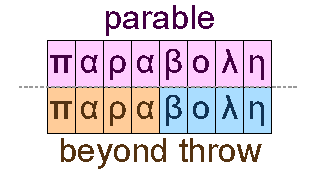
What is the difference between a "parable" and a "proverb"? It appears that the Hebrew/Aramaic has one word for this concept and that word can be translated into Greek as "parable" or "proverb".

Parable and beyond throw


Information sign More: Parables and secret codes used and explained by Jesus
The Wessex Gospels use "by-spell" for "proverb" and "openlice" or "openly" for "plainly".

It is possible that whoever did the Greek translation picked the Greek word that they thought best matched the original language, but the differences and implications are yet interesting (and left for another time and place).

Information sign More: Parables and secret codes used and explained by Jesus

13. James 2:15 Newspaper
James 2:15 If a brother or sister be naked, and destitute of daily food, [kjv]
εαν αδελφος η αδελφη γυμνοι υπαρχωσιν και λειπομενοι της εφημερου τροφης [gnt]

The ancient Greek word "ἐφήμερος""daily" and comes from the Greek words for "on" and "daily". The modern Greek word "εφημερίδα" (eh-fee-meh-REE-tha) ≈ "newspaper".

Information sign More: James 2 Selected logical issues

14. James 2:15 Essential attributes
James 2:15 If a brother or sister be naked, and destitute of daily food, [kjv]
εαν αδελφος η αδελφη γυμνοι υπαρχωσιν και λειπομενοι της εφημερου τροφης [gnt]

The ancient Greek word "ὑπάρχωσιν""begin, take initiative, come into being" (third person plural present active subjunctive) of "ὑπάρχω""begin, take initiative, come into being".

The KJV (King James Version) translates this word as "is".

The noun form is that of "essential attributes". Most translations translate this word as "goods" or "possessions" and one is to "sell" these and give (something) to the "beggars" (for the Good News) or, "poor".

Information sign More: Matthew 19:18-21 Existence of essential attributes
Information sign More: Matthew 25:14-30 Parable of the talents in Matthew
Information sign More: James 2 Selected logical issues

15. Matthew 19:18-21 Existence of essential attributes
The ancient Greek word As a noun (participle), Aristotle uses this word many times. The usual translations is that of an "essential attribute". This abstract idea might be expressed in English as "have the goods" on someone. In context, it can be a concrete entity.

The GNT (Greek New Testament) appears to translate this word as a concrete "goods" and not as a more abstract idea of "essential attributes", which can have a physical manifestation.

Information sign More: Existence is not is existence
Information sign More: Matthew 19:18-21 Existence of essential attributes

16. End of page

by RS  admin@creationpie.org : 1024 x 640