Send
Close Add comments:
(status displays here)
Got it! This site "creationpie.org" uses cookies. You consent to this by clicking on "Got it!" or by continuing to use this website. Note: This appears on each machine/browser from which this site is accessed.
Calques and loan translations
1. Calques and loan translations
2. Calques and loan translations
How does a meaning for a word (or phrase) move from language A to language B? There are (at least) three primary ways.
There already exists a word in language B that has the meaning of the word in language A.
The word in language A is transliterated into a word in language B. Example: "amen".
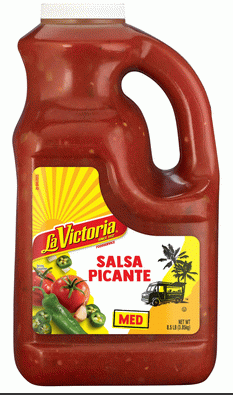
The word in language A is "calqued" into a word in language B by translating each part of the word into language B. Example: "skyscraper", "hot sauce", etc. Google Translate appears to use this method if needed.
The English word "
calque" is from the French word
"calque" ≈ "trace, imitation, close copy" and is sometimes called a "
loan translation".
Thus, a calque is a "
word-for-word" translation which itself is a calque from the Latin phrase
"verbum pro verbo" ≈ "word for word". Note that it is possible that this phrase could have originated independently of the Latin phrase, so sometimes some historical linguistics research is needed.
3. Hot sauce
4. Sky scraper
5. 1 Chronicles 22:2 Scraped stones
1 Chronicles 22:2 And David commanded to gather together the strangers that were in the land of Israel; and he set masons to hew wrought stones to build the house of God. [kjv]
και ειπεν δαυιδ συναγαγειν παντας τους προσηλυτους εν γη ισραηλ και κατεστησεν λατομους λατομησαι λιθους ξυστους του οικοδομησαι οικον τω θεω [lxx]
… kytte stoonys … [wy]
… Steine … hauen… [lu]
The Greek in the
LXX (Septuagint) for "
wrought" "
stones" is that of "
stones" "
scraped".
Wycliffe uses the Middle English words
"kytte" ≈ "cut" and
"stoonys" ≈ "stones".
6. 1 Chronicles 22:2
KJV: And David commanded to gather together the strangers that were in the land of Israel; and he set masons to hew wrought stones to build the house of God.
Hebrew: ויאמר דויד לכנוס את הגרים אשר בארץ ישראל ויעמד חצבים לחצוב אבני גזית לבנות בית האלהים׃
Greek: και ειπεν δαυιδ συναγαγειν παντας τους προσηλυτους εν γη ισραηλ και κατεστησεν λατομους λατομησαι λιθους ξυστους του οικοδομησαι οικον τω θεω
Wycliffe: And he comaundide that alle conuersis fro hethenesse to the lawe of Israel`schulden be gaderid`of the lond of Israel; and he ordeynede of hem masouns for to kytte stoonys and for to polische, that the hows of the Lord schulde be bildid;
Luther: Und David hieß versammeln die Fremdlinge, die im Lande Israel waren, und bestellete Steinmetzen, Steine zu hauen, das Haus Gottes zu bauen.
7. Expressions
In English, an "
expression" is a "
pressing out" as in a facial expression or in a mathematical expression which is "
pressed out" to get a value. The English comes from the Latin word
"expressio" ≈ "pressing out".
The mathematical expression
1*2*3*4 evaluates (or is pressed out) to a value of
24.
The German word "der Ausdruck" ≈ "expression" which is a calque from Latin.
The German word "aus" ≈ "out of".
The German word "Druck" ≈ "pressure, print"
In imperative programming languages, there is a big difference between statements and expressions. Example: A conditional statement compared to a conditional expression.
Many abstract terms in English, German, etc., become easier to learn when one realizes that they are calques from Latin (or another language).
 |
Details are left as a future topic.
|
8. Genesis 40:11
Genesis 40:11 And Pharaoh's cup was in my hand: and I took the grapes, and pressed them into Pharaoh's cup, and I gave the cup into Pharaoh's hand. [kjv]
και το ποτηριον φαραω εν τη χειρι μου και ελαβον την σταφυλην και εξεθλιψα αυτην εις το ποτηριον και εδωκα το ποτηριον εις τας χειρας φαραω [lxx]
… expressi … [v]
… presside … [wy]
… wronge … [ty]
… zerdrückte … [lu]
Latin word
"expressio" ≈ "pressing out" and is the source of the English word
"expression".
The English word
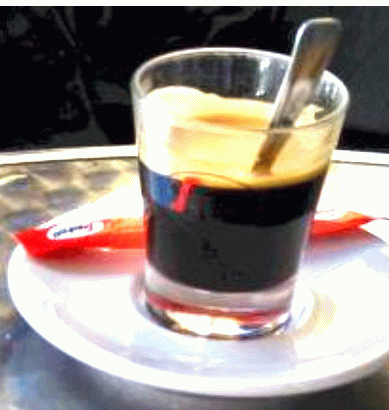
"expresso" (coffee) is from the Italian word
"expresso" ≈ "(pressed out) coffee" which is from the Latin word
"exprimere" ≈ "press out". A few take the idea from "
fast" coffee. The original English phrase was "
cream coffee".
9. Genesis 40:11
KJV: And Pharaoh's cup was in my hand: and I took the grapes, and pressed them into Pharaoh's cup, and I gave the cup into Pharaoh's hand.
Hebrew: וכוס פרעה בידי ואקח את הענבים ואשחט אתם אל כוס פרעה ואתן את הכוס על כף פרעה׃
Greek: και το ποτηριον φαραω εν τη χειρι μου και ελαβον την σταφυλην και εξεθλιψα αυτην εις το ποτηριον και εδωκα το ποτηριον εις τας χειρας φαραω
Latin: calicemque Pharaonis in manu mea tuli ergo uvas et expressi in calicem quem tenebam et tradidi poculum Pharaoni
Wycliffe: and the cuppe of Farao was in myn hond; therfor Y took the grapis, and presside out in to the cuppe which Y helde, and Y yaf drynk to Farao.
Tyndale: And I had Pharaos cuppe in my hande and toke of the grapes and wronge them in to Pharaos cuppe and delyvered Pharaos cuppe into his hande.
Luther: und ich hatte den Becher Pharaos in meiner Hand und nahm die Beeren und zerdrückte sie in den Becher und gab den Becher Pharao in die Hand.
10. Calque: The good news
11. Matthew 24:14 Gospel
Matthew 24:14 And this gospel of the kingdom shall be preached in all the world for a witness unto all nations; and then shall the end come. [kjv]
και κηρυχθησεται τουτο το ευαγγελιον της βασιλειας εν ολη τη οικουμενη εις μαρτυριον πασιν τοις εθνεσιν και τοτε ηξει το τελος [gnt]
… evangelium … [v]
… godspel … [wes]
… gladtidingees … [ty]
… Evangelium … [lu]
… Евангелие … [rus]
… evangelio … [es]
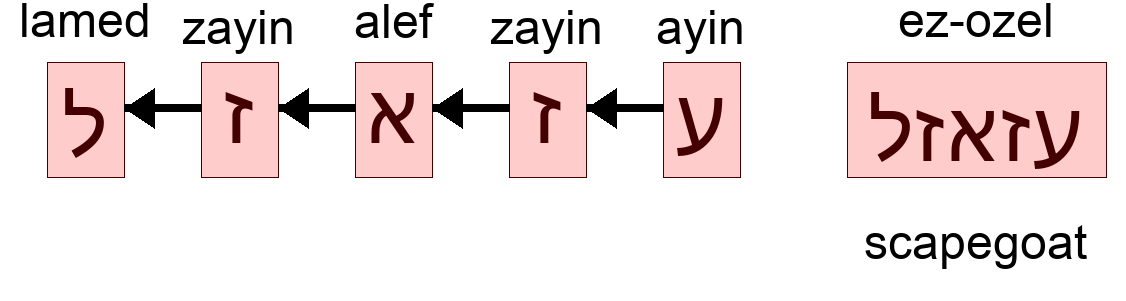
12. Calque: The goat that escaped
Leviticus 16:8 And Aaron shall cast lots upon the two goats; one lot for the LORD, and the other lot for the scapegoat. [kjv]
και επιθησει ααρων επι τους δυο χιμαρους κληρον ενα τω κυριω και κληρον ενα τω αποπομπαιω [lxx]
… capro emissario [v]
… goot that schal be sent out. [wy]
Latin: "capro" ≈ "goat" which is the origin of the Zodiac sign Capricorn.
Latin: "emissario" ≈ "sent out" which is the origin of the English word "emissary".
Discuss: Would you like to be the "
scapegoat" or the "
goat that escaped" or would you like to be the "
goat" that did not escape and was sacrificed as a sin offering? [pigs in Judea]
13. Calque: Advocate
14. Fruit: longsuffering and enduring patience
Any sermon on the topic of "
patience" from the list of fruit needs to be taken carefully. There are two Greek words that have been translated as "
patience". Both Paul and James use both of them so there appears to be a distinction made so that they may not be interchangeable.
Galatians 5:22 But the fruit of the Spirit is love, joy, peace, longsuffering, gentleness, goodness, faith, [kjv]
ο δε καρπος του πνευματος εστιν αγαπη χαρα ειρηνη μακροθυμια χρηστοτης αγαθωσυνη πιστις [gnt]
… longanimitas … [v]
… pacience… [wy]
The ancient Greek word
"μακροθυμία" ≈ "longsuffering, patience" and comes from
"μᾰκρό" ≈ "long" and
"θῡμός" ≈ "soul, desire, temper, passion" and many related meanings.
15. Aristotle: Insects
Aristotle coined the word
"insect" from the idea that their bodies were
"in sections". The Latin word
"inseco" ≈ "cut up, incise" is a
calque of the Greek word.
Greek:
Καλῶ δ’ ἔντομα ὅσα ἔχει κατὰ τὸ σῶμα ἐντομάς.
English:
I call notched all those that have below/under the body notches.
English:
I call in section all those that have below/under the body in sections.
Aristotle, History of Animals 1.487a.33.
"ὅσα" ≈ "as far as" and "ἔχει" ≈ "have" (third person singular active indicative).
16. Matthew 6:11 Latin Vulgate
17. Passive Passover
18. End of page