- *G88 *2 ἀδιάλειπτος (ad-ee-al'-ipe-tos) : from G1 (as a negative particle) and a derivative of a compound of G1223 and G3007; unintermitted, i.e. permanent:--without ceasing, continual.
- αδιαλειπτος
- Romans 9:2 ... great heaviness and continual sorrow in my heart.
- αδιαλειπτον
- 2 Timothy 1:3 ... pure conscience, that without ceasing I have remembrance of ...
- *G89 *4 ἀδιαλείπτως (ad-ee-al-ipe'-toce) : adverb from G88 ἀδιάλειπτος; uninterruptedly, i.e. without omission (on an appropriate occasion):--without ceasing.
- αδιαλειπτως *4
- Romans 1:9 ... of his Son, that without ceasing I make mention of you always in my prayers;
- 1 Thessalonians 1:3 Remembering without ceasing your work of faith, and ...
- 1 Thessalonians 2:13 ... thank we God without ceasing, because, when ye received the word ...
- 1 Thessalonians 5:17 Pray without ceasing.
5. Usage - not interrupted
*G88 *2 ἀδιάλειπτος (ad-ee-al'-ipe-tos) : from G1 (as a negative particle) and a derivative of a compound of G1223 and G3007; unintermitted, i.e. permanent:--without ceasing, continual.
*G89 *4 ἀδιαλείπτως (ad-ee-al-ipe'-toce) : adverb from G88 ἀδιάλειπτος; uninterruptedly, i.e. without omission (on an appropriate occasion):--without ceasing.
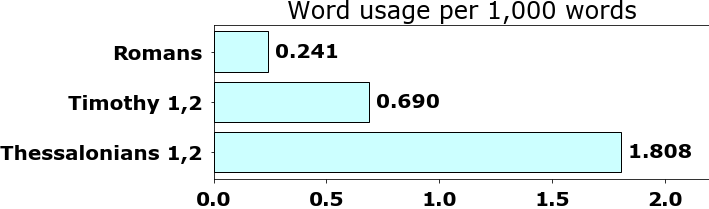 |
Words: αδιαλειπτον αδιαλειπτος αδιαλειπτως=4
|
6. Greek
All six verses where this word appears are written by Paul. It does not appear in the
LXX (Septuagint). Why might Paul have used this word?
7. Cease work
There is another Greek word for "
cease" that could have been used in a negative sense. The ancient Greek word
"παῦσις" ≈ "stopping, ceasing". The modern Greek word
"παύση" (PAV-see) ≈ "pause, stop".
Paul could have used this word. Unfortunately, this could have been interpreted as a pun on his name that would have been pronounced in a similar sounding way.
The ancient Greek word
"Παῦλος" ≈ "Paul".
8. Puns
Paul would have avoided this possible pun with his name - though there are a few places that appear to use this pun relationship. One is in 1 Corinthians 13:8.
9. 1 Corinthians 13:8
1 Corinthians 13:8 Charity never faileth: but whether there be prophecies, they shall fail; whether there be tongues, they shall cease; whether there be knowledge, it shall vanish away. [kjv]
η αγαπη ουδεποτε εκπιπτει πιπτει ειτε δε προφητειαι καταργηθησονται ειτε γλωσσαι παυσονται ειτε γνωσις καταργηθησεται [gnt]
If one considers 1 Corinthians 12 as a setup about the problems with tongues and 1 Corinthians 13, the love chapter, as the completion of that setup, then 1 Corinthians 13:8 might have a pun on Paul's name in that he may wish them to "
cease".
Paul may have wanted to avoid using a pun on his name. He might also have wanted to avoid puns made about what he wrote by others. Everyone knows how annoying it is to have someone making puns about every little thing. Not me! I'm thinking of - someone else.
Perhaps that is why he used the word he used and avoided a word as a direct pun on his name. Just a thought.
10. 1 Corinthians 13:8
KJV: Charity never faileth: but whether there be prophecies, they shall fail; whether there be tongues, they shall cease; whether there be knowledge, it shall vanish away.
Greek: η αγαπη ουδεποτε εκπιπτει πιπτει ειτε δε προφητειαι καταργηθησονται ειτε γλωσσαι παυσονται ειτε γνωσις καταργηθησεται
Latin: caritas numquam excidit sive prophetiae evacuabuntur sive linguae cessabunt sive scientia destruetur
Spanish: La caridad nunca deja de ser; mas las profecías se acabarán, y cesarán las lenguas, y la ciencia acabará.
Portuguese: O amor jamais passará. As profecias terão o seu fim, o dom das línguas terminará e a ciência vai ser inútil.
11. Vacation
12. 1 Thessalonians 1:3 Remember without ceasing
1 Thessalonians 1:3 Remembering without ceasing your work of faith, and labour of love, and patience of hope in our Lord Jesus Christ, in the sight of God and our Father; [kjv]
αδιαλειπτως μνημονευοντες υμων του εργου της πιστεως και του κοπου της αγαπης και της υπομονης της ελπιδος του κυριου ημων ιησου χριστου εμπροσθεν του θεου και πατρος ημων [gnt]
Do they ever stop "
remembering"?
The Greek translated as "
sight" is that of "
being before" or "
being in front of" and not just "
being there". Are they actually "
in front of" God? Is that why the
KJV (King James Version) translated the word as "
in the sight of".
13. 2 Timothy 1:3
2 Timothy 1:3 I thank God, whom I serve from my forefathers with pure conscience, that without ceasing I have remembrance of thee in my prayers night and day; [kjv]
χαριν εχω τω θεω ω λατρευω απο προγονων εν καθαρα συνειδησει ως αδιαλειπτον εχω την περι σου μνειαν εν ταις δεησεσιν μου νυκτος και ημερας [gnt]
14. 2 Timothy 1:3
KJV: I thank God, whom I serve from my forefathers with pure conscience, that without ceasing I have remembrance of thee in my prayers night and day;
Greek: χαριν εχω τω θεω ω λατρευω απο προγονων εν καθαρα συνειδησει ως αδιαλειπτον εχω την περι σου μνειαν εν ταις δεησεσιν μου νυκτος και ημερας
Latin: gratias ago Deo cui servio a progenitoribus in conscientia pura quam sine intermissione habeam tui memoriam in orationibus meis nocte ac die
Spanish: Doy gracias a Dios, a quien sirvo desde mis mayores con limpia conciencia, de que sin cesar me acuerdo de ti en mis oraciones noche y día;
15. Romans 1:9
Romans 1:9 For God is my witness, whom I serve with my spirit in the gospel of his Son, that without ceasing I make mention of you always in my prayers; [kjv]
μαρτυς γαρ μου εστιν ο θεος ω λατρευω εν τω πνευματι μου εν τω ευαγγελιω του υιου αυτου ως αδιαλειπτως μνειαν υμων ποιουμαι [gnt]
16. Romans 1:9
KJV: For God is my witness, whom I serve with my spirit in the gospel of his Son, that without ceasing I make mention of you always in my prayers;
Greek: μαρτυς γαρ μου εστιν ο θεος ω λατρευω εν τω πνευματι μου εν τω ευαγγελιω του υιου αυτου ως αδιαλειπτως μνειαν υμων ποιουμαι
Latin: testis enim mihi est Deus cui servio in spiritu meo in evangelio Filii eius quod sine intermissione memoriam vestri facio
Tyndale: For God is my witnes whom I serve with my sprete in the Gospell of his sonne that with out ceasinge I make mencion of you alwayes in my prayers
Luther: Denn Gott ist mein Zeuge, welchem ich diene in meinem Geist am Evangelium von seinem Sohn, daß ich ohne Unterlaß euer gedenke
Spanish: Porque testigo me es Dios, al cual sirvo en mi espíritu en el evangelio de su Hijo, que sin cesar hago mención de vosotros siempre en mis oraciones,
Portuguese: Pois Deus-a quem presto culto no meu espírito, anunciando o Evangelho do seu Filho-me é testemunha de como constantemente me lembro de vós,
17. Romans 9:2
Romans 9:2 That I have great heaviness and continual sorrow in my heart. [kjv]
οτι λυπη μοι εστιν μεγαλη και αδιαλειπτος οδυνη τη καρδια μου [gnt]
18. Romans 9:2
KJV: That I have great heaviness and continual sorrow in my heart.
Greek: οτι λυπη μοι εστιν μεγαλη και αδιαλειπτος οδυνη τη καρδια μου
Latin: quoniam tristitia est mihi magna et continuus dolor cordi meo
19. Josephus
Josephus uses the ancient Greek word
"αδιάλείπτως" ≈ "uninterrupted"16 times in "
The Jewish War" (with various ending inflections).
 |
Details are left as a future topic.
|
I could not find other Greek writers who might have used this word.
20. End of page