Send
Close Add comments:
(status displays here)
Got it! This site "creationpie.org" uses cookies. You consent to this by clicking on "Got it!" or by continuing to use this website. Note: This appears on each machine/browser from which this site is accessed.
False dilemma fallacy: excluded middle
1. False dilemma fallacy: excluded middle
A "
false dilemma" is a logical fallacy whereby only a few of all possible choices are presented as being "
collectively exhaustive". In some cases, the choices presented are not "
mutually exclusive".
This fallacy is sometimes called the fallacy of "
excluded middle". Another name is that of "
false dichotomy" though the fallacy can involve more than two choices as in the trilemma: liar, lunatic or Lord.
2. Option buttons and check boxes
In user interface design,
option or
radio buttons allow one choice from a set of selections whereas
check boxes allow each selection to be either checked or not checked.
| Logical situations |
False dilemma
(pick only one) |
Not false dilemma
(pick all that apply) |
| • this |
☐ this |
| • that |
☐ that |
|
☐ something else |
| Summary |
| • option button |
☐ check box |
| select only one |
select or not select |
|
The legal process often forces false dilemma situations, sometimes to create perjury traps.

Is it white or black? Pick one.
White - you are lying.
Black - you are lying.
See how this works. Aristotle called this reasoning (and many other types of reasoning) Sophistic reasoning.
|
3. Sets: Mutually exclusive and collectively exhaustive
Items in a set can be partitioned into categories in many ways.
Given a set:
There is a question or relation.
There are answers or equivalence sets (without an ordering)
Mutually exclusive means that "yes" or a "no" are distinct and cannot be both at the same time.
Collectively exhaustive means that everything must be either a "yes" or a "no". There are no other possibilities.
4. False dilemma 1
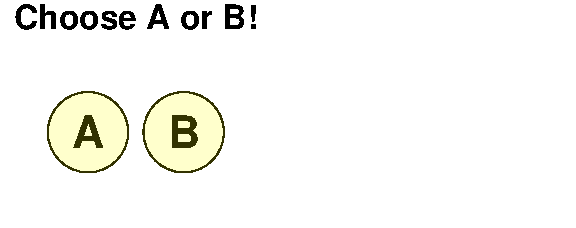
A "
false dilemma" fallacy is when only some choices are provided.
5. False dilemma 2
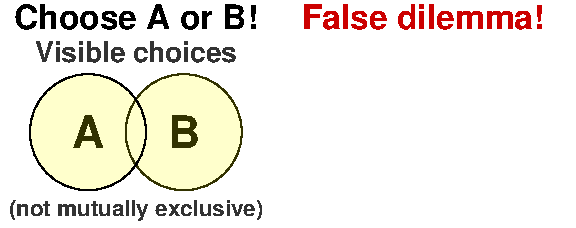
Often, the choices presented are not "
mutually exclusive". That is, they overlap.
6. False dilemma 3
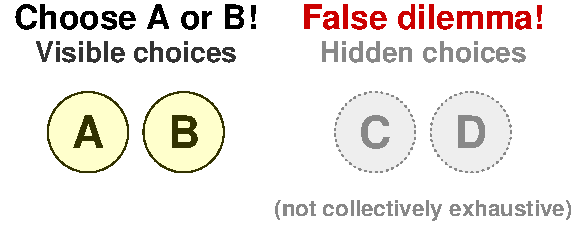
Often, there are other choices that are not presented. The choices are not "
collectively exhaustive" in that they do not cover all possible choices.
7. False dilemma 4
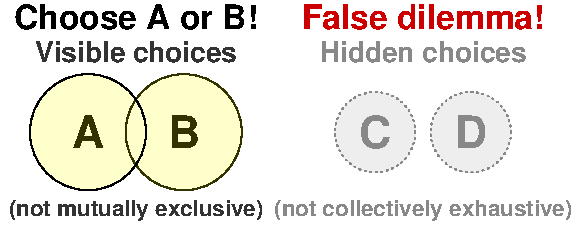
Often, the choices presented are not "
mutually exclusive" and are not "
collectively exhaustive".
8. End of page